











Cycling in Madrid: Hourly Rates, Multi-Day Deals and Park Routes
Bicycle rental in Madrid runs from €6 for one hour to €15–25 for a full day, and €45–55 for a week, while the public bike-share charges €0.50 per half hour for the first hour. Below: where the hourly ladder stops paying, how multi-day rates compare, which bike suits which route, and the street rules.
Market rates: from half an hour to a whole week
Bikes in the city are priced in four units — half an hour, hour, day and week — and the price per hour falls steeply as the booking gets longer.
Market rates by unit
| Unit | Bike | Price | Comes with |
|---|---|---|---|
| Half hour | Public bike-share | €0.50, then €3 after the first hour | Docking at any station |
| Hour | Standard city bike | from €6 | Lock and helmet on request |
| Day | City, mountain or trekking bike | €15–25 | Helmet, lock, puncture kit, basket, vest |
| Week | Standard city bike | €45–55 | Lock and helmet; route maps |
Why one day costs €15 and another €25
The spread inside a single day is set by the frame, not by the shop's postcode. A plain city bike for the day starts at €15, a mountain bike at €20 and a trekking bike at €25, so the dearest option is two-thirds more than the cheapest. The trekking model at that price is a Bergamont Horizon 7.0, the frame aimed at longer rides over mixed surfaces. A central shop near Sol charges €20 for 24 hours on a standard bike, which lands in the middle of the same band. When comparing quotes for bicycle rental in Madrid, set side by side the bike type and the kit rather than the bare figure: a €15 city bike that already includes a basket, helmet and puncture kit can be better value for a park loop than a dearer bike with fewer extras. The table on this page gives the market band, and a dated quote for your exact days remains the figure to book on.
What the weekly rate says about the market
A standard bike for seven days costs €55 at one central shop and €45 at a shop by Retiro Park, so even the higher figure works out at under €8 a day. That is less than half the single-day price at either place. In my view the gap shows how the market prices handover: a one-day hire carries the cost of handing over, checking and cleaning the bike, while a week spreads that cost over seven days. For anyone staying in the city four days or longer, the useful question is not the daily rate on the board but the total for the whole stay, which the next section works through step by step.
Hours, a full day or a week: where the switch happens
The hourly ladder at a central shop climbs in steps, and each step lowers the cost of an hour; the full day and the multi-day packages carry the same logic further.
The hourly ladder and the real cost of an hour
| Rental length | Price | Cost per hour |
|---|---|---|
| 1 hour | €6 | €6.00 |
| 2 hours | €9 | €4.50 |
| 4 hours | €12 | €3.00 |
| 8 hours | €18 | €2.25 |
| 24 hours | €20 | €0.83 |
The break-even rule for short rides
Four hours cost only twice as much as one, and eight hours only three times as much. In practice, the second hour adds €3, the next two add another €3, and the following four add €6. The 24-hour rate then costs just €2 more than eight hours, which makes it the obvious pick for anyone who wants the bike from morning until dusk: you can keep it overnight and ride again in the morning. My rule of thumb is simple: if the plan is longer than two hours, price four; if it is longer than four, price the full day. When one plan mixes a museum stop and a ride, the longer package is still usually cheaper than two short hires on the same day.
Multi-day packages from two shops
| Days | Central shop | Per day | Shop by Retiro | Per day |
|---|---|---|---|---|
| 1 | €20 | €20.00 | €15 | €15.00 |
| 2 | €30 | €15.00 | €29 | €14.50 |
| 3 | €35 | €11.67 | €41 | €13.67 |
| 4 | €40 | €10.00 | — | — |
| 5 | €45 | €9.00 | — | — |
| 6 | €50 | €8.33 | — | — |
| 7 | €55 | €7.86 | €45 | €6.43 |
Which offer wins at which length
The cheaper shop changes with the length of the stay. For one or two days the shop by Retiro is cheaper by €5 and €1. At three days the central shop takes the lead, €35 against €41. At a week the Retiro shop wins again, €45 against €55, and its week costs only €4 more than its own three days. So a rider staying four or five days could pay less for the Retiro weekly package than for a central four- or five-day package — €45 against €40 or €45 — and simply return early. Before booking bike rental in Madrid for several days, ask both shops for the total of your exact dates; the cheaper answer depends on the number, not on the shop's name.
Public bike-share or a rental shop
The city runs a public bike-share, BiciMAD, with 7,500 electric bikes at 611 stations across all 21 districts, and its price works very differently from a shop's.
How the bike-share fare jumps after an hour
An occasional user pays €0.50 for the first 30 minutes and another €0.50 for the next 30. From the 61st minute every half hour costs €3, so the fare does not grow gradually — it jumps. Docking the bike at any station closes the trip and restarts the counter. That rule rewards short hops chained together and punishes one long ride. A monthly flat rate of €10 makes trips of up to 30 minutes free, and it pays off at 20 rides a month compared with €0.50 each. The bikes are electric-assist, which helps on Madrid's climbs but also means the fleet is built for commuting between stations rather than for a full day in the parks.
Cost of one ride compared with a shop
| Ride length | Bike-share, one trip | Shop rate for the same time |
|---|---|---|
| 30 minutes | €0.50 | €6 (one hour minimum) |
| 1 hour | €1.00 | €6 |
| 2 hours | €7.00 | €9 |
| 4 hours | €19.00 | €12 |
| 8 hours | €43.00 | €18 |
When each one makes sense
Up to one hour the bike-share is far cheaper: a 30-minute crossing costs a twelfth of the shop's minimum. Past two hours the shop wins, and by four hours the shop is €7 cheaper even before counting the helmet, basket and lock that come with it. The bike-share also gives you no lock and no kit, and you depend on a free slot at a station when you arrive. For hopping between sights, the public system and its 30-minute rule are hard to beat — dock, wait a moment, take another bike. For a loop along the river or a half-day in Casa de Campo, a rented bike you can lock outside a café is the calmer choice. A sensible mix is a shop bike for one long day, the bike-share for short trips on the others.
City, mountain, trekking or electric
Five kinds of bike appear in the market for the city — city, folding, mountain, trekking and children's — plus electric models, and each suits a different kind of day.
Matching the frame to the route
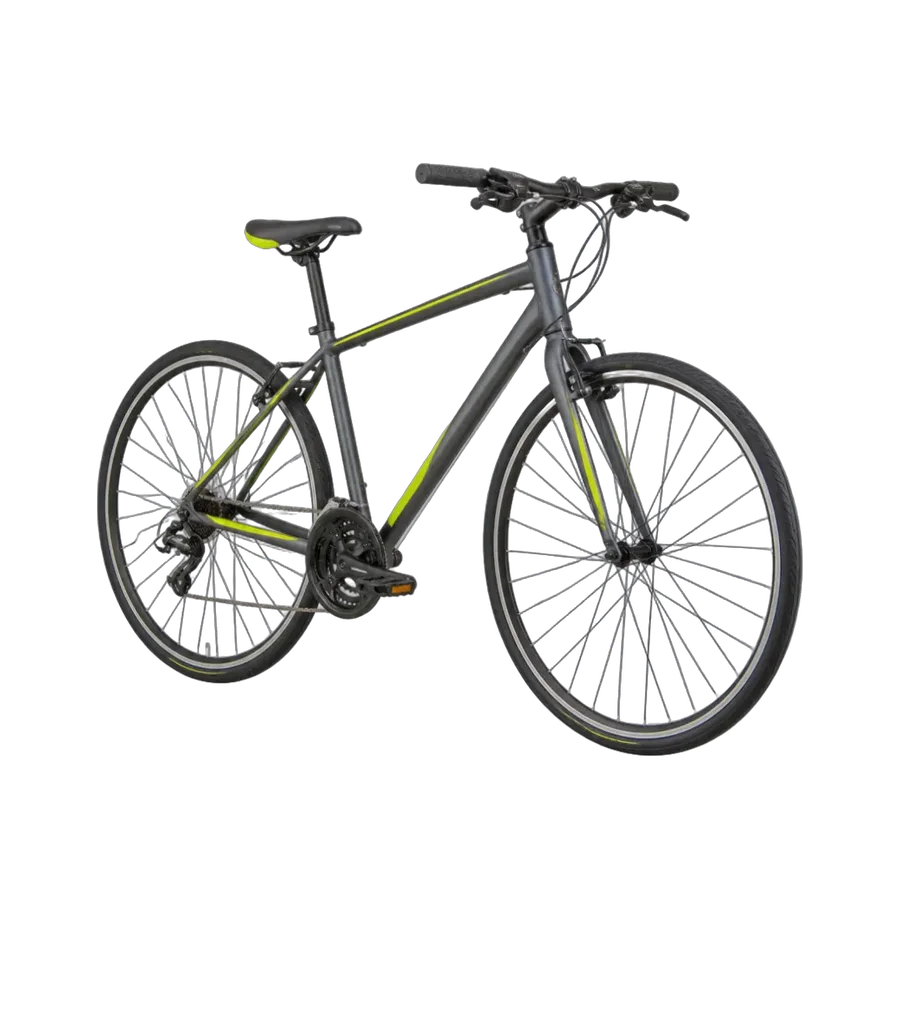
A city bike suits the paved centre, the river path and Retiro: an upright position, a basket for a bag and a lock are what matter on those routes. A mountain bike earns its extra €5 a day only off the asphalt, on the dirt tracks of Casa de Campo or in the Sierra outside the city; on smooth paths its wide tyres simply slow you down. A trekking bike with 24 or more gears sits between the two and is the frame I would choose for the long ring route around the city, which mixes surfaces and gradients. Folding bikes also appear in the market, useful if you plan to take the bike on public transport for part of the day. Whatever the frame, ask for the size that fits your height: city bikes come in sizes from XS to L.
Electric bikes and what they cost on top
Madrid is hilly, and the climb from the river back up to the centre is where a motor helps most. An electric bike costs roughly double a standard one at the same shop: €18 against €9 for two hours, and €40 against €20 for 24 hours, with a week at €110 against €55. At the Retiro shop the gap is smaller, €20 against €15 for the day. The full market for motor-assisted bikes, from €20 a day, is on the electric bike rental page. One shop offering electric models asks for a €200 deposit and a document, which is worth knowing before you plan to rent a bike in Madrid with a motor.
Children's bikes and baby seats
Children's bikes come in 20-inch and 24-inch wheel sizes, aimed at roughly five to eight years old. For younger children a baby seat is the usual option: one central shop fits seats for children up to 22 kg and a maximum age of six. Under the city's rules, children up to 12 may ride on the pavement only when an adult walks alongside at no more than 5 km/h, so a family ride works best in parks and on the river path, where cycling is allowed and there is no traffic. Ask for the seat or the small bike when you book, so the shop can confirm the size.
Where to pick up a bike and where to ride
Pick-up points cluster in two places — the streets around Sol in the centre and the edge of Retiro Park — and some shops deliver for an extra fee.
Shops near Sol, in Retiro and delivery
A central shop on Calle de los Jardines, a few minutes from Sol, opens every day from 10:00 to 18:00, so a same-day hire has to start and end inside those hours. Another rental operates from Retiro itself, which saves you the ride through traffic to reach the park's paths. A third option is delivery: some rentals bring the bike to your hotel and collect it again for a surcharge, and that fee should be part of the total when you compare offers. For bicycle hire in Madrid lasting several days, delivery can be worth it, since it spares two trips across the city to pick up and return the bike.
Madrid Río and the park routes
The easiest long ride is Madrid Río, a 30-kilometre pathway along the Manzanares river. From its western side you reach Casa de Campo, the city's largest park, with tracks that suit a mountain or trekking bike. Retiro Park, with the Palacio de Cristal, is the classic short loop in the centre. For a full day, the Anillo Verde Ciclista is a 64-kilometre cycling ring that circles the city. Further out, the Sierra de Madrid draws riders with mountain bikes. Several shops hand out route maps or downloadable self-guided routes with the bike, often in English and Spanish.
Planning a day around opening hours
With the shop open from 10:00 to 18:00, a full Madrid Río ride out and back fits comfortably, while the 64-kilometre ring needs an early start and a steady pace to return before closing. If you want the evening light, take the 24-hour rate rather than eight hours: the difference is €2, and you return the bike the next morning instead of rushing back. Agree the return time when you book, so the package you pay for matches the hours you ride.
ID, deposit, kit and the street rules
The paperwork for a bicycle is short, but the deposit and the city's traffic rules are worth knowing before you ride off.
Documents, age and the deposit
Rental terms in the city do not ask for a driving licence. What they ask for is a valid ID card or passport, and the minimum age at a central shop is 18. Shops take a deposit to formalise the contract, and the amount is set at the counter, so ask for it when you book. For electric models one shop names €200. Bikes used commercially, including rental fleets, must be entered in the city's bike register, the biciregistro, which is voluntary for private owners.
What usually comes with the bike
At the Retiro shop the daily price includes a helmet, a lock, a puncture repair kit, a basket or rack and a reflective vest; mountain bikes add a phone holder and saddlebags. At the central shop the price covers the bike, a lock, a helmet if you want one, a phone holder, a printed route with a description in English or Spanish, and public liability insurance. Comparing the two lists is the quickest way to see what a lower price leaves out, because a missing lock or vest is something you will pay for elsewhere.
Street rules for riders
Cyclists may not ride on pavements or in pedestrian streets, except on marked shared pavements (aceras-bici) and for children under 12 accompanied by an adult on foot. Where signs allow it, riders may turn right on a red light while giving way to others, and ride against the flow on residential streets limited to 20 km/h and on bicycle streets. A single bicycle may not carry more than five people. Bikes can be parked in public car parks at a bicycle rate and in motorcycle bays. Of these rules, the pavement ban shapes a ride in the centre most, since the old streets around Sol are largely pedestrian.
Key points before you pick up a bike
Five figures to keep in mind
- Hour or day: four hours cost €12 and 24 hours €20, so past four hours the full day is the better buy.
- Day by bike type: €15 for a city bike, €20 for a mountain bike, €25 for a trekking model.
- Week: €45–55, under €8 a day, and one week can cost €4 more than three days.
- Bike-share: €0.50 for each of the first two half hours, €3 for each half hour after that.
- Electric: about double the standard rate — €40 against €20 for 24 hours at the same shop.