

















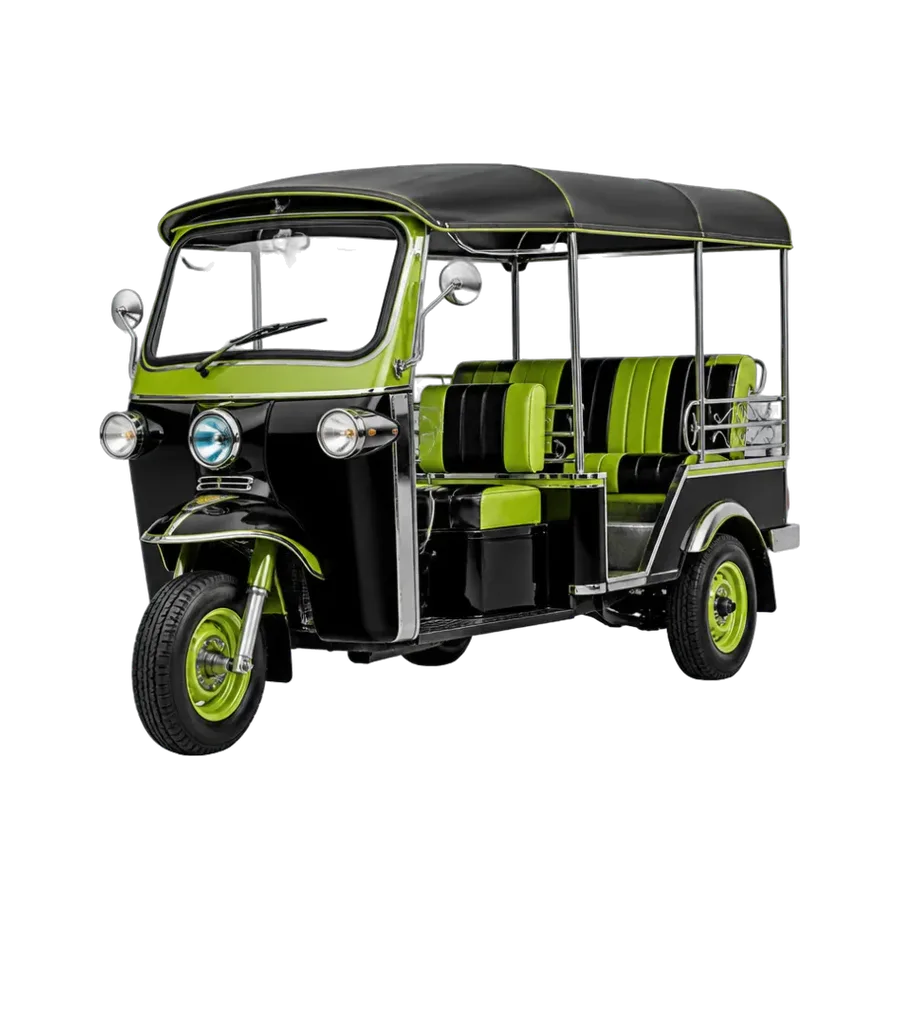

Private Tuk-Tuks in Bangkok: Day and Monthly Prices, Groups and Booking
Tuk-tuk hire in Bangkok comes with a driver as standard: the full-day rate on the market is ฿2,500 for 8 hours, with fuel and an English-speaking driver included, and an electric six-seat tuk-tuk on a monthly contract costs ฿13,000. Below: who drives, what each price covers, how many vehicles a group needs and how to book.
Who drives, where it goes and how it differs from a street ride
A private tuk-tuk in the capital is hired together with its driver, for a block of time and within city limits — three conditions that shape every other choice on this page.
Only the driver takes the wheel
Self-drive tuk-tuk hire is not offered here: the vehicle always comes with a driver, and that driver is the only person allowed to drive it. Most drivers own their tuk-tuks, so the person behind the handlebars is also the one who maintains the vehicle and knows its quirks. One organiser has worked with the same team of drivers for more than ten years, which says a lot about how the trade runs — through people rather than through a rental counter. For a visitor this removes a whole set of questions at once, from steering a three-wheeler in heavy traffic to finding parking near a temple. In my view, the useful question is not "can I drive it?" but "who is my driver and which language do they speak?" — ask exactly that before you confirm.
A whole vehicle booked for a block of time
Private hire means the tuk-tuk and its driver are yours for an agreed number of hours, and the route is set by you rather than by a fixed tour. That is the main difference from hailing a tuk-tuk on the street, where every ride is a separate trip with its own fare agreed on the spot. With a private booking you pay for time: the driver waits while you visit a temple, have lunch or walk a market, and then takes you to the next stop. The Rent-Trip section on this page sets out the two price levels the market uses for this kind of hire — a day and a month. Is a day worth it for two short rides? Probably not. The time-based format pays off once a plan has several stops spread across different districts.
Inside Bangkok only
Hire of this type is limited to Bangkok: organisers state plainly that their tuk-tuks work within the city, and the 8-hour rate applies to the Bangkok area only. The three-wheeler is a city vehicle by design — open sides, a small engine or motor, short hops between sights. A day trip to the floating markets or the old capital outside the city is therefore a job for a car with a driver, not for a tuk-tuk. Inside the city the geography is wide enough for a full day: the old town around the Grand Palace, Chinatown, the riverside and the shopping districts along Sukhumvit are all within reach. When you send a request, give the exact pickup point — a hotel name or a street address — so the driver can confirm it falls inside the area.
Two market prices: ฿2,500 a day and ฿13,000 a month
Only two prices are stated on the market for this type of hire, and they sit in different units — so the first step is to bring them to a common scale.
Market prices for a private tuk-tuk in two units
| Unit | Price | What it covers | Equivalent |
|---|---|---|---|
| Full day | ฿2,500 | 8 hours, driver, fuel | ฿312.5 an hour |
| Month | ฿13,000 | one electric tuk-tuk, maintenance | about ฿433 a day |
What the day price includes
The ฿2,500 full-day rate buys 8 hours with a personal driver who speaks English, and fuel is already inside that figure. Divided by the hours, a private tuk-tuk in Bangkok costs ฿312.5 an hour on this rate — the cleanest number for comparing it with any shorter booking. The driver doubles as a guide in a practical sense: the offer says drivers recommend sights and restaurants along the way, and guests assign their own destinations for the day. Two details are fixed. The day runs to 8 hours, not "until you are tired", and the price is for the Bangkok area only. If a second offer quotes a lower rate, check the same three points first — hours, fuel and language — because a cheaper offer without fuel or with a shorter block is not cheaper at all.
What the price does not tell you
- Vehicle or group: the 8-hour offer serves groups of 2 to 20 people, so ask whether ฿2,500 is per tuk-tuk or per group.
- Entrance fees and meals: tickets to temples, museums and lunch are not mentioned in the rate, so plan them as separate spending.
- Pickup point: the offer covers Bangkok, but ask whether pickup from your hotel is inside the 8 hours or before them.
- Extra hours: nothing is said about going beyond 8 hours, so agree the price of an extra hour before the day starts.
- Short bookings: a few hours are possible but priced on request — ask for the hourly figure and compare it with ฿312.5.
Full day, a few hours or a monthly contract
The market offers three time formats — a full day, a few hours or a regular arrangement, and a monthly contract — and each answers a different need.
Eight hours as the standard block
The full day is the format with a fixed price: 8 hours for ฿2,500, which works out at ฿312.5 an hour. That block is long enough for a proper loop of the city with breaks, and it suits a first visit best, when the list of sights is long and the distances between them are hard to judge from a map. Booking a tuk-tuk with driver in Bangkok for those 8 hours also removes the haggling that comes with separate rides — one price, agreed in advance, covers the whole day. The route stays yours: guests assign the destinations, and the driver suggests places and restaurants that fit between them. My advice: group the stops by district rather than by fame, so the 8 hours are spent at the sights, not in traffic between opposite ends of the city.
A few hours or a regular arrangement
Shorter hire exists too — organisers rent tuk-tuks "for a few hours or a whole day" and also on a regular basis — but those prices are given only on request. That makes the hourly equivalent of the 8-hour rate, ฿312.5, the reference point for any short booking. If an offer for three or four hours lands well above that hourly figure, you are paying a premium for the shorter block, which is normal; if it lands at twice the rate, the full day may simply be better value. A regular arrangement — the same driver several times a week, for example — is also on offer, with the terms agreed individually. Before agreeing to a short booking, ask for two numbers: the price per hour and the minimum number of hours, then multiply them.
The monthly electric tuk-tuk
The monthly option is a different product: ฿13,000 per tuk-tuk per month for an electric vehicle with six seats fitted with safety belts. Maintenance is included for the whole contract period, and the operator keeps a team ready to swap in a replacement vehicle in an emergency. Spread over 30 days, the contract comes to about ฿433 a day; put another way, ฿13,000 equals 5.2 full days of the day rate. But the comparison has a catch. The monthly figure covers the vehicle and its upkeep, and the contract length, insurance and whether a driver is part of the deal are not stated at all. For a visitor on a week-long trip the 8-hour rate is the relevant price; the monthly contract is a tool for regular, all-month use — ask in writing who drives before comparing it with anything.
Group size, seats and how many vehicles
The day offer accepts groups of 2 to 20 people, while one electric tuk-tuk seats six — so for anything larger than a couple, the number of vehicles decides the bill.
How many vehicles a group needs at six seats
| Group | Vehicles at 6 seats | Day total if priced per vehicle |
|---|---|---|
| 2 people | 1 | ฿2,500 |
| 6 people | 1 | ฿2,500 |
| 8 people | 2 | ฿5,000 |
| 12 people | 2 | ฿5,000 |
| 15 people | 3 | ฿7,500 |
| 20 people | 4 | ฿10,000 |
Groups from 2 to 20 people
The full-day offer is open to groups from 2 to 20 people, and that range is the clearest sign that a large group travels as a small convoy rather than in one vehicle. Six seats is the stated capacity of the electric model; the seat count of other tuk-tuks is not given, so the convoy may need more vehicles than the table shows. The price side follows the same logic. If ฿2,500 is the rate for one tuk-tuk, a group of 20 at six seats a vehicle needs four, and the day comes to ฿10,000 — or ฿500 a person. A couple pays the same ฿2,500 for one vehicle, which is ฿1,250 each. Larger groups therefore pay less per head, but only if each vehicle is full — a group of 7 still needs two tuk-tuks.
Seats, belts and passenger details
Safety belts are stated for one type only: the electric tuk-tuk on the monthly contract, with six belted seats. For the 8-hour offer, the seating layout is not described, so it is fair to ask what kind of tuk-tuk will arrive — electric or fuel-powered — and how many people it seats. That offer does not name the vehicle type, and I would not guess it from the price. Two passenger details are worth putting in the request because they change the seating plan: the ages of any children, and whether you carry bags or shopping between stops. A tuk-tuk has open sides and no boot, so bags ride with the passengers. If the group includes small children, ask the organiser directly how they seat them — do not rely on a seat count alone.
Sightseeing, photoshoots, events and business use
Organisers name four uses for a hired tuk-tuk — exploring the city, photoshoots and marketing, events and team outings, and monthly work for properties and offices.
A day of sights on your own route
Sightseeing is the use the full-day offer is built around, and the format suits it because guests set the destinations themselves. A typical plan for the 8 hours strings together districts rather than single sights: the old town around the Grand Palace and Wat Pho, Chinatown along Yaowarat Road, the riverside, and a market or a rooftop for the evening. The driver's role goes beyond driving — the offer says drivers recommend attractions and restaurants on the way, which helps when the list is long and the time is fixed. What should you settle in advance? The order of districts and the one stop that must not be skipped. That way, if traffic eats an hour, the driver knows which point to cut and which to keep.
Photoshoots, marketing and decorated vehicles
A tuk-tuk is also hired as a prop with a driver: organisers list photoshoots and marketing initiatives among the reasons people book, and vehicles can be decorated to match the brief. The format is still time-based — the driver brings the tuk-tuk to the set and moves it between locations — and prices for such bookings are given on request rather than as a fixed rate. The ฿312.5 hourly equivalent of the 8-hour rate is a sensible reference when a quote arrives. For a shoot, the most expensive mistake is a vehicle that looks wrong on camera, so describe the look you need in the request: colour, electric or classic, whether branding or flowers will be added. Ask who fits and removes the decoration — and whether that time counts toward the paid hours.
Team outings and events
Special events and team outings are the third named use, and for them the key number is again the group size. The 8-hour offer runs from 2 to 20 people, so a team of 18 at six seats a vehicle needs three tuk-tuks moving as a convoy. Decorated vehicles suit private celebrations as well as corporate days — organisers mention decoration "to meet your needs" without saying what is possible. Three questions matter more than the price for an event: whether all the vehicles arrive at the same time and place, whether the drivers know the full route in advance, and what happens if one tuk-tuk breaks down. Put the timing of the event in writing, down to the minute when guests leave the venue — a convoy is only as punctual as its last vehicle.
Monthly use for condominiums and offices
The monthly contract is aimed at regular, local use: property projects, condominiums, building management offices, public and private organisations, and individuals. For ฿13,000 a month per vehicle, the operator provides an electric six-seat tuk-tuk, maintains it for the whole contract and replaces it if it fails. A condominium can use it as a shuttle between the building and the nearest station, for example, and a business as a branded vehicle for short runs. If you need to rent a tuk-tuk in Bangkok for a whole month, the questions are different from a day hire: the contract length, whether a driver is included or must be provided, and who is responsible for damage. None of these is stated in the offer. Ask for them in writing before comparing ฿13,000 with anything else.
Booking a day ahead and comparing offers
Private tuk-tuks are booked in advance rather than hailed, and a precise request is what turns a price into a comparable offer.
The one-day rule
A full-day private tuk-tuk has to be booked at least one day ahead — organisers state that the service requires advance booking of no less than a day. Same-day private hire is therefore not something to count on, even though tuk-tuks are a common sight in the city. The reason is practical: most drivers own their vehicles, so the organiser needs time to match a driver, a language and a pickup point to your request. For a group that needs several vehicles, the lead time matters even more, because three or four drivers have to be free on the same date. My recommendation: send the request as soon as your date is fixed, and treat the one-day minimum as the last possible moment, not the target.
What to put in a tuk-tuk request
- Date and hours: the exact date and whether you want the full 8 hours or a shorter block.
- Group: the number of people and children's ages, so the organiser can work out how many vehicles to send.
- Pickup point: a hotel name or street address inside Bangkok, and the time you want to start.
- Route: the districts or sights you want to cover, in the order you prefer, plus the one stop that matters most.
- Language: English or another language you need from the driver.
- What is included: ask whether fuel, extra hours and decoration are inside the price — and get the answer in writing.
Reading two offers side by side
Two tuk-tuk offers can be compared only when four things match: the number of hours, the number of vehicles, fuel and the driver's language. A day offer at ฿2,500 for 8 hours with fuel is the reference; a 6-hour offer has to come in under ฿1,875 to beat it per hour, because 6 hours at ฿312.5 make exactly that. The same check applies to group bookings — one quote may cover a single tuk-tuk, another a convoy of three, and the totals will differ by a factor of three without either being expensive. Decoration, waiting time and extra hours are the usual places where totals drift apart. If an offer cannot say how many vehicles and how many hours it covers, it is not yet a price — ask for those two numbers before anything else.
Key points before you book
The whole picture fits in a handful of numbers and rules, and every one of them comes from current market prices and conditions for this hire.
Six facts to keep in mind
- Driver only: a hired tuk-tuk is always driven by its driver, usually its owner — self-drive is not offered.
- Day rate: ฿2,500 for 8 hours with fuel and an English-speaking driver, or ฿312.5 an hour.
- Monthly rate: ฿13,000 per electric six-seat tuk-tuk, maintenance included, about ฿433 a day.
- Group size: day hire serves 2 to 20 people; at six seats a vehicle, a group of 20 needs four tuk-tuks.
- City limits: all hire is within Bangkok, so out-of-town trips need another vehicle.
- Lead time: book at least one day ahead, and earlier when the group needs several vehicles.
When a private tuk-tuk fits the plan
Tuk-tuk hire in Bangkok makes most sense for a day with many stops in the city, a group that wants one price instead of a dozen separate fares, or an event where the vehicle itself is part of the picture. It makes less sense for a single ride across town, a trip beyond city limits or a plan with heavy luggage. The standard rate is easy to read — ฿2,500 for 8 hours, fuel included — and the main unknown is how many vehicles your group needs. Settle that number first, then the hours and the route. With those three answers on paper, two offers become directly comparable, and the cheaper one is usually obvious.