





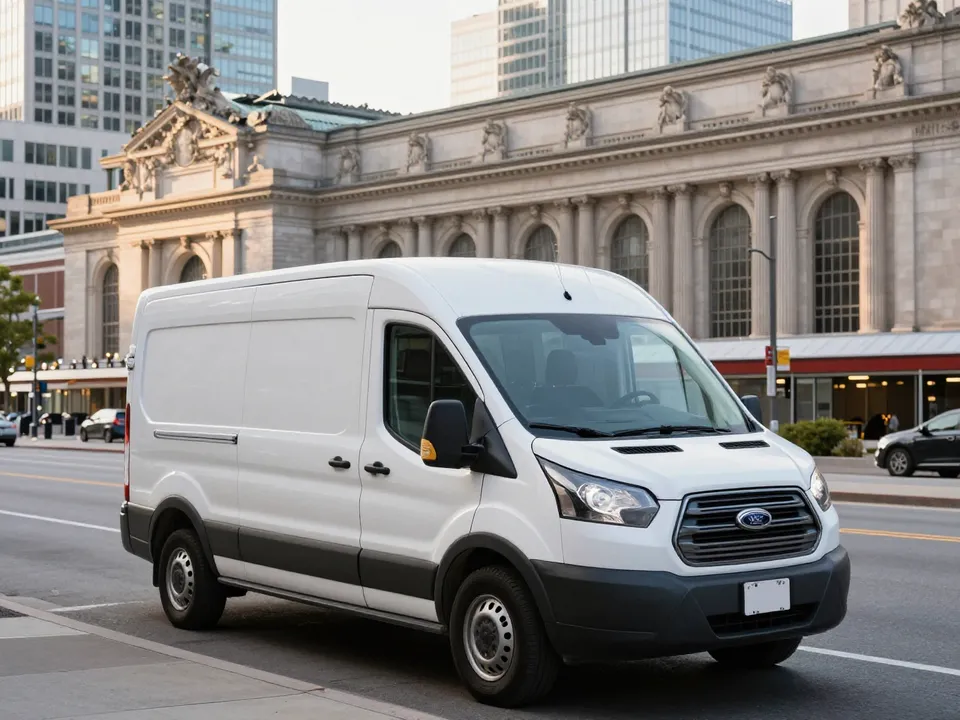












Passenger vans car rental in Canada
A week of moving a group around Canada is easier when the vehicle is delivered to you: Rent-Trip offers passenger vans car rental in Canada with one vehicle in the class, the Ford Transit Passenger Van, from C$ 182 a day. We deliver the car to any address in Toronto and to Toronto Pearson International Airport (YYZ), Billy Bishop Toronto City Airport (YTZ) and John C. Munro Hamilton International Airport (YHM), with the delivery address, date and time agreed with a manager before the booking is fixed.
What passenger vans car rental in Canada gives a group
Passenger vans car rental in Canada with us means one vehicle and no guesswork: a single 12-seat Ford Transit Passenger Van, delivered to your address with a full tank. Every group that books it gets the same body, the same drivetrain and the same seating layout — there is nothing to compare and nothing to upgrade.
Seats, body and drivetrain of the Ford Transit
Our passenger van is a Ford Transit Passenger Van, a minibus body with 12 seats. Behind that label sits a 3.5 L engine producing 275 hp, sent to the road through rear-wheel drive and an automatic gearbox. Twelve seats is the number that decides what the vehicle is for: a full hockey team with kit bags, three generations of one family, or a work crew that has to arrive together. The minibus body means a high roof and a flat floor, so passengers walk in rather than fold themselves in — worth knowing if anyone in the group has trouble with the step up into a taller vehicle. Rear-wheel drive and 275 hp are not brochure numbers when the minibus is fully loaded on a highway grade: a 12-seat minibus with twelve adults and luggage weighs far more than the same body with two people in it, and the driver feels that on the long climb north out of the city. Load the heavy bags over the rear axle, and check tyre pressures before a full-group run rather than after.
Petrol, automatic and what that means on a trip
The van runs on petrol through an automatic transmission. Regular petrol is priced per litre at the pump, so a full tank is a real line in the trip budget — budget for it before you leave, not after. Automatic matters in a minibus: hill starts, stop-and-go on the highway and a crowded parking garage all get easier when the driver is not working a clutch with eleven passengers behind them. Petrol also means every station on the route can serve you, from a highway service centre to a small town pump. In our practice, groups underestimate consumption on the first day because a loaded 12-seater drinks more than the family car they arrived in. Fill up the evening before a long run instead of hunting for a station with a van full of people at breakfast time.
Booking passenger vans car rental in Canada with a manager
The vehicle comes to you, and the booking is fixed with a manager first. That is how our passenger vans car rental in Canada works — one 12-seat Ford Transit, delivered on the day you name.
How the delivery address and time are fixed
- Start with the address: send the manager the exact street address, the date and the hour you want the van there, and they confirm what is possible.
- Name the return time too: the day and hour the van goes back are agreed in the same conversation, not left open at the end of the trip.
- Airport pick-ups: Toronto Pearson International Airport (YYZ), Billy Bishop Toronto City Airport (YTZ) and John C. Munro Hamilton International Airport (YHM) are all inside our delivery area.
- Outside the area: delivery beyond these places is arranged case by case and is not promised on the site, so ask before you build a plan around it.
- What the agreement carries: the deposit, the insurance excess and any delivery fees are set out in the rental agreement rather than quoted in advance.
Fix the return time as carefully as the pick-up — a late return is a separate conversation with the manager, and it is easier to move a hand-over earlier than to explain a van that is still on the road.
What the manager confirms before the van arrives
| What is agreed | Who sets it | Where it is written |
|---|---|---|
| Delivery address, date and time | You and the manager | Booking confirmation |
| Deposit and insurance excess | Rent-Trip | Rental agreement |
| Delivery fees outside the area | Rent-Trip | Rental agreement |
| Fuel rule: full tank out, full tank back | Rent-Trip | Rental agreement |
| Minimum rental age | Rent-Trip | Agreed when booking |
The table is the short version of the conversation: everything on the right-hand side is settled before the van leaves, and nothing on it is a surprise at hand-over. In our practice the bookings that run smoothly are the ones where the client names the return hour at the start — a 12-seat van is a big vehicle to park overnight, and knowing the end of the trip shapes where you leave it.
One more thing worth saying out loud: the van is supplied clean and with a full tank, and it must come back the same way. The missing fuel and a refuelling service fee are charged as set out in the rental agreement, so the last stop before return is a petrol station, not a discussion.
Licence, age and paperwork for passenger vans car rental in Canada
The paperwork for passenger vans car rental in Canada is short, but two documents decide whether the van leaves the delivery address at all: a licence the province accepts and proof that the vehicle is insured and registered. Both are checked against the rules below, and anything beyond them — the minimum age we rent to, for instance — is agreed with a manager when the booking is fixed.
Whose licence works and when an IDP is needed
A visitor to Ontario for less than 3 months may drive on a valid licence from their own province, state or country. Anyone arriving from another country for more than 3 months needs an International Driver's Permit (IDP) issued in their own country — Ontario states plainly that it cannot be obtained here. The permit is a translation of the licence you already hold, not a licence in its own right, so it travels alongside the original. In our experience the three-month line catches people who plan a long stay and only think about it in their second month. Sort the IDP before you fly: an application at home takes a few days, and the permit is issued in your own country rather than after you land.
Insurance, ownership permit and the legal age
- Insurance: the driver must carry insurance for the car, and the rental agreement sets out what cover applies to your booking.
- Ownership permit: the registration document travels in the van — keep the original or an exact copy inside the vehicle, not in a suitcase at the hotel.
- Legal age to drive: 16 is the minimum age to drive in Ontario, but the age we rent a van to is agreed when booking, not fixed by the law.
- Alcohol rules: criminal liability starts at 0.08 (80 mg per 100 ml of blood); the 0.05–0.079 warn range brings an immediate 7-day licence suspension, an 8-hour course and a fine for a first offence, and drivers aged 21 or under or holding G1/G2 licences must show zero.
- Highway speed: 110 km/h now applies on selected stretches of provincial highway instead of the old 100 km/h — read the signs rather than assume the limit.
The ownership permit is the document travellers forget most often, and a van parked without it is a conversation nobody wants at the roadside. Photograph it before you set off, then put the paper back in the glovebox where it belongs.
Daily, weekly and monthly rates for passenger vans car rental in Canada
Our passenger van is priced from C$ 182 a day, and the daily rate is the only figure you need to work out longer bookings. Rent-Trip runs one vehicle in this class — the 12-seat Ford Transit Passenger Van — so the price is the same whichever day you start. What changes is the term you choose, and the arithmetic behind it is fixed and public.
Daily, weekly and monthly rates for the van
| Term | Rate | What it covers |
|---|---|---|
| Per day | C$ 182 | One day of rental, full-to-full fuel |
| Per week | C$ 1,092 | Seven days, charged as daily × 6 |
| Per month | C$ 3,822 | 30 days, charged as daily × 21 |
Weekly is daily × 6 and monthly is daily × 21 — count your days before choosing. A trip of five days is cheaper at the daily rate; from six days upward the weekly figure is the one to ask the manager for. The same logic applies at the month boundary, so for a 25-day booking ask for the monthly figure.
Deposit, excess and fees
The deposit, the insurance excess and any fees are set out in the rental agreement. We do not quote those sums on this page because they depend on the agreement you sign, not on the class of van. What the page does fix is the rate itself: C$ 182 a day for the Ford Transit, C$ 1,092 for a week and C$ 3,822 for a month.
Read those lines before the vehicle arrives, not at hand-over. In our practice the questions that come up at the last minute are almost always about the excess and about what happens if the tank goes back short — both are written down, and both are cheaper to understand in advance than to argue about on a driveway in Toronto.
Fuel is the one running cost we can put a number on. Regular petrol is priced per litre at the pump, and the van takes a full tank at the start and must come back full — the missing fuel and a refuelling service fee are charged as set out in the rental agreement. No pre-paid tank option exists, so the last refuel is yours to plan.
Tolls are separate again. Highway 407 ETR is cashless: rates for light vehicles depend on the zone and the time you enter, plus a trip toll charge, and without a transponder a camera charge and a monthly account fee apply. Who pays road charges is agreed when booking — it is not a figure this page can promise.
Fuel and tolls on passenger vans car rental in Canada
Fuel and tolls are the two running costs that surprise a group most often: one is fixed by our own rule, the other by where you drive. Both are easy to plan for once you know the numbers.
The full-to-full fuel rule
Our passenger vans car rental in Canada runs on a simple fuel rule: the car comes clean with a full tank and must be returned with a full tank. The 12-seat Ford Transit Passenger Van takes petrol through an automatic gearbox, and no other fuel option — a pre-paid tank or full-to-empty — is offered on the site. If the tank comes back short, the missing fuel and a refuelling service fee are charged as set out in the rental agreement. Regular petrol is priced per litre at the pump, so a full tank is a real line in the trip budget for a 3.5 L engine. Plan the last refuel before you head back to the drop-off address rather than leaving it to the morning of return — stations near the delivery point are busier at that hour.
Highway 407 ETR and road charges
Highway 407 ETR is the one toll most van drivers meet, and it is the charge worth pricing before you set a route. Rates for light vehicles depend on the zone and the time you enter, plus a trip toll charge. Without a transponder a camera charge and a monthly account fee apply. Who pays road charges, tolls and any penalty notices on a rented car is agreed when booking — it is not a fixed line on this page.
- Full-to-full: the van leaves with a full tank and returns with one; a short tank means the missing fuel plus a refuelling fee under the rental agreement.
- Highway 407 ETR: rates depend on the zone and entry time, plus a trip toll charge.
- No transponder: a camera charge and a monthly account fee apply.
- Road charges: who covers tolls and notices is agreed when booking, not assumed.
Tolls are worth checking against your route before you leave: a single run on 407 ETR at the top rate costs more than twice the same run at the lowest rate, so the time of entry matters as much as the distance. In our experience groups heading out of Toronto for a long trip do better to fix the toll question with the manager at booking, when the route is still open to change.
Driving passenger vans car rental in Canada in cities and on long trips
A 12-seat passenger van is a different driving job from a compact car, and the difference shows up fastest in town. A 12-seat body, rear-wheel drive and a 3.5 L engine at 275 hp behave politely on an open highway and demand attention in a crowded lane. We hand the keys over with a full tank, and the first ten minutes are worth spending on an empty street getting used to the length.
Handling a 12-seat van in traffic and parking
- Braking distance: a loaded minibus needs noticeably more room to stop than a sedan, so leave a longer gap than you would in a car.
- Turn radius: the wheelbase makes wide turns normal — swing out before a corner rather than cutting it.
- Height and mirrors: the van sits higher than a car, and the mirrors cover the blind spots only if you set them before pulling away.
- Parking: choose a bay you can pull straight out of, because reversing a van into a tight space at the end of a long day is where damage happens.
- Loading: keep bags low and forward of the rear axle, since a heavy tail changes how the rear-wheel-drive van answers the steering.
In our practice the drivers who struggle are the ones who treat the minibus like a bigger estate car for the first hour. Set the mirrors, find an empty lot, and practise one reverse park before you join traffic — that single manoeuvre saves more paint than any other habit.
Long trips out of the city
Long-distance driving is where the Ford Transit Passenger Van earns its place: 12 seats, petrol, automatic, and enough power for a full load on a highway grade. Ontario's provincial highways now post 110 km/h on selected stretches instead of the old 100 km/h — read the signs rather than assuming, because other sections keep their own limits. Winter tyres are not compulsory in Ontario, unlike Quebec, where they are required from 1 December to 15 March for vehicles registered there, with fines for non-compliance; a van on Ontario plates is outside that rule, but the weather does not read the statute book.
One line matters before any cross-border plan: most cars hired here may be taken into the neighbouring country to the south, but only with permission from the rental point, and large vans fall under the restrictions. Without written permission the trip breaks both the agreement and the insurance, and a passport is needed at the border. Ask when booking, not at the crossing.
Crossing the border in passenger vans car rental in Canada
Most vehicles hired here can be taken into the United States, but only with permission from the specific location that supplies the car. Restrictions apply by class, and large vans are among the vehicles most likely to be refused, so a 12-seat Ford Transit needs to be cleared in advance rather than at the border. Without written permission the crossing breaks the agreement and voids the insurance. At the border itself you show a passport.
What to sort out before you drive south
- Written permission: ask for it before the booking is fixed, and name the dates and the crossing you plan to use.
- Van class: large vans and minibuses sit on the restricted list more often than passenger cars, so confirm the Ford Transit itself, not just the brand.
- Insurance: the cover that applies inside the country does not automatically follow the van across the line — the paperwork sets out what changes.
- Documents: a passport is what you present at the border; anything else the crossing asks for is agreed when booking.
We arrange the permission through the supplying location, and it is not something a driver can sort out on the road. The practical consequence is timing: a request made a few days before pick-up can come back refused for the van class, and by then the alternative is a smaller vehicle that no longer seats twelve. In our experience the question is worth asking at the same moment you agree the delivery address and date with the manager.
The van itself is a 12-seat minibus with a 3.5 L engine at 275 hp on rear-wheel drive, which is a lot of vehicle to put through a border queue, and the crossing adds hours to a day that already has driving in it. Plan the return leg with the same care as the outbound one, and keep the permission paperwork in the van rather than in a suitcase.