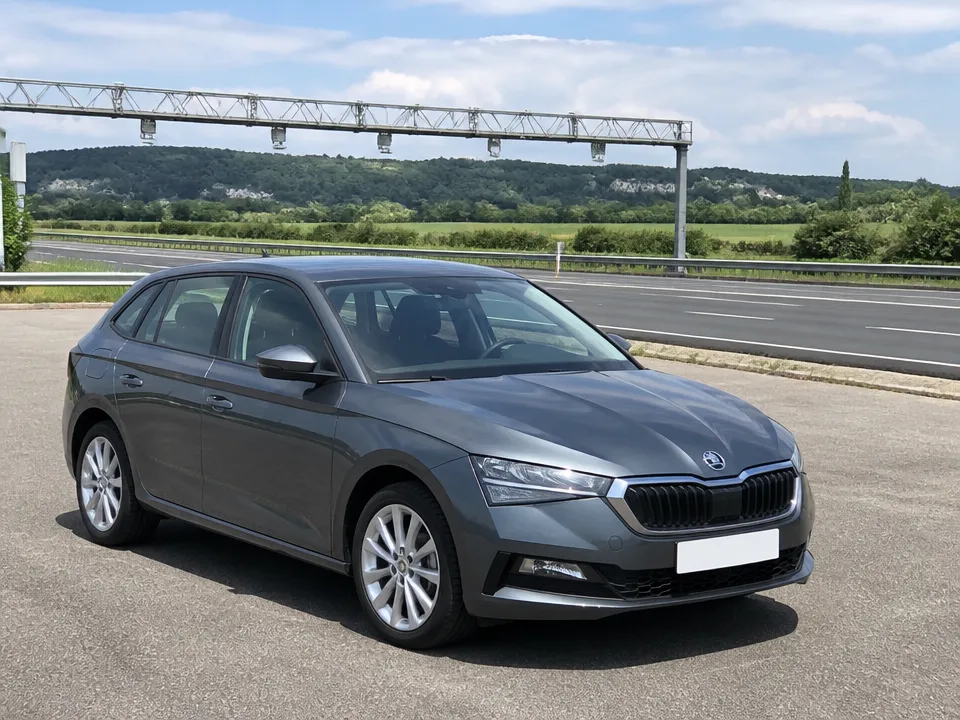
Skoda Octavia, Comfort
★5.0· 98Automatic1.5 L150 hpFront-wheel5 seats
€95per day
Book now




No cars match the selected filters. Remove some of the conditions.



This page lists 1 car: the Skoda Octavia at €95 per day. It is a Comfort class Hatchback with 5 seats and automatic transmission. Rates on this page start at €95 a day.
The transmissions on this page are Automatic. The car listed is the Skoda Octavia, a 5-seat Hatchback in the Comfort class, at €95 per day in Paris.
EU/EEA licences are valid in France with no time limit while they remain valid. Drivers from outside the EU/EEA may use national licences as tourists; if the script is not Latin, an official translation or IDP is needed alongside them.
Škoda car rental in Paris with Rent-Trip is a one-car page: a single Škoda Octavia in the Comfort class at €95 per day, weekly from €570 and monthly from €1,995.
This page is built around one car, not a catalogue.
We deliver a Škoda Octavia — Comfort class, hatchback, 5 seats, gasoline, automatic, front-wheel drive, 1.5 L, 150 hp. It is the only car on this page, at €95 per day, and it comes to you rather than waiting in a rank. Front-wheel drive keeps the car predictable in the wet, and 150 hp is more than the Octavia needs for the 50 km/h limit that applies across the city and on the boulevard périphérique.
The Octavia on this page is automatic and petrol — 1.5 L, 150 hp, front-wheel drive. Traffic drives on the right in France and every car here is left-hand drive, so the driving position matches what a European licence holder already knows. The automatic does the rest of the work: the périphérique moves in stop-start waves, and the covoiturage lane on the left — open to cars with 2+ occupants, Monday to Friday 7:00–10:30 and 16:00–20:00 — rewards a driver who can hold a steady crawl without riding a clutch.
| Parameter | Value |
|---|---|
| Model | Škoda Octavia |
| Class | Comfort |
| Body | Hatchback |
| Seats | 5 |
| Fuel | Gasoline |
| Transmission | Automatic |
| Drive | Front-wheel |
| Engine | 1.5 L, 150 hp |
| Rate | €95 per day |
One model, one class, one rate.
Škoda car hire here starts at €95 per day; a week is €570 and a month is €1,995. Those longer rates are not rounded-off guesses — a week is the daily rate multiplied by six, and a month is the daily rate multiplied by twenty-one. Both multipliers are fixed, so you can check the arithmetic yourself before you book. The Octavia is Comfort class, and every car we deliver on this page sits in that one class at that one rate. There is no cheaper tier and no more expensive one to compare against, which is why the table below has three rows rather than a dozen. What we cannot put in a table is the deposit, the excess and any delivery fee: those are set out in the rental agreement for your specific booking, and a manager confirms them with you at the time you reserve.
The rate covers the car itself; the deposit, the excess and any delivery fees are set out in the rental agreement, not on this page. In France, responsabilité civile is compulsory by law and comes with any booking automatically — it covers injury and property damage caused to third parties within the country's legal limits, but it does not cover the driver's own injuries. Collision damage protection (CDW) and theft protection (TW) sit in the basic package on the French market, and both work within a franchise — the excess, a fixed sum the renter pays personally after damage or theft. Base protection does not stretch to tyres under abnormal use, glass outside a collision, the sunroof and panoramic roof, the underside, misfuelling and the engine damage that follows, or lost and stolen keys. If your card is a Visa Premier or Gold Mastercard, it often covers the CDW/TW excess when the booking is paid with that card and the holder is the main driver on the agreement — worth checking with your bank before you travel.
| Period | Rate | How it is calculated |
|---|---|---|
| One day | €95 | Base daily rate |
| One week | €570 | Daily rate × 6 |
| One month | €1,995 | Daily rate × 21 |
For a single day out of the city, the daily rate stays the unit everything else is measured against — the weekly and monthly figures only start to pay off once your trip runs past six days.
Every booking for the Škoda Octavia on this page is agreed with a manager before the hire starts, and the hand-over is arranged as part of that same booking. That single sequence — confirm the dates, then take hand-over of the vehicle — is how self-drive hire works with us.
We agree the booking with a manager: dates, the Octavia, and the hand-over are confirmed before the hire starts. Nothing is automatic and nothing is charged on this page — the rate of €95 per day, €570 per week and €1,995 per month is the starting point, and the rest of the arrangement is settled in conversation. Conditions that fall outside a standard tariff — the minimum age, the young-driver surcharge, which card and passport are accepted — are set by the company itself, not by a national rule, so they are clarified at this step rather than assumed. The deposit, the insurance excess and any delivery fee are not listed here either; they are set out in the rental agreement. Ask about the excess before you confirm, because on French bookings the franchise is a fixed sum you pay yourself after damage or theft, and it does not disappear on its own.
The car is delivered to the client, so the meeting point and the time are part of the same conversation as the dates. We confirm where and when the Octavia reaches you when the booking is agreed — not from a fixed list of addresses. If your trip starts at an airport, a station or a hotel, say so while booking and the manager will confirm whether that hand-over can be arranged.
Traffic here runs on the right, and every car we hand over is left-hand drive, so the Škoda Octavia on this page behaves exactly like the vehicle you drive at home. The automatic gearbox and the 1.5 L / 150 hp petrol engine do the rest of the work on the boulevard périphérique, where stop-start queues are the norm rather than the exception.
The boulevard périphérique has been a 50 km/h road since 1 October 2024, when the city hall phased the change in from porte des Lilas to porte d'Orléans on the inner ring, and across the whole ring by 10 October. Code de la route still permits up to 70 km/h there, so sign-reading matters more than habit. One lane is reserved for vehicles carrying two or more people: the left-hand lane between the Issy embankment and porte de Bercy in both directions, Monday to Friday 07:00–10:30 and 16:00–20:00, an experiment running since 3 March 2025 and enforced with a 135 € fine (contravention 4th class) since 2 May 2025.
The general alcohol limit is 0.5 g/l of blood (0.25 mg/l of breath); for permis probatoire holders it is 0.2 g/l of blood (0.10 mg/l of breath), lowered on 1 July 2015. A young driver caught above that figure faces 135 €, six points and possibly a licence suspension. Children under 10 or shorter than 135 cm must travel in a child seat — both conditions have to be met before the seat becomes unnecessary, under Code de la route, R412-1 and following, with a fine of up to 750 € (contravention 4th class) for going without. Winter tyres are compulsory from 1 November to 31 March in roughly 34 mountain départements — the Alps, Pyrenees, Massif Central, Jura, Vosges and Corsica — covering more than 4,000 communes under loi Montagne II, with 135 € and immobilisation of the car as the penalty. Île-de-France is not in that zone, so a car collected here needs nothing extra — but a ski trip in February does, and that is worth settling before you leave rather than on the road.
The ZFE de la Métropole du Grand Paris (Zone à Faibles Émissions) is the low-emission zone that decides whether a Škoda booked through us can legally enter the city centre at all. It is not a toll and not a congestion charge — it is an emissions-class restriction, and the only thing that governs entry is the Crit'Air sticker on the windscreen.
The practical point is that a ZFE check and a mountain-tyre check are two different rules with two different borders, and only the first one is relevant the moment you drive out of the hand-over.
A Škoda booked for the trip keeps fuel and parking simple: the Octavia runs on petrol, city streets cost money to park on, and the Duplex A86 is the paid tunnel that comes up on some routes. Everything else you pay at the pump or at a horodateur.
Streets and the boulevard périphérique carry no toll at all. The Duplex A86 is roughly 10 km of underground road between Rueil-Malmaison, Vaucresson and Vélizy, operated by Cofiroute/Vinci. On the class 1 tariff, Rueil → Vélizy costs between €8.30 and €13.70 Monday to Thursday depending on the hour, and up to €14.90 on Fridays and the eve of public holidays. If your trip stays inside the périphérique, budget nothing for tolls and put the money towards the parking meter instead.
Licence rules, the insurance package and the deposit all sit in the agreement rather than on this page — here is what French law fixes and what the contract leaves open.
An EU or EEA licence is valid in France for as long as it stays valid, with no exchange needed and no time limit. Drivers from outside the EU or EEA on a tourist trip may drive on their national licence; if that licence is not in Latin script, an official translation or an International Driving Permit must be carried alongside it — the IDP is a translation only and never replaces the original. Anyone resident outside the EU or EEA may drive for 1 year from the entry date stamped in their visa, and must exchange the licence if they take up residence. To hire, the licence has to have been issued more than 1 year ago, and digital licences are not accepted. The IDP itself must be no older than 3 years. Minimum age, the young-driver surcharge and which card and passport are accepted are set by each company, and we confirm them when booking.
Responsabilité civile is compulsory by law and comes with every booking automatically, covering injury and property damage caused to third parties within the country's legal limits — it does not cover the driver's own injuries. CDW and TW sit in the base package on the French market, capping the renter's liability at the excess and covering repairs, downtime, theft, attempted theft and vandalism in a car park. The exact figure is not published as a single national number — it stands in the agreement for the specific booking.
Visa Premier and Gold Mastercard often cover the CDW and TW excess if the booking was paid with that card and the holder is the main driver on the agreement; that is industry practice rather than a bank document, so read your own card terms.