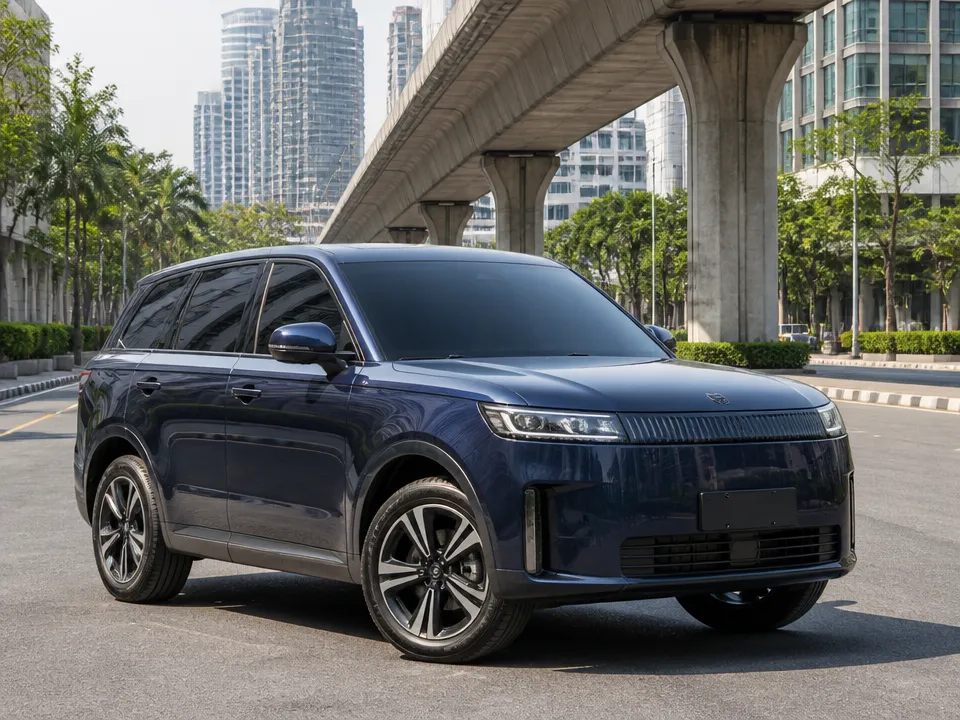
Jaecoo J5 EV, Electric
★4.6· 34Automatic—211 hpFront-wheel5 seats
฿1,300per day
Book nowVAT included




VAT included
No cars match the selected filters. Remove some of the conditions.



This page lists 1 car. It is a Jaecoo J5 EV, an Electric Crossover with 5 seats and an Automatic transmission, at ฿1300 per day in Bangkok.
The Jaecoo J5 EV is at ฿1300 per day. That is the rate for this Electric Crossover in Bangkok.
In Thailand traffic keeps to the left and the steering wheel is on the right. Drivers from ASEAN countries may use their national licences without an IDP when renting in Bangkok.
One Jaecoo J5 EV is available for rent in Bangkok at ฿1,300 per day — a five-seat electric crossover with automatic transmission and front-wheel drive. Rent-Trip delivers the car to any address in Bangkok, including Suvarnabhumi Airport (BKK) and Don Mueang Airport (DMK), with the delivery address, date and time agreed with a manager before the booking is fixed.
We rent out one model on this page — the Jaecoo J5 EV, an electric five-seat crossover with an automatic transmission and 211 hp.
| Model | Body | Seats | Fuel | Transmission | Drive | Power | Price per day |
|---|---|---|---|---|---|---|---|
| Jaecoo J5 EV | Crossover | 5 | Electric | Automatic | Front-wheel | 211 hp | ฿1,300 |
An EV is exempt from the Bangkok Low Emission Zone, which applies only to vehicles with six or more wheels. The zone covers all 50 districts and is triggered when PM2.5 passes 75.1 µg/m³ in at least five of them, so its restriction days fall on trucks and buses — not on a five-seat electric crossover. The exemption is written into the zone's exception list alongside NGV and Euro 5–6 vehicles, which is why an electric Jaecoo never sits out a pollution day.
The deposit is taken on a bank card in the main driver's name, and its amount is set out in the rental agreement. Delivery to any address in the city, the date and the time are agreed with a manager before the booking is fixed.
One model, one rate: the J5 EV sits at ฿1,300 per day, and the weekly and monthly figures follow from that number alone.
The weekly rate is the daily rate multiplied by six, and the monthly rate is the daily rate multiplied by twenty-one — those are the only multipliers we apply. A seven-day booking therefore costs ฿7,800, three weeks at the weekly rate ฿23,400, and a month ฿27,300. There is no separate discount code to hunt for: the longer rate is simply the same car at a lower per-day figure. It is worth telling the manager your rough dates at the first message rather than after the car is delivered.
Because the multiplier is fixed at six and twenty-one, the saving grows with the length of the booking — a month at ฿27,300 works out at about ฿910 per day over thirty days, against ฿1,300 for a single day.
Thai traffic keeps to the left and every car here is right-hand drive, so the first hour behind the wheel is about unlearning old habits, not paperwork.
A foreign visitor needs a home driving licence plus an International Driving Permit issued under the 1949 Geneva Convention. The rule sits in section 42 bis of the Motor Vehicle Act, and the police fine for driving without the permit is ฿500–1,000 — an insurer may also refuse a claim after an incident. Citizens of ASEAN countries drive on their national licence and do not need the permit at all.
The minimum driver age is 21.
Since 30 December 2025 a car rental agreement in Thailand is a contract controlled by the OCPB. It is written in Thai, and every fee and penalty is disclosed inside it — that is the document to read before you drive away, not the booking confirmation. Compulsory motor insurance, Por Ror Bor, is attached to the registered car and covers injury to third parties; first-class cover handles damage to the car itself, and its terms and excess are set out in the rental agreement. Traffic-camera fines are issued to the car owner first and re-invoiced to the renter, so a camera on Motorway 7 reaches you after the trip.
We deliver the Jaecoo J5 EV to any address in Bangkok and to Suvarnabhumi Airport (BKK) and Don Mueang Airport (DMK).
Suvarnabhumi handles 62,902,183 passengers and sits about 25 km from downtown; measured from Democracy Monument it is 27.9 km in a straight line, 40.6 km by road, and 52 minutes without traffic. Don Mueang is closer at 20.5 km straight and 27.4 km by road, 40 minutes in clear conditions. Traffic in Thailand keeps to the left and every car is right-hand drive. If you land in the evening peak, the road figure is the one to plan around — the straight-line distance tells you nothing about the drive.
Ask the manager at booking whether the car is delivered with a full charge and where the nearest charging point to your address is — on an electric Jaecoo that single question saves you the first hour of your trip.
Thailand drives on the left and every car in our fleet is right-hand drive, so the first ten minutes behind the wheel of the Jaecoo J5 EV are the ones that matter.
| Road type | Limit |
|---|---|
| Built-up areas | 80 km/h |
| Outside built-up areas | 90 km/h |
| Motorways (M7, M9) | 120 km/h |
| Expressways | 110 km/h |
| Elevated sections | 100 km/h |
The Low Emission Zone applies only to vehicles with six or more wheels — trucks and buses — during PM2.5 episodes, with a threshold of PM2.5 above 75.1 µg/m³ in at least five districts. A five-seat electric crossover is not covered, and EVs sit on the zone's exception list alongside NGV and Euro 5–6 cars. On a bad-air day the restriction simply does not touch your Jaecoo car rental in Bangkok. Congestion charging for Sukhumvit, Silom and Ratchadaphisek was announced in October 2024 but remains under study, so treat it as a proposal rather than a cost you will pay.
A short hop on them runs roughly ฿50–100 for a passenger car, paid in cash or with an Easy Pass or M-PASS tag — the tags are interchangeable, but one car carries one tag. Motorway 9 uses M-Flow, which has no barrier at all: a camera reads the plate and the bill arrives later.
That last detail matters for a rental. Ask at hand-over how an M-Flow charge is settled on a rental. So before you set off, ask at hand-over whether the car is registered for M-Flow and how the charge will be settled — it is a two-minute question that saves a surprise later. The same logic covers speed cameras on Motorway 7 to Pattaya: the fine goes to the owner first and is re-invoiced to the renter afterwards, which is why we put the arrangement in the rental agreement rather than in the daily rate.
Left-hand traffic and a right-hand drive layout are the two things to reset in your head on the first kilometre, and after that the car behaves like any other automatic.
Nothing on this page is a substitute for that document — it names the figures, and we do not.
Por Ror Bor is Thailand's compulsory motor insurance, and it is attached to every registered vehicle rather than to the person driving it. First-class (Class 1) insurance handles damage to the car itself, and its terms, along with the excess, are set out in the agreement rather than summarised here. The two policies do different jobs, and a driver who assumes the compulsory cover also pays for a dented door is in for an unpleasant surprise at hand-over.
Traffic-camera fines follow a similar route, because they are issued to the car owner first and re-invoiced to the driver, so a camera on Motorway 7 reaches you after the trip rather than at hand-over. Ask which clauses cover tolls and cameras before you sign, and keep the agreement with you for the length of the booking — it is the only place where the deposit, the excess and the fees are actually stated.