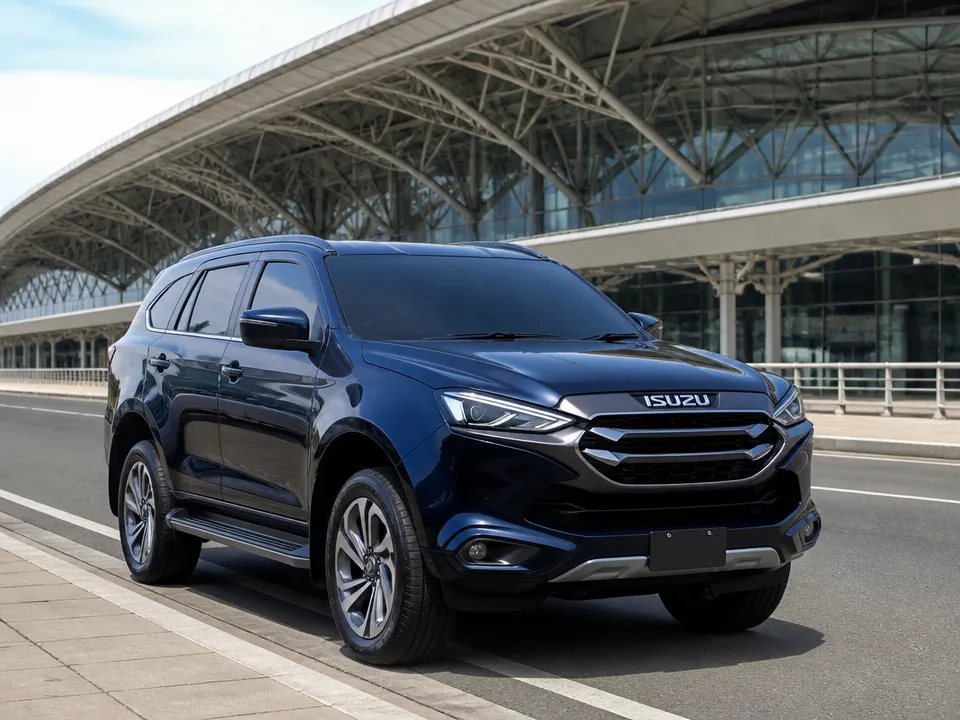
Isuzu MU-X
★4.7· 85Automatic1.9 L150 hpRear-wheel7 seats
฿3,000per day
Book now











If you need an Isuzu car rental in Bangkok, we have two diesel automatics ready — the Isuzu D-Max pickup and the Isuzu MU-X SUV — from ฿2,200 per day, with weekly rates from ฿13,200 and monthly from ฿46,200. We deliver the car to any address in Bangkok, including Suvarnabhumi Airport (BKK) and Don Mueang Airport (DMK), and the delivery address, date and time are agreed with a manager before the booking is fixed.
Rent-Trip keeps two Isuzu models in Bangkok: the D-Max pickup and the MU-X SUV. Both burn diesel, both shift automatically, and both arrive at your address with a full tank. What separates them is the body and the number of seats.
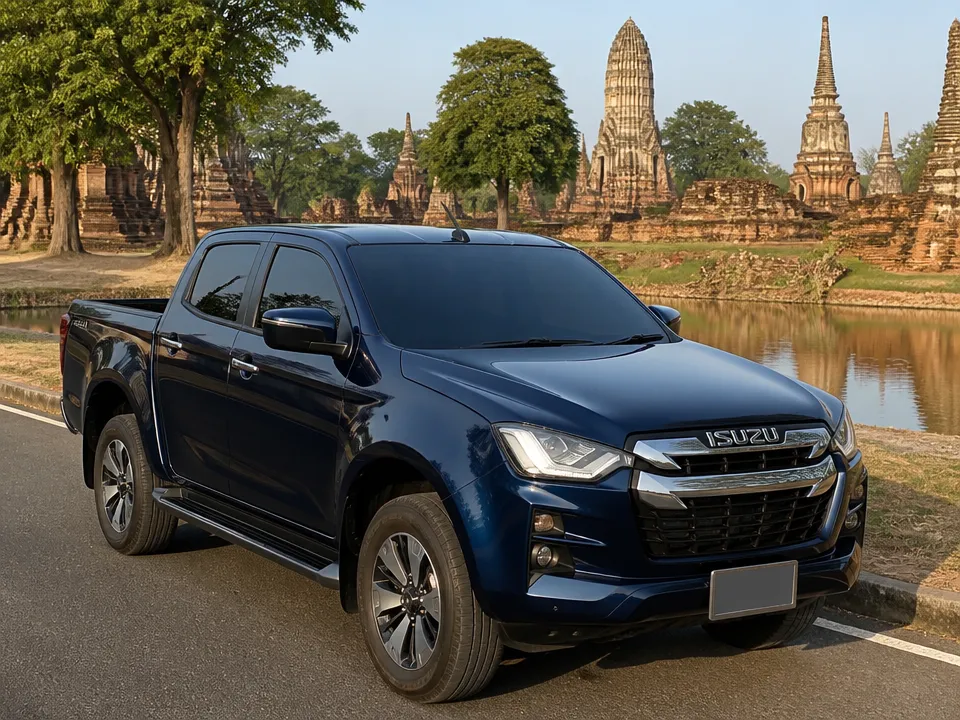
The Isuzu D-Max is the pickup on this page, seating five, from ฿2,200 per day. Under the bonnet sits a 1.9 L diesel rated at 150 hp, driving the rear wheels through an automatic gearbox. If your luggage is soft bags and nothing taller than a suitcase, the pickup is more car than you need.
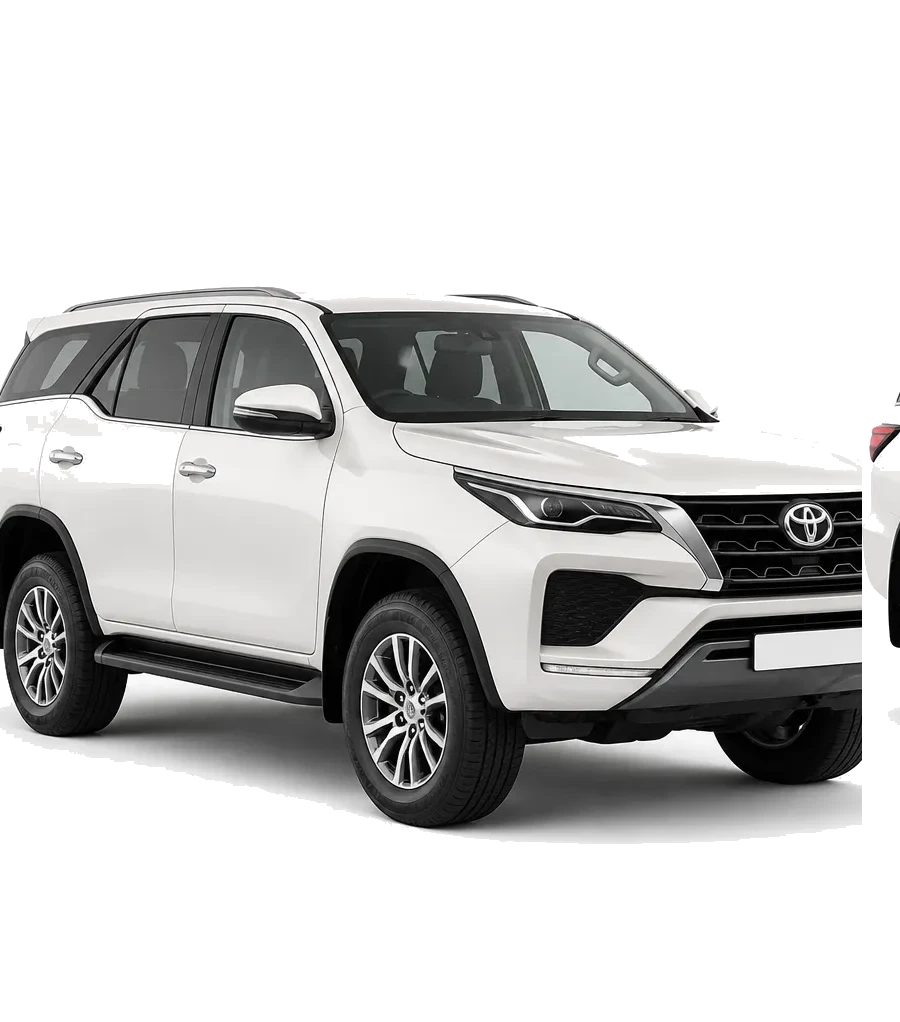
The Isuzu MU-X is the SUV & 4x4 on this page, seating seven, from ฿3,000 per day. It carries the same 1.9 L diesel and automatic gearbox as the D-Max, with three rows of seats behind a closed tailgate. A family of five with grandparents along for the day, or a group of six splitting one car, is where the MU-X makes sense. Decide which you actually need — seven people or seven bags — before you confirm the booking, because the answer changes with every trip.
| Model | Class | Seats | Fuel | Gearbox | From per day |
|---|---|---|---|---|---|
| Isuzu D-Max | Pickup trucks | 5 | Diesel | Automatic | ฿2,200 |
| Isuzu MU-X | SUV & 4x4 | 7 | Diesel | Automatic | ฿3,000 |
Both share one engine — 1.9 L, 150 hp, rear-wheel drive — so the choice comes down to body and seats. Take the pickup when the load is the point; take the SUV when the passenger count is.
Isuzu car rental in Bangkok runs from ฿2,200 to ฿3,000 per day, and the class you pick decides the figure. The D-Max pickup and the MU-X SUV sit ฿800 apart on the daily rate, and longer bookings move the per-day cost again.
Isuzu car rental in Bangkok starts at ฿2,200 per day, with weekly from ฿13,200 and monthly from ฿46,200. The D-Max pickup opens at ฿2,200 per day, the MU-X SUV at ฿3,000 per day. Weekly is daily × 6 and monthly is daily × 21, so a longer booking lowers the per-day figure without any separate discount code. On a monthly booking of the D-Max, the arithmetic lands near ฿1,540 a day — that is what the multiplier does, not a promotion.
| Class | Model | Seats | From per day | Weekly from | Monthly from |
|---|---|---|---|---|---|
| Pickup trucks | Isuzu D-Max | 5 | ฿2,200 | ฿13,200 | ฿46,200 |
Because the deposit, the excess and any delivery fee sit in the agreement and not in the rate you see first, the daily figure is only half the comparison — read the agreement terms alongside it before you decide.
A foreign visitor driving an Isuzu in Bangkok needs a home driving licence plus an International Driving Permit, a passport and a bank card in the main driver's name. Citizens of ASEAN countries may drive on their national licence without an IDP. Traffic keeps to the left here and every car is right-hand drive, so the first hour behind the wheel of a D-Max or MU-X takes more attention than the paperwork does.
Drivers holding an ASEAN national licence skip the permit entirely; everyone else carries the 1949 Geneva Convention document next to the original. The security hold is taken on a bank card in the main driver's name, and the amount is confirmed in the agreement. Since 30 December 2025 a car rental agreement in Thailand is a contract controlled by the OCPB: it is written in Thai, and all fees and penalties are disclosed in it. Both models on this page run on diesel with an automatic transmission: the D-Max is a five-seat pickup at ฿2,200 a day, the MU-X a seven-seat SUV at ฿3,000 a day, and the paperwork for either is agreed when booking.
Compulsory motor insurance, Por Ror Bor, covers injury to third parties and is attached to every registered car; first-class insurance covers damage to the car, and its terms and the excess are set out in the rental agreement. The delivery address, the date and the time are agreed with a manager before the booking is fixed. Whether the car carries an expressway tag, and who settles the M-Flow bill, is worth confirming before you drive off rather than after.
We deliver the car to any address in the city and to Suvarnabhumi Airport (BKK) and Don Mueang Airport (DMK). The delivery address, the date and the time are agreed with a manager before the booking is fixed, and a delivery fee, if any, is agreed when booking.
A landing time is not a hand-over time. Build a buffer into the slot you agree with the manager: if the flight lands at 14:00, ask for 16:00, not 14:30. The same applies at Don Mueang, where 31,650,816 passengers passed through in 2025 and the run into town uses the Don Muang Tollway over Vibhavadi Rangsit Road.
If your plans move — a delayed flight, a late train into Krung Thep Aphiwat — tell the manager as soon as you know.
The rental agreement, the deposit, the insurance excess and any delivery fee are all set out in that agreement; we do not quote figures for them here, and you will see them before you commit. The car arrives clean with a full tank, and hire is available from 1 day. Both Isuzu models on this page run on diesel, so fill up with diesel, not gasohol.
One practical note: the Low Emission Zone covers vehicles with six or more wheels, so a D-Max pickup or an MU-X is not affected — the restriction targets trucks and buses on high PM2.5 days.
Both Isuzu models on this page run on diesel and drive on the left with a right-hand drive layout, so your first hour here is about unlearning lane habits, not about the car.
Those are Bangchak retail prices recorded on 24 September 2026 without the provincial tax.
City tolls are collected in cash or by an Easy Pass or M-PASS tag on the windscreen, and the two tags are interchangeable, though a car carries only one. A short expressway hop costs roughly ฿50–100 for a passenger car.
Motorway 7 towards Chonburi and Pattaya is the other road you will meet: 149.3 km long, with Pattaya at the 125.865 km mark, and nine payment points. From the Lat Krabang entry a passenger car pays ฿25 to Bang Bo, ฿100 to Pong and ฿105 to Pattaya. Motorway 9, the outer Kanchanaphisek ring, runs cashless under M-Flow, where a camera reads the plate and the bill follows later — around ฿30–70 for a car. Don Muang Tollway, 28.1 km above Vibhavadi Rangsit Road from Din Daeng to Don Mueang, sits at roughly ฿60–115.
M-Flow has a rule worth knowing before you join it. Without a registered tag you must pay within two days by plate number through the M-Flow site or app, a QR code, a bank or an ATM. From the third day the tariff doubles, then the tariff plus twice again plus a penalty of ten times the tariff, and eventually court.
Built-up areas are an 80 km/h city, the open road outside them allows 90 km/h, motorways M7 and M9 permit 120 km/h, expressways 110 km/h and elevated sections 100 km/h. The Low Emission Zone does not touch you: it applies only to vehicles with six wheels or more — trucks and buses — on high PM2.5 days, across all 50 districts in the current fiscal year, triggered when PM2.5 passes 75.1 µg/m³ in at least five districts. A five-seat D-Max or a seven-seat MU-X is outside it; the exemptions also cover the Green List, EVs, NGV vehicles and Euro 5–6 engines.
Every registered car in Thailand carries compulsory motor insurance, known as Por Ror Bor, which pays for injury to third parties. What it does not do is pay for damage to the car itself. Read the excess line before you sign anything, because it is the one number that decides how much of a scrape comes out of your own pocket.
Since 30 December 2025 the paperwork a renter signs here is a contract controlled by the OCPB. It is written in Thai, and every fee and penalty is disclosed inside it.
Traffic-camera fines in Thailand are issued to the car owner and then re-invoiced to the renter. On the Isuzu D-Max and MU-X you are driving a right-hand-drive diesel pickup or SUV on the left side of the road, and a fine from a camera reaches us first and reaches you afterwards. Speed limits are 80 km/h in built-up areas, 90 km/h outside them, 120 km/h on the motorway and 110 km/h on the expressways.
The Thai capital is a good base for a loop rather than a single stop. Motorway 7 runs south-east for 149.3 km towards Chonburi and Map Ta Phut, and the Pattaya exit sits at 125.865 km from the start — a straight run on a road that passes Suvarnabhumi. Motorway 9, the outer ring, gets you around the city without crossing it.
Tolls on the way out are paid in cash or with an Easy Pass tag — M-PASS is accepted too, and the tags are interchangeable, though one car carries one tag. On Motorway 9 the M-Flow gantries have no barrier at all: a camera reads the plate and the bill follows. A short hop on the city expressways runs ฿50–100 for a passenger car, and the Don Muang Tollway, 28.1 km of elevated road above Vibhavadi Rangsit, runs ฿60–115. Motorway 7 is the exception — the tariff table is published, so you can count the cost before you leave.
Fuel is the one figure that moves. Diesel B7 was ฿41.44 a litre and diesel B20 ฿36.44 at the last check, against gasohol 95 at ฿39.94 and premium diesel at ฿50.05. Both Isuzu models take diesel: B7 costs more per litre than gasohol 95, B20 less.
And no beach or jungle-track driving: the rental agreement rules it out, and the MU-X is a rear-wheel-drive SUV, not an off-roader.
This page lists 2 cars: the Isuzu D-Max at ฿2200 per day and the Isuzu MU-X at ฿3000 per day. Daily prices on this page run from ฿2200 to ฿3000.
The Isuzu cars on this Bangkok page have 5 or 7 seats, with automatic transmission. Body types are Pickup and SUV, in the Pickup trucks and SUV & 4x4 classes.
Thailand drives on the left and cars have the steering wheel on the right. This applies in Bangkok and is the law of the country, not our rental term.