






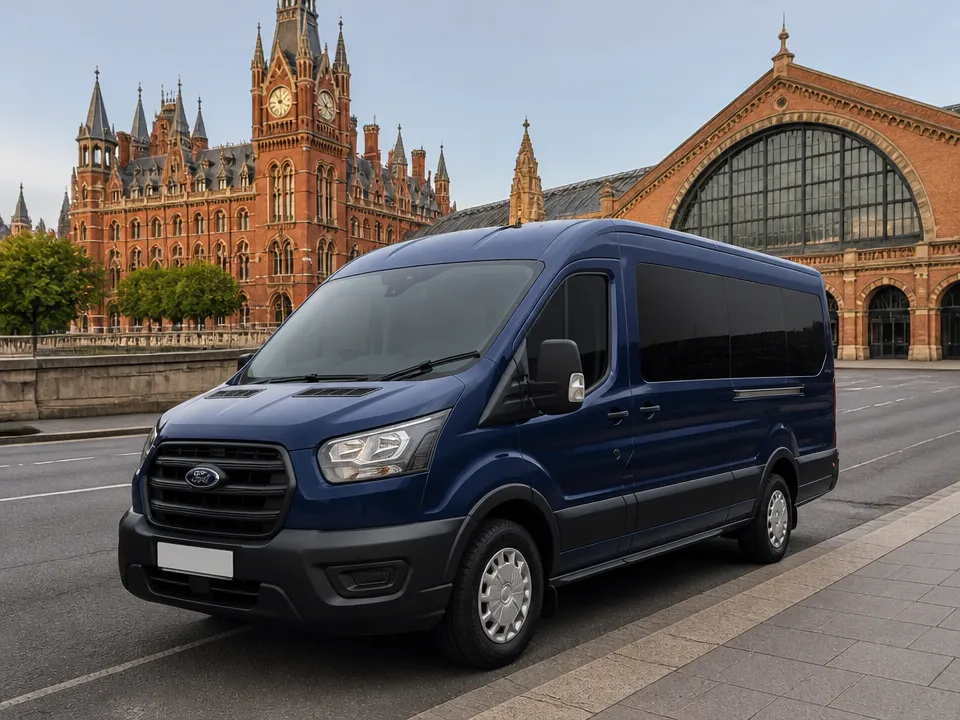

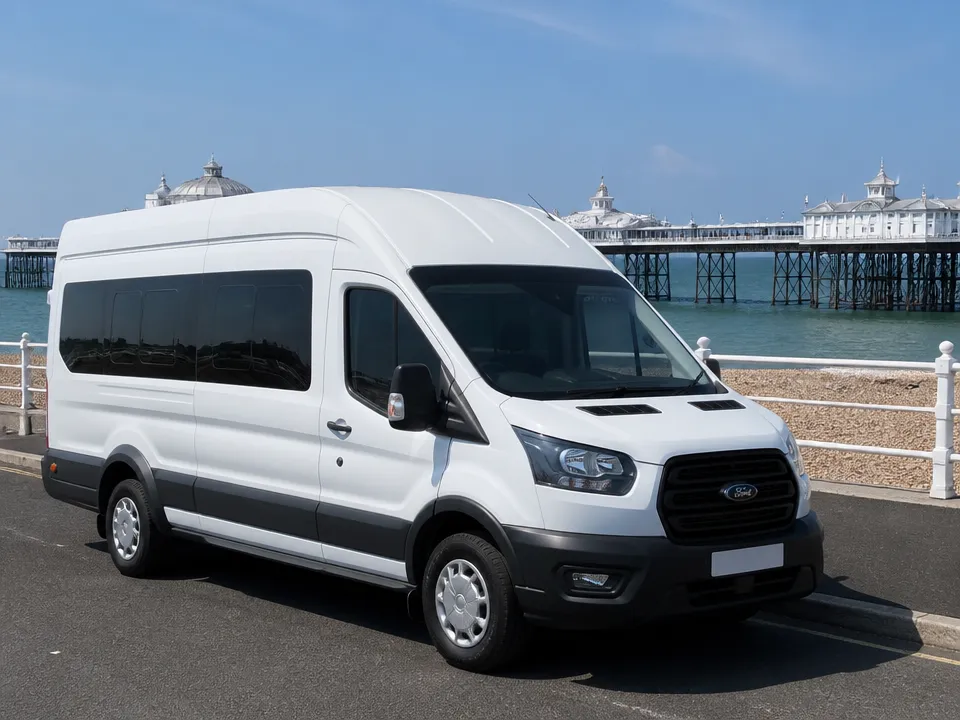













Passenger vans car rental in United Kingdom
Thinking about passenger van hire in the United Kingdom? Rent-Trip offers 5 passenger vans for hire, from £90 per day, with weekly bookings from £540 and monthly from £1,890.
Which passenger vans car rental in United Kingdom fits your group
Our passenger vans car rental in United Kingdom comes down to one question: how many people and how much luggage. Rent-Trip offers five diesel vans on this page with manual gearboxes, seating 8, 9, 12 and 17, at £90 to £168 a day. Three carry the passenger van body, two are minibuses. Below is what each one actually holds.
Seats, body types and luggage across our five vans
| Model | Body | Seats | Drive | Engine | From |
|---|---|---|---|---|---|
| Ford Tourneo | Passenger van | 9 | Front-wheel | 2.0 L, 130 hp | £90/day |
| Mercedes-Benz Vito 8 Seater | Passenger van | 8 | Rear-wheel | 2.0 L, 136 hp | £132/day |
| Ford Transit 12 Seater | Minibus | 12 | Front-wheel | 2.0 L, 130 hp | £132/day |
| Ford Transit 17 Seater | Minibus | 17 | Rear-wheel | 2.0 L, 130 hp | £138/day |
| Volkswagen Transporter 9 Seater | Passenger van | 9 | Front-wheel | 2.0 L, 150 hp | £168/day |
The Ford Tourneo is the cheapest at £90 a day and the Volkswagen Transporter 9 Seater the most expensive at £168. A 9-seat model takes a group plus luggage and still parks like a large estate car; a 17-seat minibus needs a minibus category (D1) on the licence, and it needs space at the kerb.
Passenger van or minibus — what the difference means on the road
Three of our vans are passenger vans, two are minibuses, and the badge changes how the vehicle handles a car park as well as which licence category you need to drive it. A passenger van is a converted panel body: the Vito at 8 seats, the Tourneo and the Transporter at 9 each. A minibus is built as a bus from the start, with a longer wheelbase and a higher roof — that is the Transit 12 Seater and the Transit 17 Seater. In practice the 17-seater is the one to think about twice: it is 130 hp on a 2.0 L diesel, rear-wheel drive, and reversing it into a tight bay in central London is a two-person job. The 12-seater sits between the two worlds — front-wheel drive, the same 130 hp, 12 seats and a body shorter than the 17-seater's.
In our experience groups overbook seats and underbook boot space. Count bags first, then seats: a 9-seat van full of people leaves room for soft bags only, so a group of nine with hard cases should look at the 12-seater instead.
Licence and driver rules for passenger vans car rental in United Kingdom
Every passenger vans car rental in United Kingdom comes down to one question at booking: what does the driver hold. Our five vans do not all sit in a single licence band, and the rules below are the ones that decide whether a group can set off as planned.
Who can drive our vans on a standard category B licence
- Seats first: a standard category B licence covers vehicles with up to 8 passenger seats, so it covers the 8- and 9-seat vans, while the 12- and 17-seat Ford Transit minibuses need category D1.
- Manual gearbox: every van on this page is manual, so the driver needs a manual entitlement, not an automatic-only one.
- Group size: the 8-, 9- and 12-seat models suit a driver who has never handled a long wheelbase before.
- Documents: the licence and the rest of the paperwork are agreed with a manager when booking.
Foreign licences and the 12-month rule
A full foreign licence is valid for 12 months from your last entry to Great Britain — England, Wales and Scotland alike — so a visitor can legally drive our vans for a full season of trips. The clock starts at entry, not at delivery: a driver who arrived in March and takes delivery of a van in October has roughly five months of validity left, not a fresh year. In our booking conversations this is the single detail groups get wrong most often, because the arrival stamp and the collection date sit far apart on a long visit. If the 12-month window closes mid-trip, plan the hand-over date around it rather than discovering the problem at the delivery address. Whether an international driving permit is needed is agreed with a manager when booking, since it depends on the licence's country of issue.
What to check before the delivery slot is fixed
| Check | Why it matters for a van booking |
|---|---|
| Licence category | Category B covers the 8- and 9-seat vans; the 12- and 17-seat minibuses need D1 |
| Manual entitlement | All five vans are manual, no automatic option |
| 12-month window | Counted from last entry to Great Britain, not delivery |
| Named driver | Agreed with a manager when booking |
| Age and experience | Agreed with a manager when booking |
The table is short on purpose: the heavy detail — deposit, excess and any additional-driver terms — lives in the rental agreement, and reading it before the date is fixed saves a second conversation. A 17-seat minibus booked for a group arriving at Heathrow is the case where this matters most, because the driver who turns up is sometimes not the one who made the booking. Confirm who is driving before the van leaves the depot, and the hand-over in London takes minutes rather than an afternoon.
Driving passenger vans car rental in United Kingdom on the left
Left-hand traffic is the single biggest adjustment for drivers arriving from left-hand-drive countries, and it shapes how our fleet behaves on British roads. Every vehicle on this page is right-hand drive with a manual gearbox, so the gear lever sits to your left and the mirror layout takes a day to trust. The Highway Code is the reference point for everything in this section, and the rules below apply wherever you drive across the country.
Left-hand traffic, roundabouts and speed limits
- Keep left: drive on the left unless signs or markings say otherwise (Highway Code, rule 160), and turn closer to the left kerb (rule 183).
- Roundabouts: give way to traffic approaching from your right (rule 185); you travel clockwise around the island.
- Built-up areas: 30 mph in England, Scotland and Northern Ireland unless signs show another limit.
- Single and dual carriageways: 60 mph on a single carriageway and 70 mph on a dual carriageway for the 8- and 9-seat vans; the 12- and 17-seat minibuses are limited to 50 mph and 60 mph.
- Motorways: 70 mph for vans, with the national speed limit sign marking the change.
- Lit roads: 30 mph applies by default on lit roads where no sign says otherwise.
Many London boroughs post 20 mph signs in residential zones, so read the signs rather than assuming the default. A 17-seat Ford Transit 17 Seater carries lower limits than a small hatchback on single and dual carriageways, and its length changes how much room you need at a roundabout entry.
Seat belts, child seats and phones behind the wheel
Seat belts are compulsory wherever they are fitted, and children must use a child seat until they reach 135 cm or turn 12, whichever comes first — the fine runs up to £500. Holding a phone, satnav or tablet while driving is illegal even when you are stopped at a red light: £200 and 6 penalty points, and a driver who passed their test less than 2 years ago loses the licence outright. A hands-free device is allowed only if it does not block your view of the road. On a 9-seat Volkswagen Transporter 9 Seater, that means setting the route before you pull away rather than adjusting it in traffic. The drink-drive limit in England, Wales and Northern Ireland is 80 mg per 100 ml of blood, 35 µg per 100 ml of breath and 107 mg per 100 ml of urine; in Scotland the figures are 50, 22 and 67. Our vans run on diesel, and the fuel policy is full-to-full: the car comes with a full tank and must go back full, with any shortfall and the refuelling service fee set out in the rental agreement.
Longer bookings of passenger vans car rental in United Kingdom
A van hired for a week or a month is priced on a simple multiplier rather than a separate tariff sheet: weekly works out at the daily rate times six, monthly at the daily rate times twenty-one. That applies across our five passenger vans, from the 8-seat Mercedes-Benz Vito to the 17-seat Ford Transit, so a longer term is a matter of arithmetic on the model you have already chosen.
How weekly and monthly terms work
Weekly is daily x 6 and monthly is daily x 21, so the longer the term you book, the lower the effective rate relative to the daily figure. Our five vans run from £90 to £168 a day, and the multiplier is the same for every one of them — the 9-seat Ford Tourneo at the bottom of the range and the 9-seat Volkswagen Transporter at the top are priced by the same rule. Pick the term by trip length, not by the day rate alone: a group that needs a 12- or 17-seat minibus for a fortnight pays two weekly rates (daily x 12), and the monthly figure (daily x 21) pays off only from about three and a half weeks. In our practice, groups touring with a full load of luggage usually settle on the largest van they can park, then book the term around it.
What the rental agreement sets out
- Deposit and excess: the security deposit and the insurance excess are set out in the rental agreement, so read them before the delivery slot is fixed.
- Delivery fees: any charge for bringing the van to your address is also set out in the rental agreement, together with the fuel terms.
- Term and dates: the collection and return dates, the delivery address and the time are agreed with a manager before the booking is fixed — a longer term is no different in that respect.
- Changes: if the trip runs longer than planned, raise it with the manager rather than simply keeping the van, so the agreement reflects the real term.
Read the agreement before the delivery slot is fixed. A weekly or monthly booking ties up a specific van for a long stretch, and the terms around deposit, excess and delivery are easier to settle at the start than to unpick at hand-over.
Rent-Trip delivers to any address in London and to the six London airports, and delivery outside those places is arranged case by case. For a long booking, tell us the full term when you enquire — the van is reserved against those dates, not against a single day.
Delivery of passenger vans car rental in United Kingdom
We bring the van to you rather than asking you to collect it: Rent-Trip delivers to any address in London and to the six airports around it, and the address, date and time are agreed with a manager before the booking is fixed. Everything below describes how that hand-over is arranged and what state the vehicle comes in.
Where we deliver and how the slot is agreed
Groups we have delivered to tend to split into two habits: some want the van waiting at the terminal when the flight lands, others prefer it outside the hotel after a night's sleep — both work, because the timing is not a fixed slot but a conversation. Delivery outside these places is arranged case by case and is not promised on the site, so a group heading straight for the Cotswolds or Bath should raise it early rather than assume it. Name the flight number and the terminal when you book — a landing time that shifts by forty minutes is far easier to absorb than a van circling a drop-off lane.
Full-to-full fuel and a clean van on hand-over
- Full tank out, full tank back: the vehicle is supplied with a full tank and must be returned with a full tank, and no other fuel option — a pre-paid tank or full-to-empty — is offered on the site.
- Missing fuel: if the tank comes back short, the missing fuel and a refuelling service fee are charged as set out in the rental agreement.
- Clean on arrival: the van comes clean with a full tank, which matters most on a 17-seat minibus where a whole group's luggage and shoes leave their mark within a day.
- One rule for all five: the same full-to-full arrangement applies to the 8-seat Mercedes-Benz Vito and the 17-seat Ford Transit alike, diesel engines across all five, so nobody has to learn a different routine per model.
In our experience the fuel rule is the one thing groups forget at the end of a trip, usually because the last stop before hand-over is a supermarket car park rather than a filling station. Leave ten minutes for it: a diesel van filled on the way back costs nothing extra, while a short tank turns into a charge on the agreement. The deposit, any delivery fee and the excess sit in the rental agreement rather than in conversation — worth reading before the delivery slot is fixed, since that is when changes are still easy to make.
London charges that affect passenger vans car rental in United Kingdom
Two road charges apply to vans driven into the capital, and ULEZ hits older diesel vehicles hardest. The Congestion Charge covers the central zone inside the Inner Ring Road, and the Ultra Low Emission Zone now spans all 32 boroughs plus the City of London. Our five vans are diesel and manual, so the emission rules matter for every booking that goes near the centre.
Congestion Charge and ULEZ for a diesel van
| Charge | Rate | Hours |
|---|---|---|
| Congestion Charge | £18 a day, £21 if paid by midnight of the third day after | 07:00–18:00 Mon–Fri; 12:00–18:00 Sat, Sun and bank holidays |
| ULEZ | £12.50 a day for non-compliant vans | 24 hours, 7 days a week, except 25 December |
| Dartford Crossing (Dart Charge) | £3.50 per crossing, £2.80 prepaid | Usually 06:00–22:00 every day |
The Congestion Charge is not levied from 25 December to the New Year bank holiday inclusive, and the zone boundary runs along Pentonville Road, City Road, Old Street, Commercial Street, Mansell Street, Tower Bridge Road, New Kent Road, Elephant & Castle, Kennington Lane, Vauxhall Bridge Road, Park Lane, Edgware Road, Marylebone Road and Euston Road — those roads themselves sit outside or on the edge. ULEZ compliance for a diesel passenger van means Euro 6, which in practice is a vehicle registered from September 2016; petrol vans need Euro 4 or newer. Vans up to 3.5 t pay the ULEZ rate if they fall short, while heavier vehicles above 3.5 t and buses over 5 t come under the separate Low Emission Zone. Check the plate on the TfL vehicle checker before you plan a route through the centre — a non-compliant diesel van costs £12.50 a day on top of everything else, and the charge runs around the clock rather than in office hours.
Who pays the charges and tolls
Who pays road charges, tolls and penalty notices on a hired van is agreed when booking, so settle it with the manager before the delivery slot is fixed. The charges themselves are set by the authorities: a Congestion Charge penalty notice is £180, cut to £90 if paid within 14 days and rising to £270 after a charge certificate, with 28 days to pay. ULEZ penalties follow the same £180 and £90 pattern. The Dartford Crossing on the M25 takes £3.50 per crossing or £2.80 prepaid, payment due by midnight the following day, and its own penalty is £70, £35 if paid within 14 days and £105 if left unpaid. Blackwall and Silvertown tunnels charge £4.20 at peak — northbound 06:00–10:00 and southbound 16:00–19:00 on weekdays — and £1.55 off-peak with Auto Pay.
Our advice from running vans in and out of the capital: work out the charge total for the whole trip before you choose the vehicle, because a week of daily crossings adds up faster than most groups expect.
Day trips and group trips with passenger vans car rental in United Kingdom
A group of twelve travelling together does not need three cars and three drivers. Passenger vans car rental in United Kingdom exists for exactly that arithmetic: one vehicle, one driver, one parking space at the other end. The five vans on this page seat 8, 9, 12 and 17, so the whole party stays in the same cabin for the entire trip.
Airport runs and out-of-town trips for a full group
- Airport runs: a 12- or 17-seat van covers an airport run for a whole group in one vehicle, with every bag in the same load space rather than split across a convoy.
- Out-of-town trips: Oxford, Cambridge, Bath, Brighton, Windsor, Canterbury and Stonehenge sit within a comfortable day's drive, and the whole group shares one fuel bill instead of several.
- Seat count first: count heads, then count luggage — the 12-seat Ford Transit 12 Seater and the 17-seat Ford Transit 17 Seater are minibuses, while the 9-seat Ford Tourneo and Volkswagen Transporter 9 Seater are passenger vans with a different load shape.
- Driver planning: one driver with the right licence category covers any of the five vans, so a group does not need to nominate several people to share the driving.
- Delivery: we bring the van to any address in London or to one of the six London airports, and the address, date and time are agreed with a manager before the booking is fixed.
Choosing between the 12-seat and the 17-seat
The Ford Transit 17 Seater is the largest vehicle on this page at £138 a day, and the Ford Transit 12 Seater sits at £132 a day. Both are diesel, manual, 2.0 L and 130 hp, so the difference between them is seats and physical size, not engine. A 17-seat minibus is the right answer when the headcount genuinely reaches the high teens; when the group is eleven or twelve with luggage, the smaller minibus parks more easily at a day-trip stop, provided the bags fit. Book the largest van only if luggage needs the space — a half-empty 17-seater is harder to place in a busy car park than a full 12-seater.
Where the day actually goes
Distances from the capital are the thing to plan around, not the driving itself. A run out to Oxford or Cambridge is a straightforward motorway trip, while Stonehenge and Bath stretch the day longer and reward an early start. In our experience groups underestimate the time spent loading and unloading a full van at each stop — build in fifteen minutes per stop and the itinerary feels less rushed. The vehicle comes clean with a full tank and must return full, so plan a fuel stop near the end of the day rather than at the last minute.
For longer group trips, weekly terms run at daily x 6 and monthly at daily x 21, which suits a multi-day tour better than a string of single days.