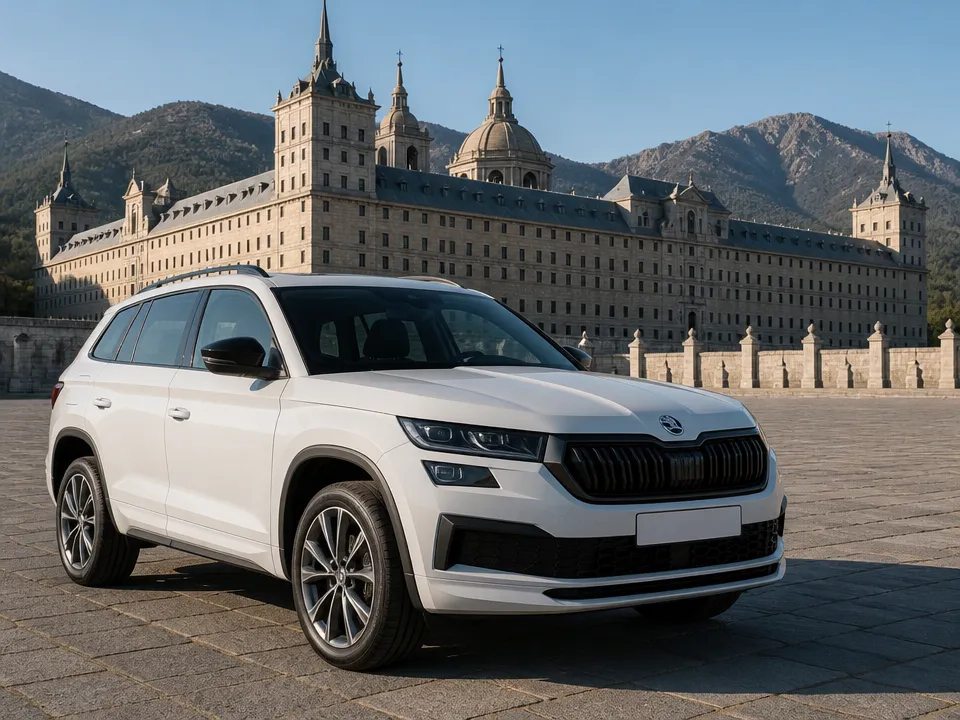
Skoda Kodiaq
★4.6· 32Automatic2.0 L150 hpAll-wheel7 seats
€78per day
Book now









From €78 per day, Škoda car rental in Madrid puts you behind the wheel of a Skoda Kodiaq — a seven-seat, all-wheel-drive diesel SUV with an automatic gearbox. Our fleet on this page is one car in the SUV class, and we deliver it to you in Madrid; the booking is agreed with a manager.
On this page we rent exactly one car: the Škoda Kodiaq, a seven-seat diesel SUV with automatic transmission and all-wheel drive, from €78 per day. It is the only Škoda in our lineup here, so there is no class list to sift through — you either need seven seats and a 2.0-litre engine, or you do not.
Rent-Trip hands over the Škoda Kodiaq — a 7-seat SUV with a 2.0 L, 150 hp diesel engine, automatic transmission and all-wheel drive. The 2.0-litre unit produces 150 hp, which is modest for a body this size, but the torque delivery suits the Kodiaq's job: a full car, a loaded boot and a steady motorway cruise rather than quick overtaking. All-wheel drive is not a decoration on this model. The third row folds flat, so the same car carries seven people on a short transfer or five plus luggage on a two-week trip, and the seating layout is what most families ask about first. All-wheel drive matters on the mountain roads north of the city, where snow can change the surface within an hour.
| Parameter | Value |
|---|---|
| Seats | 7 |
| Fuel | Diesel |
| Transmission | Automatic |
| Drive | All-wheel |
| Engine | 2.0 L, 150 hp |
| Body type | SUV |
Every Kodiaq on this page is diesel, automatic and seats seven. Diesel is the cheaper fuel at the pump here, and on a car that returns diesel consumption figures, a long run out to Segovia or Toledo costs noticeably less than the same trip in a petrol seven-seater. Fill up before you leave the city ring rather than on the motorway itself: the stations along the A-6 and the radial roads price higher than the ones inside the M-30.
We bring the car to you rather than asking you to collect it from a counter, and the booking is agreed with a manager — the delivery point, the time and the hand-over are settled when you book, not from a list on this page. The deposit, the excess, delivery fees and any discount are set out in the rental agreement, and the agreement is where you will find them in writing. Ask for the full figure before you confirm, because that document, not this page, is the one that counts.
One price covers the whole page: the Škoda Kodiaq goes for €78 a day, with longer bookings worked out from that figure. There is no cheaper class to trade down to and no larger one to trade up to — the 7-seat diesel SUV is the only car Rent-Trip offers here.
| Period | Price | How it is worked out |
|---|---|---|
| One day | €78 | The daily rate |
| One week | €468 | Daily rate × 6 |
| One month | €1,638 | Daily rate × 21 |
The weekly figure is the daily rate × 6, not × 7, and the monthly figure is the daily rate × 21 — so a month of the Kodiaq costs about as much as 21 separate days. In our experience, families flying into Adolfo Suárez Madrid–Barajas Airport for a fortnight do better on the weekly line than on fourteen daily ones, because the saving grows with every extra day past the sixth. Anyone planning a month-long stay in Barrio de Salamanca or Las Tablas should ask the manager for the monthly figure rather than renewing week by week.
The deposit, the insurance excess, delivery fees and any discounts are set out in the rental agreement, not on this page. Rent-Trip delivers the car to you, and the booking is agreed with a manager — that conversation is also where the fuel policy, the mileage allowance and anything about an additional driver are settled, because none of those is fixed by Spanish law. Ask for the full figure before you confirm: the agreement is where every extra is written down, and it is the only document that binds both sides. It also lists the environmental sticker fitted to the Kodiaq, which matters the moment you plan a route through the centre.
For a family of six with luggage, the arithmetic is simple — one car, seven seats, one rate. A group that splits into two smaller cars pays two deposits and two sets of fees for the same week, and still has less boot space than the Kodiaq. The trade-off is real, though: a single 7-seat SUV cannot be in two places at once, so if half the party wants Toledo and half wants the Sierra de Guadarrama on the same morning, one of them waits. We usually suggest planning the long drives on separate days instead.
Paperwork is the part of a booking that goes wrong most often, so we keep it plain: what your licence has to be, what you bring to the hand-over, and what is agreed when you book. The rules below are Spain's, not ours to bend.
An EU/EEA licence — including Iceland, Liechtenstein and Norway — is valid in Spain as it is, for as long as it has not expired, and no international permit is needed alongside it. A non-EU licence is valid for driving here as a tourist; anyone who takes up ordinary residence in Spain may drive on it for no more than six months from the date that residence begins, and after that it has to be exchanged. A licence not written in Latin script, such as Cyrillic, Arabic or Japanese characters, is accepted only if it is in Spanish, carries an official translation, or was issued on the Appendix 9 model of the Geneva Convention or Appendix 6 of the Vienna Convention. The Permiso Internacional de Conducción is not a licence on its own — it is shown only together with your national one, and it runs for one year. The DGT advises getting one before you travel, and for Cyrillic or Arabic script that advice is practical rather than optional.
Driving in Spain is allowed from 18 for category B, while companies as a rule start at 21 and some at 23, with at least a year of holding the licence. Ask about the surcharge before you confirm — it is written into the agreement, not into the law, so the figure depends on who you book with.
The deposit, the excess, delivery fees and any discounts are set out in the rental agreement, so we do not put numbers to them here. What we can say is that a Spanish booking always carries the Seguro Obligatorio de Responsabilidad Civil — the compulsory third-party cover, with minimum limits of €70,000,000 per incident for personal injury and €15,000,000 for property damage. The full figure, including every mandatory charge, is agreed with a manager when you book your Škoda car rental in Madrid.
The low-emission zone is the single rule that most often catches out visitors in a hired car, and it applies to the Škoda Kodiaq exactly as it applies to every other vehicle on the road. What follows is how the zone works, what the sticker on the windscreen means, and which driving rules are worth knowing before you leave the city.
ZBE Madrid (Zona de Bajas Emisiones de Madrid) covers all 21 districts of the municipality, and vehicles without a DGT environmental sticker are not allowed in. The category that cannot enter is A — petrol cars registered before 2000 and diesels registered before 2005. The current transitional rule, Ordenanza 2/2026 of 24.03.2026 (new transitional provision seven), applies from 00:00 on 07.04.2026. The Kodiaq we hand over is a current diesel SUV, so it carries a sticker and is not caught by the category A bar. On my side, the practical advice is simple: check the sticker on the windscreen before you plan a route through the centre, because the boundary is administrative, not signposted at every street corner.
The general limits come from article 50 of the Reglamento General de Circulación (RD 1428/2003 as amended by RD 970/2020). In our experience the 30 km/h rule is the one drivers notice most on a first day in the city.
Parking inside the regulated zones is where most of the money goes. SER zona azul allows a maximum of 4 hours, SER zona verde a maximum of 2 hours; both run 09:00–21:00 on weekdays and 09:00–15:00 on Saturday. Holders of the 0 emisiones sticker park under resident conditions. On the motorway side, the ring roads M-30, M-40, M-45 and M-50 and the radial autovías A-1 to A-6 cost nothing, while the radial toll roads R-2, R-3 and R-4 are paid. One detail worth knowing: any discount on a fine is set out in the rental agreement, so if something does arrive in the post, the terms you agreed at booking are the ones that apply.
A seven-seat SUV changes what a family holiday or a long touring week looks like: nobody rides with a bag on their knees, and the third row is there when grandparents or friends join for a day. Below is how the Kodiaq works for both jobs, and what to check before you load it.
The Kodiaq carries seven people, and the third row folds flat when you do not need it. On a two-row day you get a deep, square boot that swallows a folded pushchair, four cabin bags and a cool box without a game of Tetris at the kerb. On a seven-seat day, the two rearmost places suit children or adults on a short hop far better than a full touring stage. With all three rows up, luggage space shrinks to a couple of soft bags, so plan the airport run as a people-first trip and the driving days as a luggage-first one. When you book, tell the manager how many passengers and how many large cases you are bringing — that single detail decides whether the third row stays up or goes down.
A 2.0 L diesel with 150 hp and an automatic gearbox is built for steady motorway hours rather than traffic-light sprints, and all-wheel drive keeps it planted when the surface changes. That combination matters on the mountain roads north of the city, where snow can alter the surface within an hour and where winter tyres or chains are required point by point by signs and overhead panels rather than by a standing seasonal rule. Diesel is also the cheaper fuel at the pump here: Gasolina 95 E5 averages €1.971 per litre across the sample of filling stations, while gasóleo A is the grade this car takes. Fill up before you leave the urban ring — motorway service areas on the radial routes price higher than stations inside the M-30 and M-40.
Day trips out of the city are where the car stops being a family bus and starts being useful: Toledo, Segovia, Ávila, San Lorenzo de El Escorial, Aranjuez and Chinchón, and Alcalá de Henares all sit within a comfortable return drive, and seven seats mean you can take another family along and split the day. The all-wheel drive and the higher seating position help on the older, narrower streets in those towns, and the automatic gearbox takes the sting out of the stop-start stretches on the way in. If your plan is a longer loop rather than a single day out, book it as one continuous hire — the per-day cost drops with the weekly and monthly multipliers, and you avoid re-doing the paperwork mid-trip.
A seven-seat all-wheel-drive SUV opens up the day-trip map around the capital in a way a city car does not. The Kodiaq's 2.0 L, 150 hp diesel and automatic gearbox handle the motorway run out and the hill roads back, and the third row means the whole group travels in one car rather than two.
Snow on the Sierra de Guadarrama changes the surface quickly, and DGT imposes restrictions for cars without winter tyres or chains when conditions demand it, signposted road by road. All-wheel drive helps with traction but does not replace the right rubber — if you plan a mountain pass in the cold months, check the road signs and boards on the way out. The Kodiaq's diesel range also matters here: a full tank covers the longest of these routes and back without hunting for a filling station in the hills.
Book the Kodiaq for the days you actually need it, and let the booking be agreed with a manager so the hand-over fits your itinerary. Two full days cover either two shorter trips or one long one, and the weekly rate at €468 gives you enough room for both. If your plans shift, the agreement is where the details are set out — ask before you confirm. In our experience, travellers who fix the car to a fixed morning departure see more of the region than those who leave the decision to the last hour.
Spanish traffic fines follow the driver, not the car, but while a rented Škoda is registered to someone else, the paperwork lands with us first. When a camera or a patrol records an offence and the driver is not stopped at the roadside, the notice goes to the registered keeper — the company — and we pass it on to the person named in the agreement. That is how the system works here, and it is why the details on your booking matter more than most drivers expect.
The table DGT uses is built on two figures, not one: the posted limit and your actual speed.
| Posted limit | Your speed | Fine | Points |
|---|---|---|---|
| 30 km/h | 31–50 km/h | €100 | 0 |
| 30 km/h | 51–60 km/h | €300 | 2 |
| 30 km/h | 61–70 km/h | €400 | 4 |
| 120 km/h | 121–150 km/h | €100 | 0 |
| 120 km/h | 151–170 km/h | €300 | 2 |
| 120 km/h | 171–180 km/h | €400 | 4 |
The general limits are 120 km/h on autopistas and autovías, 90 km/h on conventional roads outside town, and 30 km/h on a city street with one lane in each direction. Streets built as a single shared platform for cars and pedestrians drop to 20 km/h, while two or more lanes in one direction allow 50 km/h. Going more than 60 km/h over the limit in town, or 80 km/h over it outside, stops being a fine and becomes a criminal offence — a completely different procedure.
If a fine arrives after you have flown home, it does not disappear — it follows the signed agreement, and the deposit is where an unpaid penalty is usually settled. Fines for parking and for unpaid tolls can fall on the owner or the driver of the car, while moving offences, alcohol and drugs fall on whoever was behind the wheel. So the practical step is simple: keep your copy of the paperwork and pay any notice within the 20-day window, because the 50% reduction only exists during it. Ask us to confirm the reference number on the notice if it reaches you through Rent-Trip rather than by post.
Booking a Škoda with Rent-Trip follows one route: you send a request, a manager confirms the model, the dates and the hand-over point, and the car is delivered to you. Nothing is charged on this page and no price is final until the manager has written the agreement out and you have read it.
The manager replies with the Kodiaq's availability for your dates, the total for the period — €78 for a day, €468 for a week, €1,638 for a month — and the terms of the rental agreement. The deposit, the excess, any delivery fee and any discount sit in that agreement, not in the message, so read the document before you accept it. If something in it does not match what you asked for, say so then: it is far easier to change a booking before it is confirmed than after the car is on its way to you.
Booking early helps here more than in most cities. October and May are the two busiest months, and the Kodiaq is the only car we rent on this page, so a single unit is all the availability there is. A request sent a few weeks ahead of a half-term week or a long weekend is a request we can usually meet; the same request sent two days out is a coin toss.
If you are unsure which documents you need, sort that out before you send the request rather than at the hand-over — a missing translation or an expired licence is the one thing that stops a confirmed booking from going ahead.
This page lists 1 car, the Škoda Kodiaq, with 7 seats, an automatic transmission and an SUV body type. Daily prices on this page run from €78 to €78.
The Škoda Kodiaq on this Madrid page has 7 seats. It is listed as an SUV with an automatic transmission, at €78 per day.
Under the DGT rule, third-country licences are valid for driving as a tourist; residents may use them for no more than 6 months from obtaining permanent residence in Spain, after which an exchange (canje) applies. The DGT recommends an international driving permit before the trip.