







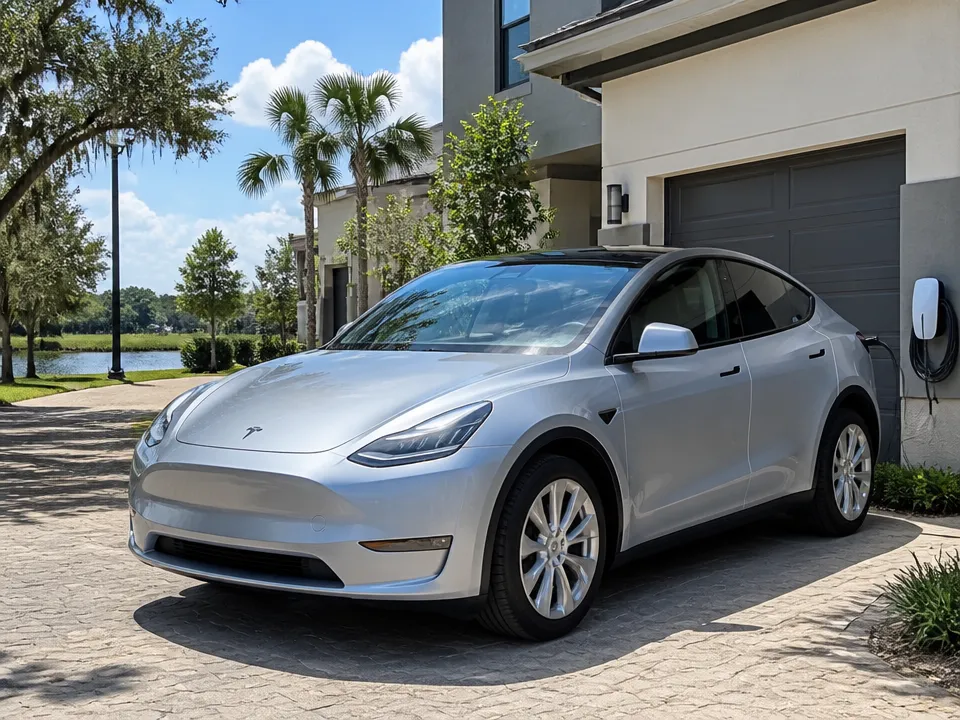










Electric car rental in USA
Electric car rental in USA starts with a simple comparison inside our own fleet: the Chevrolet Equinox EV and Tesla Model 3 both sit at $75 per day, while the Tesla Cybertruck asks $250 — same electric drivetrain, same automatic transmission, three very different trips.
Rent-Trip electric car rental in USA with 8 EVs from $75 a day
Electric car rental in USA with Rent-Trip means eight EVs on one page, from the Chevrolet Equinox EV and Tesla Model 3 at $75 a day up to the Tesla Cybertruck at $250, with weekly rates from $450 and monthly from $1,575. We deliver the car to you, and every booking is agreed with a manager.
What you get with every booking
- Eight electric models: five crossovers, a sedan, an SUV and a pickup truck, four of them Teslas, all automatic and all left-hand drive.
- Delivery to you: the car comes clean with a full charge and goes back the same way, from 1 day of hire.
- One price ladder: $75–$250 per day, weekly from $450, monthly from $1,575, with no lower tier hidden behind a call.
- Charging sorted before hand-over: we set the car up for electronic tolling and show you the range on the dash.
- A manager on the booking: you agree the dates, the delivery point and the model in a chat or on the phone, not through a form.
Why travellers pick an electric car here
An EV suits the way most visitors actually drive. Charging is where the savings hide: level 2 chargers fit an overnight stop, DC fast chargers cover a long drive in one break, and both are cheaper per mile than filling a tank. What we cannot promise is that an EV is cheaper than a gas car on the daily rate alone — the rate is what you compare first, and the fuel you no longer buy is the second line of the sum. On our fleet the spread is wide: 213 hp in the Equinox EV at $75 a day, 670 hp in the Model X at $160, 600 hp in the Cybertruck at $250. On a seven-day booking the weekly rate applies, and a weekly rate costs the same as six days, so the seventh day comes free per day.
Booking is a request, not a checkout
There is no online checkout and no reservation form on this site. You send the dates, the model you want and where you are staying, and a manager confirms the car, the time and the meeting point. The rental agreement is signed in person at hand-over — Florida law requires us to inspect the physical licence and witness the signature, so nothing is signed in advance and a digital licence will not work. Bring the physical card, your passport if you are visiting from abroad, and a bank card in the main driver's name for the security hold. The amount of that hold and the young-driver fee for drivers aged 21–24 are set out in the rental agreement, and prices exclude tax: 6.5% sales tax in Orange County plus the $2-a-day Florida rental car surcharge, added when you pay.
What electric car rental in USA costs with Rent-Trip
Electric car rental in USA with Rent-Trip starts at $75 a day and tops out at $250 for the largest pickup in the fleet. Weekly rates start at $450 and monthly at $1,575, so the longer you book, the less each day costs. The rate you see covers the car, state-minimum liability coverage and a Loss Damage Waiver — tax is added when you pay.
Daily, weekly and monthly rates
We price from $75 a day, with weekly rates from $450 and monthly from $1,575. A weekly booking is charged as six days, not seven, so a seven-day trip brings the effective daily cost down; a monthly booking is charged as twenty-one days. Everything in the fleet is automatic and front- or all-wheel drive, and hire runs from one day, twenty-four hours. Mileage within the state is unlimited, so a long loop through the centre of the state does not change the bill. Daily rates are the yardstick for a short trip, but if your plans run past five days, ask for the weekly figure before you confirm — the difference is usually worth the extra question at booking.
Prices by model and class
Eight electric cars sit on one price ladder, from a $75 crossover to a $250 pickup. Battery size, power and body type all move the number.
| Model | Body | Seats | Battery | Power | Per day |
|---|---|---|---|---|---|
| Chevrolet Equinox EV | Crossover | 5 | 85 kWh | 213 hp | $75 |
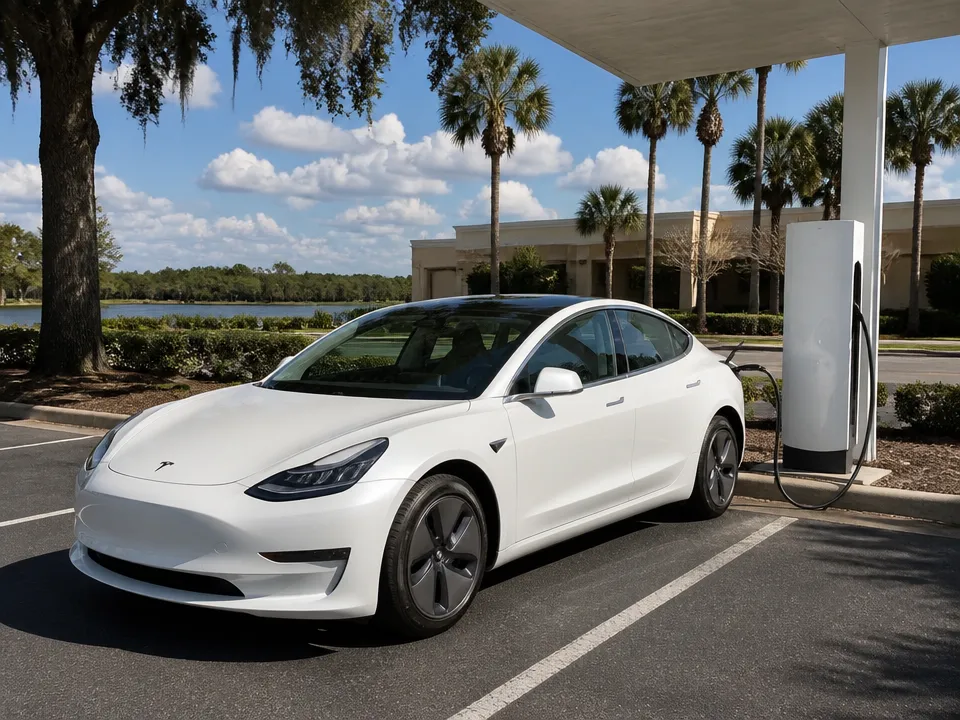
| Tesla Model 3 | Sedan | 5 | 79 kWh | 271 hp | $75 |
| Hyundai Ioniq 5 | Crossover | 5 | 84 kWh | 225 hp | $80 |
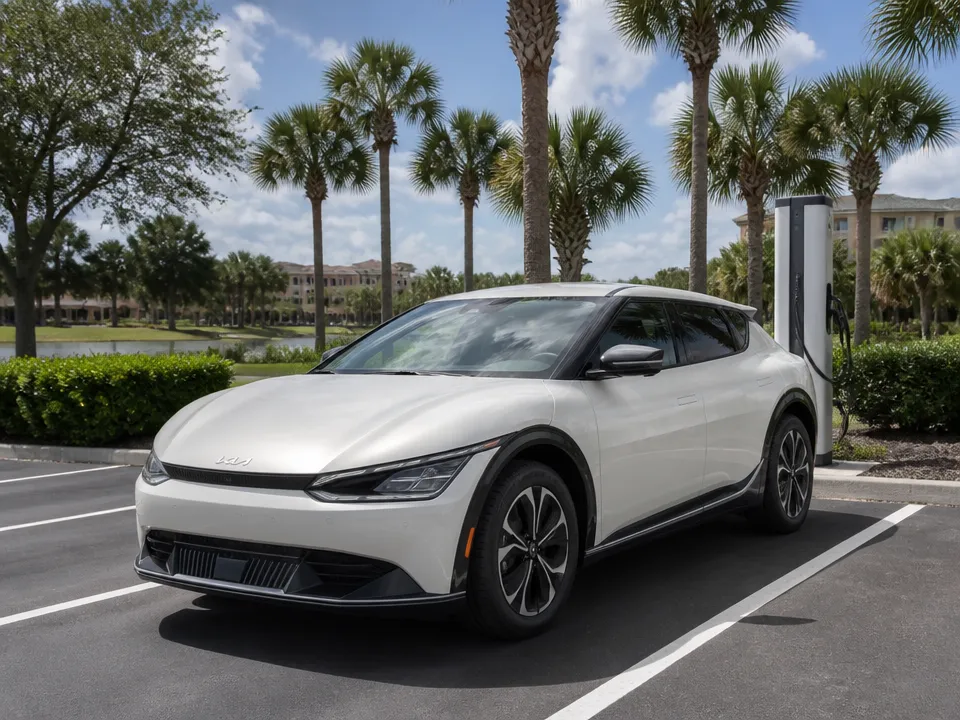
| Kia EV6 | Crossover | 5 | 84 kWh | 225 hp | $80 |
| Ford Mustang Mach-E | Crossover | 5 | 91 kWh | 266 hp | $85 |
| Tesla Model Y | Crossover | 5 | 81 kWh | 384 hp | $90 |
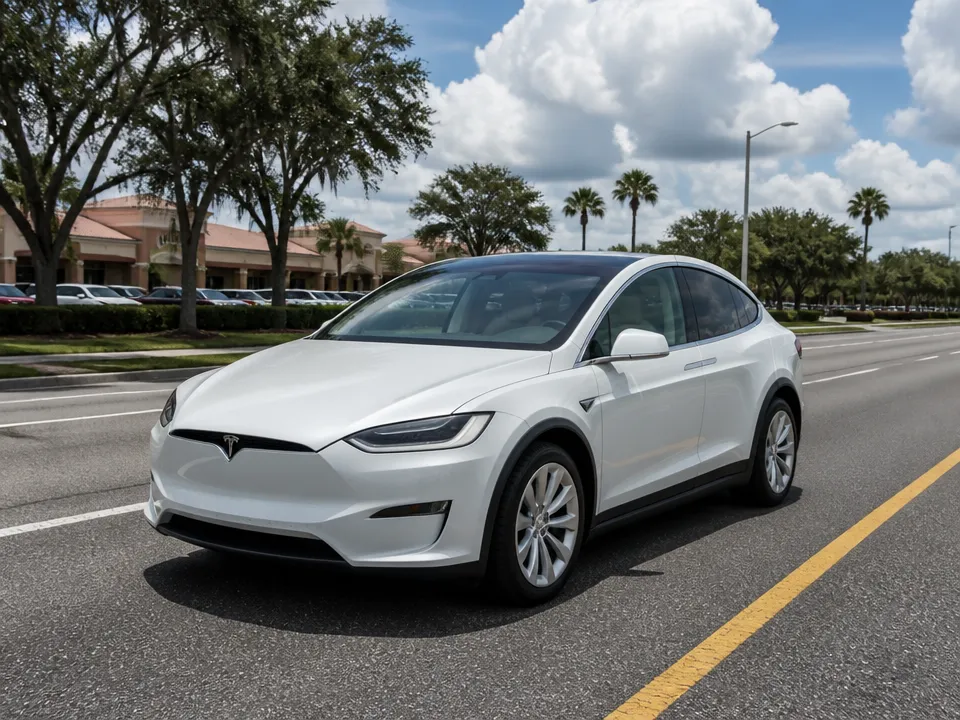
| Tesla Model X | SUV | 6 | 100 kWh | 670 hp | $160 |
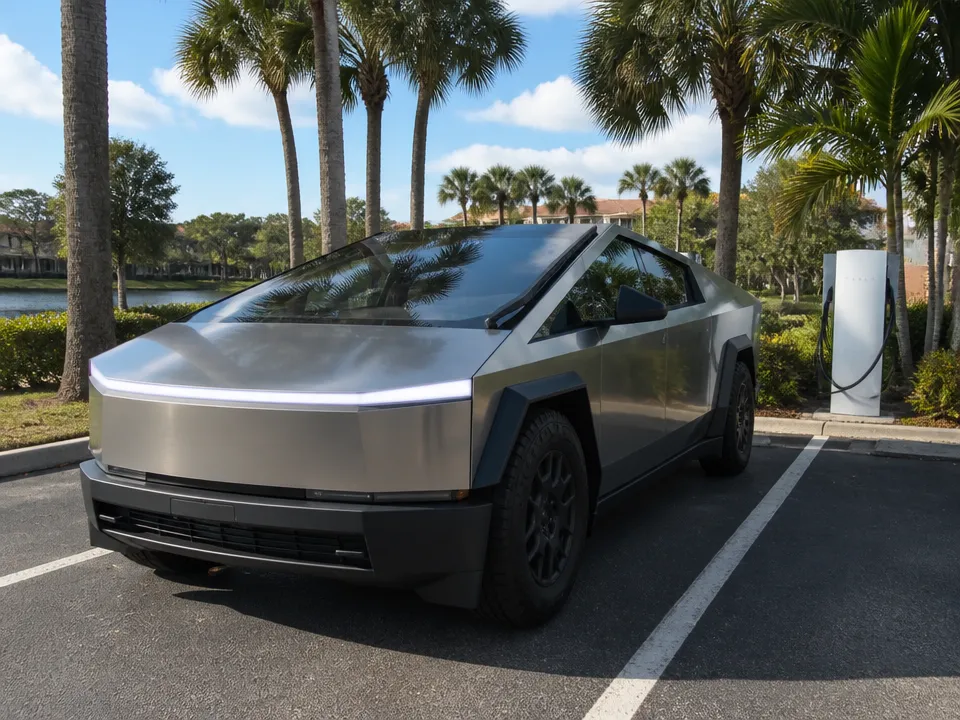
| Tesla Cybertruck | Pickup truck | 5 | 123 kWh | 600 hp | $250 |
Is an electric rental cheaper than a gas car
An EV takes fuel stops out of the trip budget, but the daily rate is still the first number to compare. Electricity is not free on the road: a DC fast charger bills per kilowatt-hour, and the price varies by network and by state, so the charging cost belongs in your plan rather than in the headline rate. What the rate does include is state-minimum liability coverage and the Loss Damage Waiver, and what it excludes is tax — 6.5% sales tax in Orange County and the $2-a-day rental car surcharge, both added when you pay. In our experience the honest comparison is total cost for the days you actually need, not the sticker on one day.
What changes the total
- Trip length: weekly is charged as six days and monthly as twenty-one, so a seven-day booking costs less per day than paying daily.
- Model choice: the ladder runs from $75 for the Equinox EV and Model 3 to $250 for the Cybertruck, with the six-seat Model X at $160.
- Driver age: the minimum age is 21, and drivers of 21–24 pay a young-driver fee whose amount is set out in the rental agreement.
- Tax and surcharge: 6.5% sales tax in Orange County plus the $2-a-day surcharge are added at payment.
- Tolls: the car is set up for electronic tolling, and tolls are re-invoiced as recorded on the terms in the agreement.
Pick the model that matches your longest day, not your shortest — a car that runs short on range mid-trip costs more in charging stops than the upgrade would have.
Electric models you can rent in the USA
Our electric fleet on this page runs to 8 cars — 5 crossovers, a sedan, an SUV and a pickup truck — all automatic and all left-hand drive, with 5 or 6 seats. Every one is a current-generation model, and the price ladder starts at $75 a day.
Tesla models in the electric car fleet
Four of the eight cars are Teslas. The Model 3 is the sedan of the group at $75 a day: 79 kWh, rear-wheel drive, 271 hp, 5 seats. The Model Y is the volume crossover — 81 kWh, all-wheel drive, 384 hp, $90 a day. The Model X is the only 6-seat car on this page and the most powerful of the three at 670 hp and 100 kWh, priced at $160 a day. The Cybertruck is the pickup: 123 kWh, 600 hp, all-wheel drive, $250 a day — the top of our range. In our practice, the Model Y is the one most travellers settle on, because it takes five people plus luggage without stepping up to the $160 tier. If your group is six, though, the Model X is the only car here that fits everyone in one vehicle.
Crossovers, a sedan and a pickup
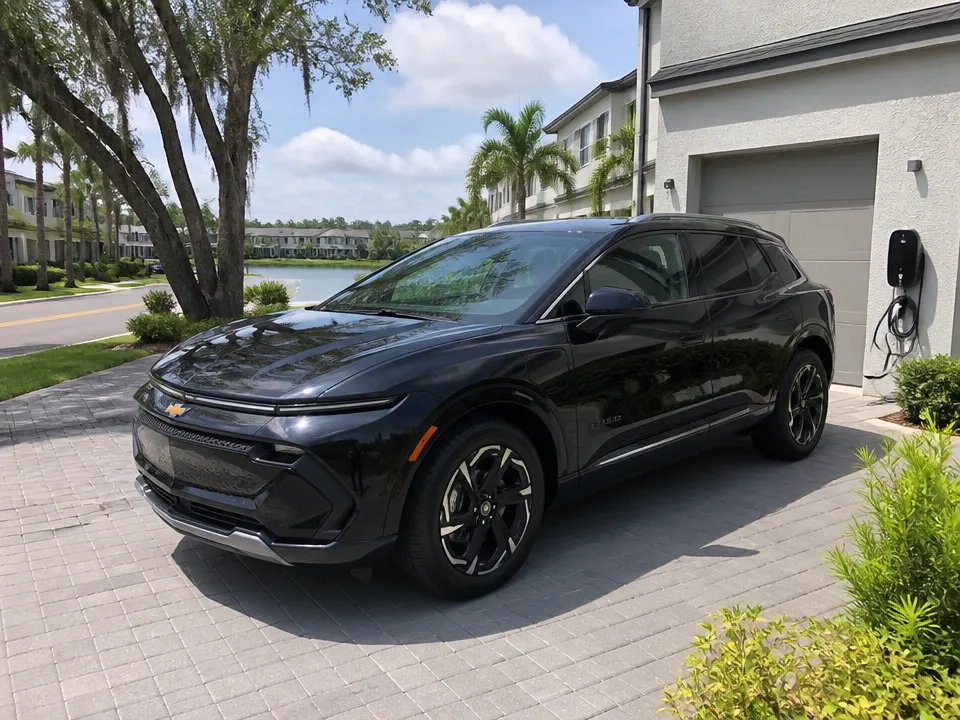
- Chevrolet Equinox EV: front-wheel drive, 85 kWh, 213 hp, 5 seats, $75 a day — the cheapest car on the page.
- Kia EV6: all-wheel drive, 84 kWh, 225 hp, 5 seats, $80 a day.
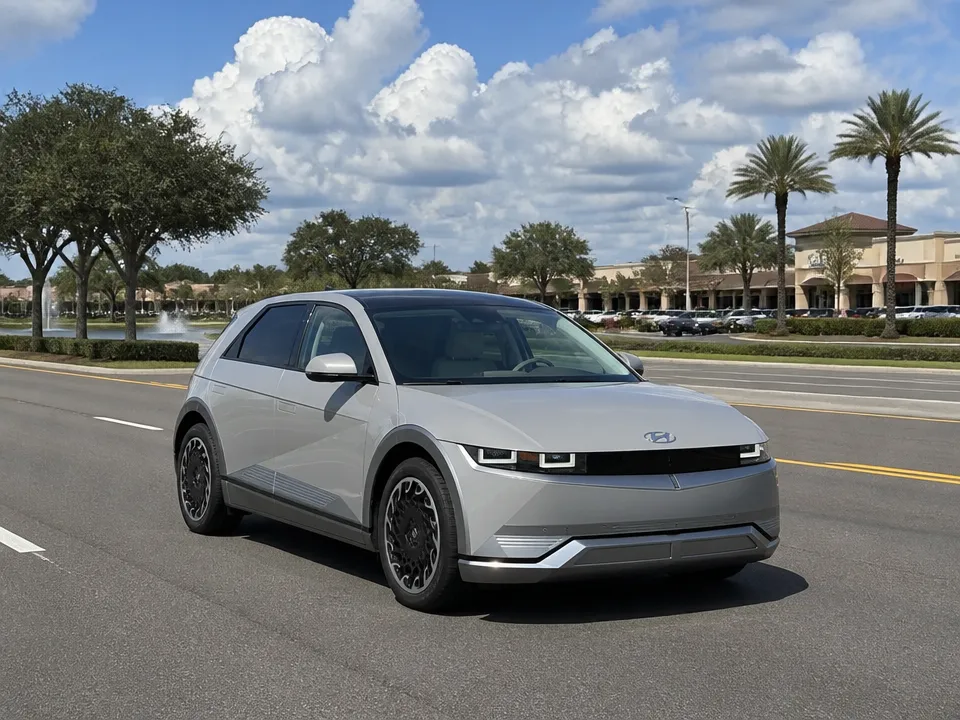
- Hyundai Ioniq 5: all-wheel drive, 84 kWh, 225 hp, 5 seats, $80 a day — same battery and power as the EV6.
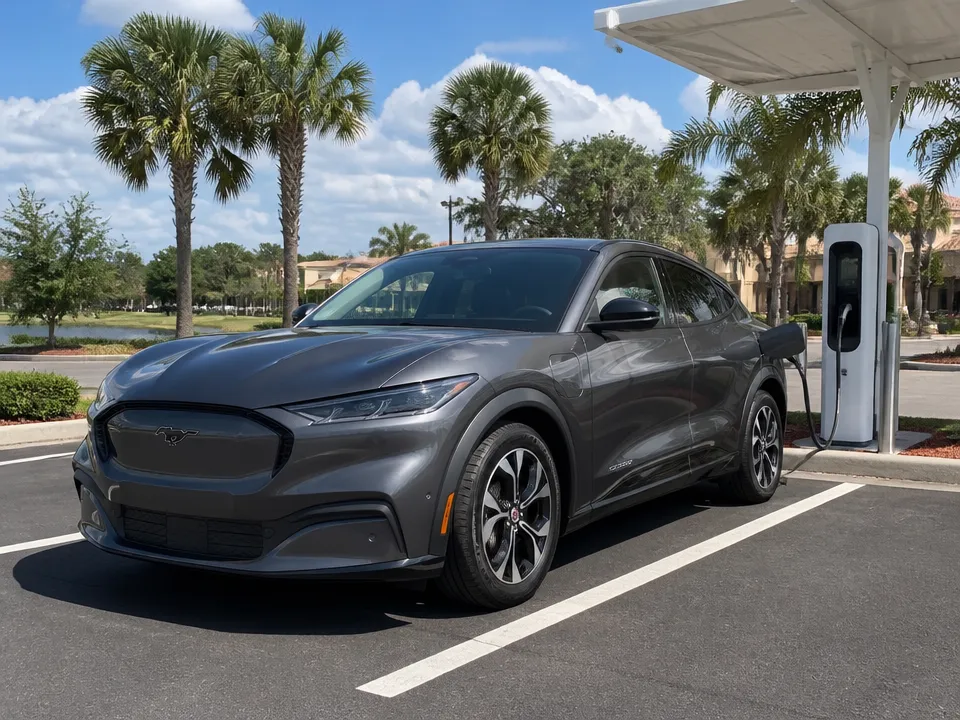
- Ford Mustang Mach-E: all-wheel drive, 91 kWh, 266 hp, 5 seats, $85 a day.
- Tesla Model Y: all-wheel drive, 81 kWh, 384 hp, 5 seats, $90 a day.
- Tesla Model X: all-wheel drive, 100 kWh, 670 hp, 6 seats, $160 a day.
- Tesla Cybertruck: all-wheel drive, 123 kWh, 600 hp, 5 seats, $250 a day.
Battery size and power across the fleet
Batteries run from 79 kWh in the Model 3 to 123 kWh in the Cybertruck, and power from 213 hp in the Equinox EV to 670 hp in the Model X. The five crossovers cluster tightly between 81 and 91 kWh, so the real difference between them is drivetrain and horsepower rather than usable capacity. Front-wheel drive appears once, on the Equinox EV; every other car here is all-wheel drive. Charging speed follows battery size, and the largest packs here also carry the highest daily rate. For a first electric trip, the 213 hp Equinox EV is the value pick — it costs the least per day and still returns a five-seat crossover body. Book the Cybertruck only if you actually need the pickup bed, since it sits at the top of the ladder.
How charging works on a rental EV
Every car on this page leaves the hand-over point clean and with a full charge, and the battery that arrives with it is the one you plan your first day around. The eight electric cars in our fleet carry between 79 kWh and 123 kWh, which is the difference between topping up once on a long day and topping up twice.
Picking up your electric car with a full charge
Rent-Trip hands over each electric car clean and charged to full, so the first leg of your trip needs no charging stop at all. We walk you through the car at hand-over: where the charge port sits, how the connector releases, and how the remaining range reads on the dash. The smallest battery here is the 79 kWh pack in the Tesla Model 3, and the largest is the 123 kWh unit in the Tesla Cybertruck, so the same first day can mean very different numbers depending on the car you booked. Before you pull away, compare the range figure on screen with the distance you have planned for day one — if the plan is longer than the display, charge first rather than hunting for a station on the road. That one check takes a minute at hand-over and saves an hour later.
Where to charge an electric rental car
- Level 2 chargers: the slow ones, found at hotels, shopping plazas and parking garages; a few hours adds a solid amount of range and suits an overnight stop.
- DC fast chargers: the quick ones along highways and near larger retail areas; a stop of roughly the length of a coffee break puts a meaningful charge back in the pack.
- Tesla models: the Model 3, Model Y, Model X and Cybertruck can use Tesla's own fast-charging sites, which are far more numerous than a few years ago.
- Non-Tesla models: the Chevrolet Equinox EV, Hyundai Ioniq 5, Kia EV6 and Ford Mustang Mach-E charge on the open CCS network instead.
- Hotel charging: ask at check-in whether the property has a charger and whether it is free for guests; many bill it separately or not at all.
Plan charging around your meals and your overnight stops rather than around the battery gauge. A fast charger adds range in the time it takes to eat, so a lunch break and a top-up become the same stop — and you never stand next to the car waiting for it to finish.
Range and planning a day's drive
Range depends entirely on the model you booked, and the battery sizes in this fleet run from 79 kWh to 123 kWh, with the biggest pack in the Cybertruck and the smallest in the Model 3. Real-world range is not the same as the number on the window sticker: highway speed, air conditioning and a loaded car all pull it down, and Florida heat means the air conditioning is usually on. Keep a buffer of charge in hand before you reach the next charger rather than arriving on a few miles. On a day that mixes city streets with a long highway run, the car will use noticeably more energy on the highway stretch. If the plan for the day is tight, charge in the morning while the car is cool and the network is quiet.
Charging costs and the practical side
Charging is not free, and it is not included in the daily rate — you pay for the electricity you use, whether that is a fast charger, a hotel charger or a public Level 2 point. Prices vary by network and by location, so treat charging as a running cost of the trip alongside tolls. Some hotels include charging for guests; others bill it to the room, so it is worth asking before you plug in. If you are staying somewhere with a charger on site, an overnight top-up usually costs less than a fast-charge stop on the road. The car is returned with the same charge level it left with, so plan the last charge of your trip before you hand it back. When you book, tell the manager where you are staying — we can point you towards the charging options closest to your route.
What to check before you drive away
- Charge level: confirm the display shows a full charge before you leave the hand-over point.
- Connector type: check whether your car takes the Tesla plug or the open CCS connector, so you know which stations to look for.
- Charging apps: set up at least one charging network app before you set off; most stations need an account or a card on file.
- Route plan: note where the fast chargers sit along your route, and how far apart they are.
- Return level: agree the charge level for return when you book, so there is no surprise at the end.
If anything about charging is unclear, ask at hand-over — the manager walks you through the car and can answer questions about connectors, apps and the chargers nearest your hotel.
Where you can drive an electric rental car
Flat, paved roads are what make an electric rental practical across the state: there are no mountain passes to drain the battery, and every route on this page runs on asphalt. Rent-Trip hands over the car locally, and from there the region opens up in every direction — coast, springs and theme-park corridors.
Day trips from the hand-over point
- Chevrolet Equinox EV and Tesla Model 3: both from $75 per day, 5 seats, automatic, with 85 kWh and 79 kWh batteries — the most affordable way to cover a full day of driving.
- Hyundai Ioniq 5 and Kia EV6: from $80 per day, 5 seats, all-wheel drive and 84 kWh each — a step up in traction for mixed city and highway routes.
- Ford Mustang Mach-E and Tesla Model Y: from $85 and $90 per day, 5 seats, all-wheel drive, 91 kWh and 81 kWh — the middle of the electric range.
- Tesla Model X and Tesla Cybertruck: from $160 and $250 per day, 6 and 5 seats, 100 kWh and 123 kWh — the largest batteries on this page for the longest days out.
What sits around the hand-over point
Phillips are short hops on surface roads.
Driving an EV across the state
Trips to other US states are agreed when booking, and Mexico, Canada and ferries are prohibited under the agreement. Highway speed and air conditioning both pull range down, so on a longer day keep a buffer before the next charger rather than arriving on a low single-digit percentage. In our experience, the flat terrain here is forgiving: a day of mixed city and highway driving rarely costs more than one charging stop, and planning that stop around a meal keeps the trip moving.
Booking your electric car rental in USA
Electric car rental in USA through Rent-Trip starts with a message, not a shopping cart — you write on WhatsApp or call, a manager confirms the model and the dates, and the vehicle is brought to you. Nothing is paid or signed online, because the paperwork is completed face to face when the keys change hands.
What to send when you book
- Model and dates: name the EV you want from the fleet of eight — the Chevrolet Equinox EV at $75 a day, the Tesla Model 3 at the same $75, or the Tesla Cybertruck at $250 — and give the pick-up day plus how many days you need it.
- Hand-over point: the address and exact meeting spot are fixed during the booking, whether that is a hotel, a private address or one of the two airports serving the area, MCO or SFB.
- Driver's licence: the physical card, in the main driver's name — state law requires us to inspect it and witness your signature at hand-over, so a digital licence will not work.
- Passport and bank card: international visitors show a passport, and a bank card in the main driver's name is used for the security hold.
- Extras: child seats and boosters for children under six, and any trip outside the state, are agreed when booking.
What happens at hand-over
We bring the car to you clean and with a full charge, and we walk around it with you before you drive away. The agreement is signed in person at that moment — there is no advance or electronic signing. The car is returned with a full charge, and the hire runs from one day, 24 hours.
Prices exclude tax — 6.5% sales tax in Orange County, plus the $2/day rental car surcharge for the first 30 days — and the amount of the security hold, the young-driver fee for drivers aged 21–24 and the LDW deductible are all set out in the rental agreement.
Weekly and monthly electric car rental in USA for long stays
Electric car rental in USA over a longer stretch changes the maths: a weekly booking is charged as six days and a monthly booking as twenty-one, so the daily cost falls the longer you keep the car. Our fleet here runs 8 electric cars from $75 to $250 a day, with weekly rates from $450 and monthly from $1,575, and every booking is agreed with a manager.
Weekly electric car rental in USA
A weekly booking is charged as six days, so a seven-day trip costs the same as six and the seventh day rides along. On the cheapest car on this page, the Chevrolet Equinox EV or the Tesla Model 3 at $75 a day, that puts the weekly figure at $450 — the same money as six daily rates. Step up the ladder and the weekly rate moves with the model: the Hyundai Ioniq 5 and Kia EV6 at $80, the Ford Mustang Mach-E at $85, the Tesla Model Y at $90, the six-seat Tesla Model X at $160 and the Tesla Cybertruck at $250. Mileage within the state is unlimited on every booking, so a week of driving around does not move the number. If your plans run past five days, ask for the weekly figure before you confirm — that one question is where the saving sits.
Monthly electric car rental in USA
A monthly booking is charged as twenty-one days, which is why the per-day figure drops furthest on a long stay. On the entry cars at $75 a day that puts the monthly rate at $1,575, and the same multiplier applies up the ladder. Long-stay clients are usually the ones who care most about charging, because a month of hotel chargers, fast-charge stops and tolls adds up in a way a weekend never does — ask at check-in whether the property charges guests for electricity, and treat charging as a running cost alongside tolls. The car is returned with the same charge level it left with, so plan the last top-up before hand-back. Trips to other US states are agreed when booking; Mexico, Canada and ferries are prohibited under the agreement.
Long stays and trips beyond the state
- Unlimited in-state mileage: every booking on this page includes it, so a month of driving inside the state does not change the bill.
- Out-of-state trips: agreed when booking, not assumed — say where you are going before you confirm the car.
- Prohibited: Mexico, Canada and ferries are excluded under the rental agreement.
- Charging on a long stay: ask your hotel whether charging is free for guests or billed separately, and plan overnight top-ups rather than daily fast-charge stops.
- Return level: the car goes back with the same charge it left with, so the last charge belongs in your plan.
Electric car rental in USA by trip type and which EV fits
Electric car rental in USA comes down to matching one of 8 cars to the shape of your trip, because the price ladder here runs from $75 to $250 a day and the differences between the models are body type, seats and power rather than fuel. Every car on this page is electric, automatic and left-hand drive, with 5 or 6 seats.
Solo travellers and couples
- Tesla Model 3: the sedan of the group — 79 kWh, rear-wheel drive, 271 hp, 5 seats, $75 a day, and the smallest battery here.
- Kia EV6 and Hyundai Ioniq 5: both all-wheel drive, 84 kWh, 225 hp, 5 seats, $80 a day — the same battery and power in two bodies.
Two people with luggage fit any of these without thinking about it, and the shortest trips on the page — 20–35 miles out of the city — are the easiest on range.
Families and groups of five or six
Tesla Cybertruck: all-wheel drive, 123 kWh, 600 hp, 5 seats, $250 a day — the pickup, and the top of the range.
A group of six has exactly one option on this page, so if that is your party size the Model X is the car to book rather than the car to upgrade to later.
When the pickup truck makes sense
The Cybertruck is the only pickup in the fleet: 123 kWh, 600 hp, all-wheel drive, 5 seats, $250 a day. It carries the largest battery here, which matters on a long highway day, and it has a bed for gear that would otherwise ride in the cabin. It is also the most expensive car on the page by a wide margin — $250 against $90 for the Model Y — so it earns its place only if you actually need the bed or the extra capacity. For a family of five with ordinary luggage, the Model Y does the same job for less. Book the truck for the trip you are taking, not for the one you might take.
What to check in the rental agreement before you drive
The agreement is the document that carries the numbers this page does not: the security hold, the young-driver fee, and the deductible and exclusions of the Loss Damage Waiver. It is signed in person at hand-over, and reading it at the car takes a few minutes and answers most questions on the spot.
Documents to have with you
- Physical driver's licence: the card itself, in the main driver's name — state law requires us to inspect it and witness your signature, so a digital licence will not work.
- Passport: international visitors show one alongside the licence.
- Bank card: in the main driver's name, used for the security hold.
- Home-country licence: a valid licence from your own country is enough to rent and drive here, and an International Driving Permit is not required by state law.
- Translation: if your licence is not in English, an IDP or a certified translation is recommended as a translation for police and insurers, nothing more.
What the agreement covers
- Included in the price: state-minimum liability coverage and a Loss Damage Waiver — the LDW is a waiver, not insurance, and its deductible and exclusions are set out in the agreement.
- Excluded from the price: tax at 6.5% sales tax in Orange County, added when you pay, plus the $2-a-day rental car surcharge for the first 30 days.
- Security hold: taken on a bank card in the main driver's name, with the amount set out in the agreement.
- Young drivers: the minimum age is 21, and drivers of 21–24 pay a young-driver fee whose amount is set out in the agreement.
- Tolls: the car is set up for electronic tolling (E-PASS/SunPass), and tolls are re-invoiced as recorded on the terms in the agreement.
- Tickets: traffic-camera tickets, unpaid tolls and parking tickets are issued to the car owner and re-invoiced to the renter.
Questions worth asking at hand-over
- Charge level: confirm the display reads full before you drive away, since the car is returned at the same level.
- Connector type: check whether your car uses the Tesla plug or the open CCS connector, so you know which stations to look for.
- Charging apps: set up at least one network app before you leave, because most stations need an account or a card on file.
- Child seats: seats and boosters are required for children under six and can be provided — agreed when booking.
- Return time: hire runs from one day, 24 hours, so note the hour you took the car and the hour it is due back.
Delivery and return of your electric car rental in USA
Electric car rental in USA with Rent-Trip is delivered to you rather than collected from a counter: we bring the car to the address you agree when booking, and we collect it the same way. Delivery across Greater Orlando is free, and the exact meeting point is agreed when booking rather than assumed.
How delivery works
- Condition: the car arrives clean and with a full charge, and it is walked around with you before you drive away.
- Paperwork: the rental agreement is signed in person at that moment — there is no online, electronic or advance signing.
- Timing: hire runs from one day, 24 hours, and the hand-over time is fixed when you book.
How return works
- Charge level: the car goes back with the same charge it left with, so plan the last top-up before hand-back.
- Cleanliness: it is returned in the condition it arrived, clean and ready for the next client.
- Tolls and tickets: tolls are re-invoiced as recorded on the terms in the agreement, and any traffic-camera or parking ticket issued to the car owner is re-invoiced to the renter.
- Collection: we collect the car from the same agreed point, so the meeting place for hand-back is settled when you book.
- Extensions: if your plans change mid-trip, speak to the manager rather than simply keeping the car.
Weather and changes to your booking
Outside those conditions, any change to dates or model is agreed with the manager when you book. It is worth knowing this before you travel rather than after: a Florida storm season can move a trip by a day or two, and the rule exists so that a warning does not become a cost. If a warning is issued while you hold the car, contact the manager and the booking is handled under that clause.
Mistakes people make with electric car rental in USA
Most problems with an electric hire come from a handful of avoidable habits, not from the car. The fleet here is 8 EVs from $75 to $250 a day, all automatic, and the trip goes smoothly when the plan matches the battery rather than the other way round.
Range and charging mistakes
- Treating the dash figure as exact: a long highway run with the air conditioning working and a full boot pulls the real figure well under the display, so leave yourself room before the next plug.
- Rolling in on a low single-digit percentage: a morning session while the pack is still cool and the network is quiet beats a late scramble for a free cable.
- Forgetting the connector: Tesla models use Tesla's own fast-charging sites, while the Equinox EV, Ioniq 5, EV6 and Mach-E charge on the open CCS network.
- No app before you set off: most charging points want an account or a card on file, and sorting that out at the post burns the stop.
- Ignoring where you sleep: ask at reception if the building has a plug and whether guests use it at no cost, because an overnight fill normally works out below a fast-charge stop.
Booking and paperwork mistakes
- Turning up with a digital licence: the physical card is required, and Florida law requires us to inspect it and witness your signature at hand-over.
- Assuming an online checkout: there is no reservation form on this site — you send the dates, the model and where you are staying, and a manager confirms the car.
- Leaving the model to chance: a party of six needs the six-seat Model X, the only car here that fits everyone in one vehicle.
- Booking the truck for the wrong reason: the Cybertruck at $250 a day earns its place when you need the bed, not when you want the badge.
- Skipping the agreement: the security hold, the young-driver fee and the LDW deductible are all set out there, and reading it at hand-over takes minutes.
Driving mistakes
- Planning an out-of-state loop without saying so: trips to other US states are agreed when booking, and Mexico, Canada and ferries are prohibited.
- Leaving tolls to sort out later: the car is set up for electronic tolling (E-PASS/SunPass) and tolls are re-invoiced as recorded, so there is nothing to arrange at the booth.
- Driving off paved roads: off-road, beach-sand and unpaved-track driving is prohibited by the rental agreement.
- Forgetting the return charge: the car goes back at the level it left with, so the last top-up belongs in the plan for your final day.