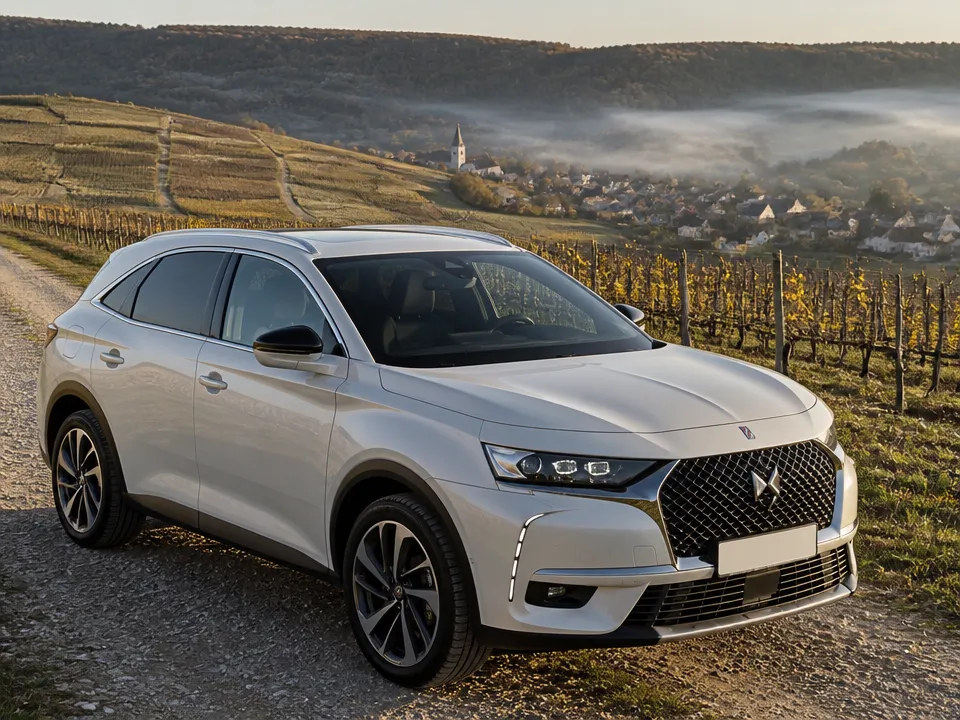
DS 7 Crossback
★4.4· 18Automatic1.6 L225 hpFront-wheel5 seats
€129per day
Book now











A week of Paris errands — the périphérique at rush hour, a meeting at La Défense, a weekend run out to Versailles — goes smoother with a car you don't have to collect. Rent-Trip offers DS car rental in Paris, with 1 DS model on this page: the DS 7 Crossback, a 5-seat hybrid SUV with automatic transmission, from €129 per day. We deliver the car to you, and the booking is agreed with a manager.
DS car rental in Paris with Rent-Trip is one model, not a category: a Premium-class hybrid SUV delivered to your address, with the rate and the booking agreed with a manager.
Rent-Trip offers a single DS model in Paris — the DS 7 Crossback, a Premium-class SUV with 5 seats, hybrid power and an automatic gearbox. It is a 1.6 L unit producing 225 hp through the front wheels, and it is the only car this page carries. That matters more than it sounds. A class-based booking tells you the size of the car you will get and leaves the rest to the counter; here the specification you read is the specification you drive, down to the trim and the drivetrain. We keep the page to one vehicle so that the hybrid SUV you reserve is the hybrid SUV that arrives, with no upgrade lottery and no substitution at hand-over. If your trip turns on a particular body type, seat count or fuel, that certainty is the whole point of booking this way.
Rates for DS car rental in Paris start at €129 per day, with €774 per week and €2,709 per month.
| Model | Class | Seats | Fuel | Gearbox | Per day | Per week | Per month |
|---|---|---|---|---|---|---|---|
| DS 7 Crossback | Premium | 5 | Hybrid | Automatic | €129 | €774 | €2,709 |
Longer bookings are priced as daily × 6 for a week and daily × 21 for a month, so the saving comes from the multiplier built into the rental agreement, not from a seasonal promotion that may or may not be running when you travel. Nothing on this page is a limited offer: the weekly and monthly figures are the arithmetic of the daily rate, and they hold whether you book in a quiet week or in the middle of the summer rush.
The DS 7 Crossback produces 225 hp from a 1.6 L engine and drives the front wheels through an automatic gearbox.
Front-wheel drive with a hybrid drivetrain is the combination that keeps fuel use low in stop-start traffic while still holding motorway speed on the run out of the city. On a car like this, the figure worth watching is not the horsepower but the fuel consumption over a week of short urban trips — that is where the hybrid pays for itself, and where a larger petrol SUV would not.
The practical consequence: because one model means one set of numbers, there is no class upgrade to weigh up and no engine variant to compare. You check the specification once, confirm the weekly or monthly multiplier against your dates, and the rest — the delivery point, the paperwork, the cover level — is settled in a single conversation with the manager before the car reaches you. In our experience that is what people actually want from a premium rental: fewer decisions at the counter, and a car that matches the page.
The city adds two rules that shape any DS hire here: the low-emission zone and the way street parking is charged. Neither is exotic, but both catch drivers who arrive with the keys and no plan.
The ZFE de la Métropole du Grand Paris covers everything inside the A86 motorway, the A86 itself excluded, and it bans Crit'Air 5, Crit'Air 4, Crit'Air 3 and «Non classé» vehicles — the boulevard périphérique and the Bois de Boulogne and Bois de Vincennes sit inside that perimeter. The compliance document is the vignette Crit'Air, a sticker that goes on the windscreen, and without it entry into the zone is formally prohibited. For a hybrid like the DS 7 Crossback the classification is favourable, which is one reason this model suits the city better than a large diesel SUV would. We settle the sticker question with you when the booking is agreed, because the classification depends on the vehicle's first registration date and fuel type, not on the model name alone. The practical point: sort the classification before the car is delivered, not at the first camera on the périphérique, and check the current ZFE calendar, since the restricted classes tighten on a published schedule.
Street parking in zone 1 — arrondissements 1 to 11 — is charged progressively rather than by the hour, and the tariff is a visitor rate in force since 1 August 2021, split into 15-minute blocks.
| Duration | Zone 1 street parking | Notes |
|---|---|---|
| 1 hour | €6 | Billed in 15-minute blocks |
| 2 hours | €12 | Same parking space |
| 3 hours | €24 | Same parking space |
| 4 hours | €39 | Same parking space |
| 5 hours | €57 | Same parking space |
| 6 hours | €75 | Maximum stay on one space |
Beyond six hours on one space the app or the horodateur stops selling you time, so a day of errands means moving the car or using an underground car park. Unpaid parking is not a driving offence but a forfait post-stationnement, 75 € or 50 € for a light vehicle, and it lands on the registered keeper rather than on the windscreen. Tolls are separate: the boulevard périphérique and the city streets are free, while the Duplex A86, the roughly 10 km underground tunnel between Rueil-Malmaison, Vaucresson and Vélizy run by Cofiroute/Vinci, bills class 1 at €8.30 to €13.70 from Rueil to Vélizy on Monday to Thursday depending on the hour, and up to €14.90 on Fridays and the eve of public holidays. That tunnel is the reason a cross-town run to the west can be fast or expensive, depending on when you enter it. Our advice from the hand-overs we do: photograph the parking receipt and keep the ticket in the car, because the 15-minute block means a 20-minute stop is charged as 30 — small, but it adds up over a week of city driving.
DS car rental in Paris runs on French driving rules, and the licence you hold decides what you can do at the wheel. We check this when the booking is agreed with a manager, so the paperwork is settled before the DS 7 Crossback reaches you.
Minimum age, the young-driver surcharge, and the card and passport requirement are not fixed by French law — there is no single national rule, and each company sets its own. That is a measured gap on our side too, so we do not quote a number for it. It is agreed when booking, together with everything else that belongs in your agreement: the deposit, the insurance excess, delivery fees and any discount. Bring the physical documents you will drive on, and confirm the rest with the manager before the car is handed over.
The DS 7 Crossback has a hybrid drivetrain and an automatic gearbox, so there is no manual-gearbox clause to worry about: boîte automatique is the only configuration on this page. What matters is that the licence details you give us match the driver who turns up, because the agreement is drawn up for that person and nobody else.
Every DS booking from Rent-Trip leaves with cover already in the rate, and the question is not whether you are insured but how much of the risk stays with you. French law splits protection into two layers: liability cover that is compulsory and automatic, and damage protection that works against a fixed excess. The deposit and the excess are set out in the rental agreement, so nothing about your exposure is a surprise at hand-over.
The excess is a fixed sum you pay yourself if the car is damaged or stolen, and it is not absorbed over time — it is determined by the level of protection you choose. French companies offer a buy-out: the Medium package brings the excess down, and Premium removes it or reduces it substantially. The exact amount sits in the agreement for your particular booking, and it is agreed when booking. Two honest routes exist. Pay for the buy-out and stop thinking about it, or leave the excess in place and rely on your own card. Visa Premier and Gold Mastercard frequently cover a CDW or TW excess if the booking was paid with that card and the cardholder is the main driver on the agreement — an industry practice, not a promise from a bank, so check your own policy wording before you count on it.
The excess is only ever charged after an état des lieux — the joint inspection of the car at pick-up and at return. Photograph the bodywork, the wheels and the glass at both ends of the trip, in daylight, and keep the images until the deposit is released. A caution, or dépôt de garantie, is blocked on the card for the duration and released when the keys go back, which is why the return inspection matters more than the departure one. Damage that the base cover excludes — a kerbed alloy, a stone-chipped windscreen, a misfuel — comes out of your pocket regardless of the excess level you bought, so the buy-out is not a licence to skip the walkaround. Fuel policy matters here too: on a plein-plein arrangement you collect the car full and bring it back full, and the level is recorded on the same sheet as the damage. If anything on that sheet looks wrong, raise it before you drive away rather than at the end.
The length of your booking changes what the DS 7 Crossback is worth to you: a two-day run to Versailles and back asks something different of a hybrid SUV than a month of Paris errands does.
Book the weekend as two separate days rather than a short week — the multiplier is a weekly figure, not a pro-rata one.
A week of DS car rental in Paris is priced at €774, which is the daily rate of €129 multiplied by 6, and that is the only way the weekly figure is calculated. Seven days of city driving in a hybrid SUV is where the fuel type earns its place: the electric side covers the stop-start stretches on the périphérique and around Le Marais, and the petrol engine takes over on the motorway runs out to Reims or the Loire Valley châteaux. Parking is the cost people forget. Zone 1 street parking runs €6 for the first hour and climbs to €75 at six hours, and the maximum stay on one space is six hours, so a week of errands means moving the car or paying for an underground car park instead. Our advice: plan the week around two or three parking hubs rather than chasing spaces near each stop.
A month of DS car rental in Paris is €2,709 — the daily rate multiplied by 21, and no other multiplier applies. That figure is worth reading against the alternative of renting week by week, because the monthly rate is the one that absorbs a long stay rather than a holiday. A month is also long enough for the ZFE calendar to matter: the restricted Crit'Air classes tighten on a published schedule, so a hybrid classification that is favourable today is the reason the DS 7 Crossback suits a long booking better than a large diesel SUV would. The practical point for a month-long stay: confirm the full duration at booking, since the agreement is drawn up for the period you state, and any further conditions are agreed when booking.
The rate is the easy part — the terms that decide what you actually pay sit in the contract, and they are settled with a manager when the booking is agreed.
Read the excess figure before you decide on a buy-out — it is the one number that changes what a kerbed alloy or a stone-chipped windscreen costs you.
Every DS booking from Rent-Trip leaves with cover already in the rate: responsabilité civile, compulsory under French law, plus CDW and TW in the standard French package, all working against a fixed excess. The rachat de franchise is the paid option that changes that — Medium brings the excess down, Premium removes it or reduces it substantially — and the exact amount for your booking sits in the contract rather than on this page.
A DS car rental in Paris is not only a city tool. The ZFE perimeter ends at the A86, and once you are outside it the DS 7 Crossback turns into a long-distance car: 5 seats, a hybrid drivetrain and a boot that takes a family's luggage.
For a day trip, book the car for the day you actually leave, not the evening before: the rate is per day, and an unused evening is an unused day.
The one habit worth keeping on a day trip: fill the tank before you re-enter the city, because the plein-plein arrangement means the car goes back full, and a fuel stop on the périphérique at rush hour costs more time than the fuel costs money.
One model on this page means one decision, not a class lottery — and the DS 7 Crossback is a Premium-class hybrid SUV, which is a different proposition from the compact cars most people picture when they book a rental.
| Parameter | DS 7 Crossback |
|---|---|
| Class | Premium |
| Body | SUV |
| Seats | 5 |
| Fuel | Hybrid |
| Gearbox | Automatic |
| Drive | Front-wheel |
| Engine | 1.6 L |
| Output | 225 hp |
| Per day | €129 |
| Per week | €774 |
| Per month | €2,709 |
The honest rule from our hand-overs: match the car to the trip, not to the price. A hybrid SUV pays for itself over a week of mixed city and motorway driving; over two days of nothing but short urban hops, a smaller car would do the same job.
Delivery changes the shape of the booking: the car comes to you, and the hand-over point is settled with a manager before the trip rather than at a depot desk.
That is why the return inspection matters more than the departure one: it is the record the deposit is measured against. Keep the fuel level on the same sheet, because a plein-plein arrangement means the car goes back full and the level is written down next to the damage notes. Our advice: settle the return time when you book, not on the last morning, because a late return is a conversation nobody wants at the end of a trip.
A month changes the maths. The DS 7 Crossback is priced at €2,709 per month, which is the daily rate of €129 multiplied by 21, and no other multiplier applies to a long booking.
The pattern we see with long stays is simple: the people who enjoy the month are the ones who decide on two or three parking hubs in the first week and stop treating the car as a taxi substitute.
Most of the friction in a Paris rental comes from four habits, and none of them is about the car itself.
Settle the duration, the excess level and the delivery point in one conversation when the booking is agreed, then drive the car as specified. The DS 7 Crossback is a hybrid with an automatic gearbox and front-wheel drive, which covers the two things that trip people up most in this city — stop-start traffic and the péage — so the remaining risk sits in the paperwork and the parking, not in the driving. And keep the parking receipts: the zone 1 tariff is split into 15-minute blocks, so a 20-minute stop is charged as 30, and over a week that difference is worth knowing about.
This page lists 1 car, a DS 7 Crossback at €129 per day. It is a Premium class DS with 5 seats, an SUV body and an automatic transmission.
EU and EEA licences are valid in France without a time limit, and no exchange for a French licence is needed while the licence is valid.
The ZFE de la Métropole du Grand Paris covers the area inside the A86, including the boulevard périphérique and the Bois de Boulogne and Vincennes. Crit'Air 5, 4, 3 and unclassified vehicles are banned; Crit'Air 3 from 1 January 2025. A Crit'Air sticker is required.