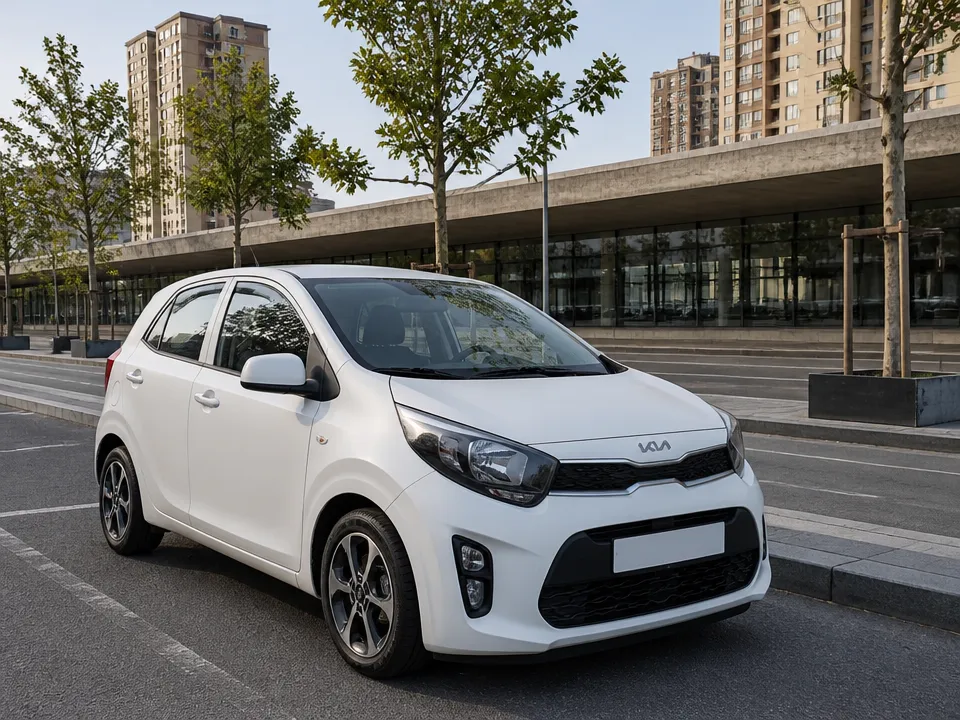
Kia Picanto
★4.9· 58Manual1.0 L67 hpFront-wheel5 seats
€19per day
Book now








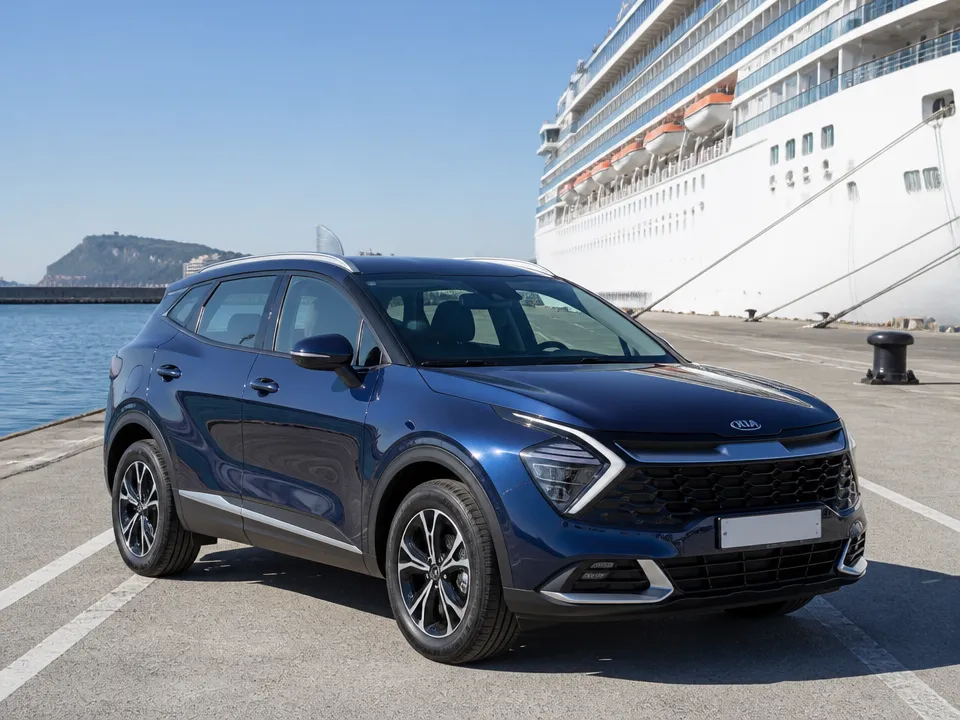




We deliver the car to you anywhere in the city, and the booking is agreed with a manager.
Rent-Trip keeps four Kia models in Barcelona, split across Economy, Comfort and SUV. The pick comes down to three things: how far you are going, how many people are aboard, and whether the road turns to gravel.
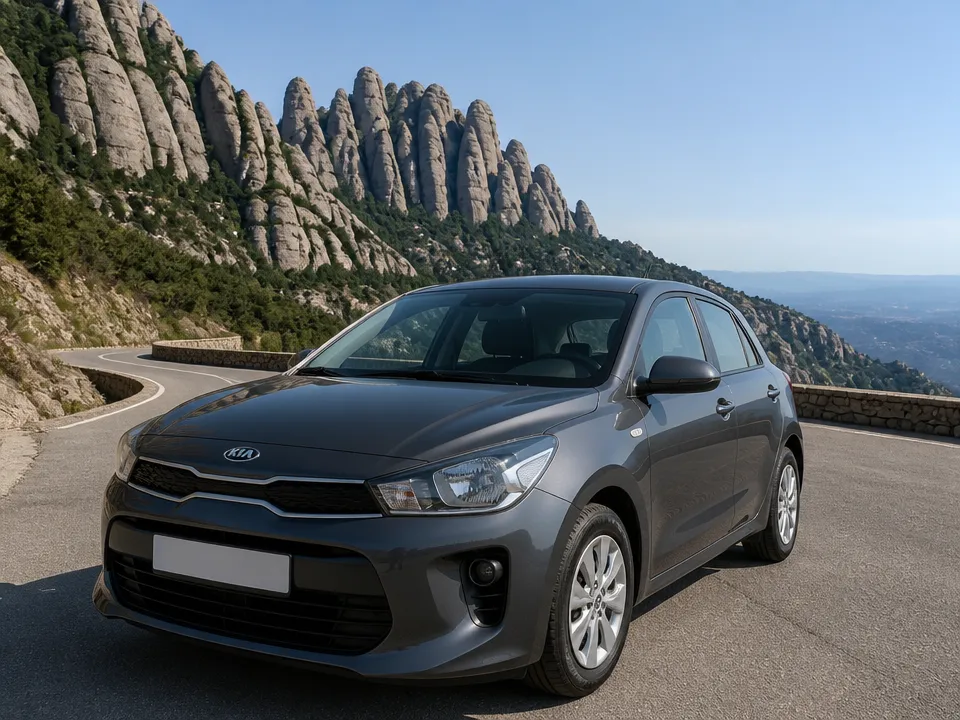
Our two Economy Kias start at €19 a day — Picanto at €19, Rio at €23, both 5-seat petrol hatchbacks with manual transmission. The Picanto carries a 1.0 L engine at 67 hp, the Rio the same 1.0 L block tuned to 100 hp; both are front-wheel drive and both run on petrol. In our local fleet the Picanto is the shortest car we hand over, which is why it comes back most often from Ciutat Vella and L'Eixample, where the streets were laid out long before anyone thought about parking. The Rio is the one to take if three of you are travelling with luggage — its 100 hp makes the merge onto the B-10 and B-20 ring roads calmer than the Picanto's 67 hp. If your week mixes city errands with a couple of motorway runs, the €4 daily gap between them is the cheapest upgrade on this page.
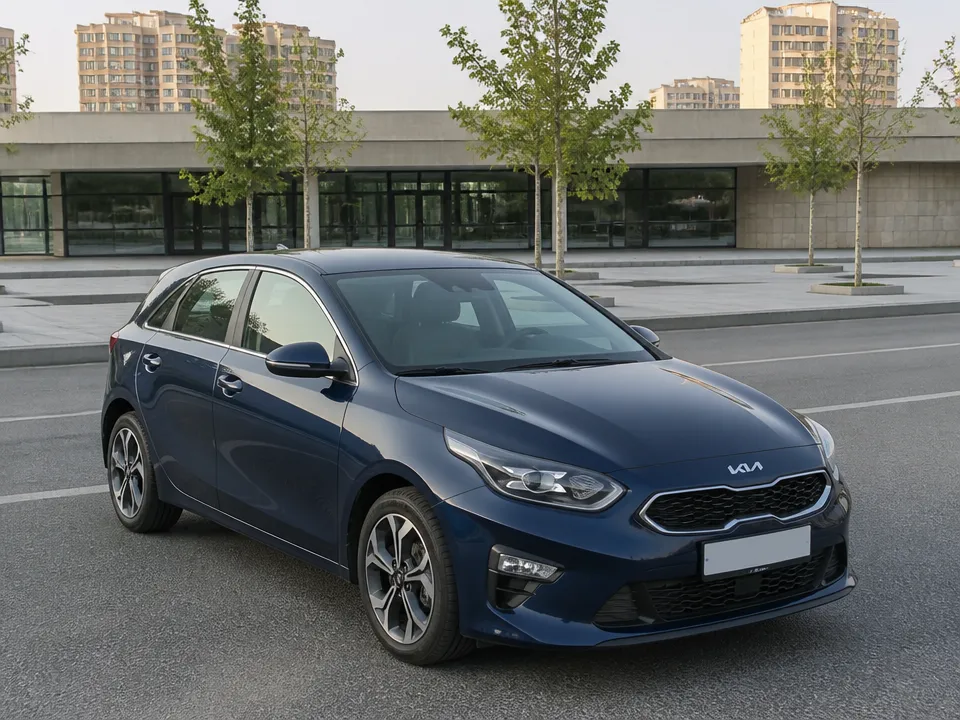
The Comfort Kia Ceed is €41 a day and the SUV Kia Sportage €50, the only hybrid here, with 150 hp from 1.6 L and a choice of front-wheel drive or AWD. The Ceed is a 5-seat petrol hatchback with a 1.0 L engine at 120 hp and manual transmission, front-wheel drive; it sits a class above the Rio without changing the shape of the car. The Sportage is the only model on this page with a hybrid drivetrain, the only one with all-wheel drive, and the only SUV — 1.6 L, 150 hp, 5 seats, manual. For five people plus luggage heading to Montserrat or the Pyrenees, the Sportage's AWD and hybrid drivetrain matter more than the €9 daily gap over the Ceed. On the C-16 towards the Túnels de Vallvidrera and on into the mountains, that is the difference between a car that copes and one that does not.
| Model | Class | Fuel | Power | Price per day |
|---|---|---|---|---|
| Kia Picanto | Economy | Petrol | 67 hp | €19 |
| Kia Rio | Economy | Petrol | 100 hp | €23 |
| Kia Ceed | Comfort | Petrol | 120 hp | €41 |
| Kia Sportage | SUV | Hybrid | 150 hp | €50 |
Match the class to the trip length, not to the price alone — over a week the Ceed can work out cheaper per useful kilometre than the Picanto, depending on what you load into it. All four are 5-seat and manual, so if you need an automatic, say so when booking and we will tell you what is available.
Rent-Trip prices Kia car rental in Barcelona across four cars and three classes, from €19 to €50 per day. Longer terms move the daily figure: a week starts at €114 and a month at €399.
Kia car rental in Barcelona runs from €19 to €50 per day; a week starts at €114 and a month at €399, calculated as daily × 6 and daily × 21. The Picanto sits at the bottom of that range at €19, the Rio at €23, the Ceed at €41 and the Sportage at €50. Those are the only four cars on this page, and every one of them is a five-seater with a manual gearbox — the Picanto and the Rio on petrol, the Ceed on petrol, the Sportage on hybrid. The multiplier is fixed rather than negotiated, which means a long booking scales predictably: three weeks of Picanto is simply €19 × 21, not a number a manager has to approve. What we cannot do is quote you a final figure before the booking is agreed — the deposit and the excess are set out in the rental agreement, and they differ by car.
| Model | Class | Fuel | Power | Seats | Price per day |
|---|---|---|---|---|---|
| Kia Picanto | Economy | Petrol | 67 hp | 5 | €19 |
| Kia Rio | Economy | Petrol | 100 hp | 5 | €23 |
| Kia Ceed | Comfort | Petrol | 120 hp | 5 | €41 |
| Kia Sportage | SUV | Hybrid | 150 hp | 5 | €50 |
The advertised price includes the mandatory Seguro Obligatorio de Responsabilidad Civil, which by Spanish law applies to any car legally on the road and covers injury and property damage to third parties — not the driver and not the car itself. Everything beyond that is a matter for the rental agreement: the deposit blocked on the card, the franquicia you carry if the car comes back damaged, and the optional waivers that reduce it. In our practice the question that decides most bookings is not the daily rate at all but the excess, and the figure is set out in the rental agreement whatever protection level you take. Ask the manager to confirm that figure before you sign, along with any delivery fee — it is agreed when booking, and it is the one number that can move the total more than the class does.
Whether you hold an EU licence or arrive from outside Europe decides how much paperwork surrounds the keys. Spain's rules are national, so they apply identically to every Kia in our fleet, whatever the model or the daily rate.
EU and EEA licences — including Iceland, Liechtenstein and Norway — are fully valid in Spain while unexpired, and nothing extra is needed. A licence from a third country is valid if it is in force, if the holder meets the Spanish age rule for that category, and if less than six months have passed since they took up ordinary residence in Spain. The DGT advises getting a Permiso Internacional de Conducción before travelling; it is a supplementary document, shown only together with your passport and your national licence, and it expires after one year. In our experience the IDP question comes up most from guests who land at Josep Tarradellas Barcelona–El Prat Airport and plan to drive straight out towards Sitges. Sort the IDP at home, not after landing — issuing desks abroad are closed on arrival and a weekend passes before one opens.
A licence that is not in Spanish is valid either with an official sworn Spanish translation or if it was issued to the model of Annex 9 of the Geneva Convention or Annex 6 of the Vienna Convention. For Cyrillic, Arabic and character scripts this in practice means an IDP or a certified translation — the DGT names the Permiso Internacional de Conducción as the alternative to a translation.
Minimum rental age, the young-driver surcharge and the accepted cards are conditions of the rental company, not Spanish law — we confirm ours with you when booking. Two rules do come from the law, though: driving in Spain is allowed from 18 for category B, and the declared price of a rental must already include every mandatory charge, the obligatory Seguro Obligatorio de Responsabilidad Civil among them. One practical note from our own hand-overs: for a Kia Picanto or Rio booked by a driver whose licence was issued less than a year ago, say so at booking rather than at the kerb — it changes what we can confirm before the car leaves.
The city rules that catch visiting drivers are the low-emission zone, the paid parking tariffs and the two tolled tunnels on the north-west edge. None of them changes which Kia you drive — all four of ours are petrol or hybrid and manual — but each one changes where you can go and what a day costs.
The Zona de Bajas Emisiones Rondes de Barcelona (ZBE Rondes BCN) covers more than 95 km² — the whole municipality except the Zona Franca industrial estate and the Vallvidrera – el Tibidabo i les Planes neighbourhood, plus L'Hospitalet de Llobregat, Sant Adrià de Besòs and parts of Esplugues de Llobregat and Cornellà de Llobregat. It operates on working days, Monday to Friday. Access depends on the DGT environmental sticker (distintivo ambiental): 0 emisiones (blue) and ECO (blue-green) are the cleanest categories, and a foreign-plated car needs prior registration in the Registre metropolità de vehicles estrangers i altres vehicles autoritzats a les zones de baixes emissions. Our hybrid Kia Sportage is the model in our fleet that sits closest to this logic, and the petrol Picanto, Rio and Ceed all carry a valid DGT sticker. Ask the manager at booking which sticker your Kia carries — that single detail decides whether the ZBE is a formality or a detour.
The C-16 and the Túnels de Vallvidrera carry the traffic leaving the city towards Sant Cugat and the Vallès, and a passenger car pays €4.7 per crossing. Speed limits matter more than the toll on these roads: an autopista or autovía allows 120 km/h, a conventional out-of-town road 90 km/h, and inside the city the Rondes B-10 and B-20 are capped at 80 km/h unless a sign says otherwise. In town, a street with one lane each way is 30 km/h, two or more lanes in one direction is 50 km/h, and a single-platform street shared with pedestrians is 20 km/h. In our experience the B-20 catches drivers out because it feels like open road while the limit is 80; keep the Ceed or Sportage in a lower gear and watch the overhead signs.
We deliver the car to you and agree every booking with a manager — that is how Kia car rental in Barcelona works with us. Four Kias sit on this page, from €19 to €50 a day, and the hand-over point is confirmed in the same conversation that fixes your dates.
You tell us where you are staying and the manager confirms the hand-over point when booking. Nothing on this page is a promise of a named terminal, address or district — the delivery detail is agreed with the manager, and it is the manager who confirms it in writing before your arrival day. Rent-Trip works this way because a delivered car removes the first hour of a trip: no counter queue, no shuttle, no search for a lot on the ring road. What we do state plainly is the fleet itself: 4 Kias here, 754 cars across the site, all of them self-drive. If your dates are fixed, book early — the Sportage is one car, not a class you can count on twice.
The agreement is signed at hand-over, and before you move off, walk the car with the manager and get every scratch and dent written into the contract or the inspection sheet — both sides sign it and you keep a copy. This is what Spanish consumer rules require, and it is the single step that decides who pays if damage is found later. Fuel follows the lleno a lleno principle: the car leaves full and comes back full, with a filling-station receipt if you have driven under 100 km and a gauge reading of 8/8 if you have driven more. Refuel within 25 km of the return point. On the road, the Kia is covered by the Seguro Obligatorio de Responsabilidad Civil, which is part of every booking by Spanish law and applies even if the driver at the wheel is not named in the contract. Speeding fines here run from €100 to €600 with 2–6 points, and a 50% discount applies if you pay within 20 calendar days. That last point is worth a diary note: the discount window closes fast, and the manager can tell you how the notice reaches you.
Three of the four Kias on this page are built for the roads that leave the city: the Ceed and the Sportage handle the C-16 and the Túnels de Vallvidrera with far less strain than a 67 hp Picanto, and the Sportage is the only model here with a hybrid drivetrain and all-wheel drive. Weekly rates start at €114, so a seven-day booking costs the daily figure multiplied by six.
Leaving the city means paying the Túnels de Vallvidrera on the C-16 toward Sant Cugat and the Vallès — €4.70 for a passenger car. Fuel around the municipality runs at an average of €1.953 a litre for Gasolina 95 E5, with a median of €1.987 and a spread from €1.758 to €2.059 across the 74 stations in the survey. The ZBE Rondes BCN covers more than 95 km² — the whole municipality of Barcelona except the Zona Franca industrial area and the Vallvidrera – el Tibidabo i les Planes neighbourhood — and also takes in L'Hospitalet de Llobregat, Sant Adrià de Besòs and parts of Esplugues de Llobregat and Cornellà de Llobregat, so a day trip that loops back through those towns stays inside the low-emission zone on working weekdays. In our experience the Ceed is the one people come back happiest with after a Tarragona or Penedès day.
The fuel policy on a Kia car rental in Barcelona is agreed when booking, as are the return point and the time. Fill up within a reasonable distance of the hand-back location if your agreement asks for a full tank, and keep the receipt — on short trips under 100 km a station receipt is the cleanest proof, while longer runs are usually read off the gauge. If you are heading for Montserrat or the Pyrenees, tell the manager at booking rather than on the morning of the trip: mountain signage for winter tyres and chains is set point by point on the C-16 and the Túnel del Cadí when snow affects traffic, and that is a route decision, not a last-minute one.
Two things decide what a Kia in Barcelona really costs you at the end: the cover that is already inside the price and the cover you add on top. Spanish law sets one part of it, the agreement sets the other, and the manager walks you through both when the booking is agreed.
Every Kia we hand over carries Seguro Obligatorio de Responsabilidad Civil — compulsory third-party cover that is part of the advertised price and applies whenever the car is on the road, even if the person driving was not named on the agreement. Its legal limits are 70,000,000 EUR per incident for personal injury, however many people are hurt, and 15,000,000 EUR per incident for property damage, under Real Decreto Legislativo 8/2004, article 4.2 as amended by Ley 5/2025, in force since 26.07.2025. What that cover does not touch is the car itself or the driver: damage to your Kia, and anything the driver suffers, sit outside it. That gap is what the optional waivers are for.
Parking tickets and unpaid toll charges fall on the owner or the renter of the car, while moving offences, alcohol and drugs fall on whoever was driving — DGT names both vehículos de alquiler and de renting here until the driver is established. Speed cameras are graded by the DGT table: 100 EUR with no points, 300 EUR with 2, 400 EUR with 4, 500 EUR with 6, and 600 EUR with 6 for the most serious band. Alcohol starts at 0.25 mg/l of breath, 0.15 mg/l for drivers in their first two years, and above 0.60 mg/l it stops being an administrative fine. Paying within 20 calendar days cuts 50% off. In our experience the tolls around the Rondes catch visitors more often than speed does — keep the ticket from the Túnels de Vallvidrera and check it against the agreement before you drop the car back.
The consumer authority requires every scratch and dent to be written into the agreement or the inspection sheet before you leave, signed by both sides, with a copy for you. Do that walk-around with the manager on the Kia you booked, and confirm the excess figure and the deposit in the same conversation — they are the two numbers that decide what a damage claim actually costs you.
This page lists 4 cars. Rates run from €19 to €50 a day: Kia Picanto at €19 per day, Kia Rio at €23 per day and Kia Ceed at €41 per day. All have 5 seats and Manual transmission.
The classes on this page are Comfort, Economy and SUV, and the body types are Hatchback and SUV. The make is Kia. Daily prices here run from €19 to €50.
In the municipality of Barcelona, Petrol 95 E5 averages 1.953 EUR per litre, with a minimum of 1.758 and a maximum of 2.059. Petrol 98 E5 averages 2.085 EUR per litre. The date of the measurement is 2026-09-21.