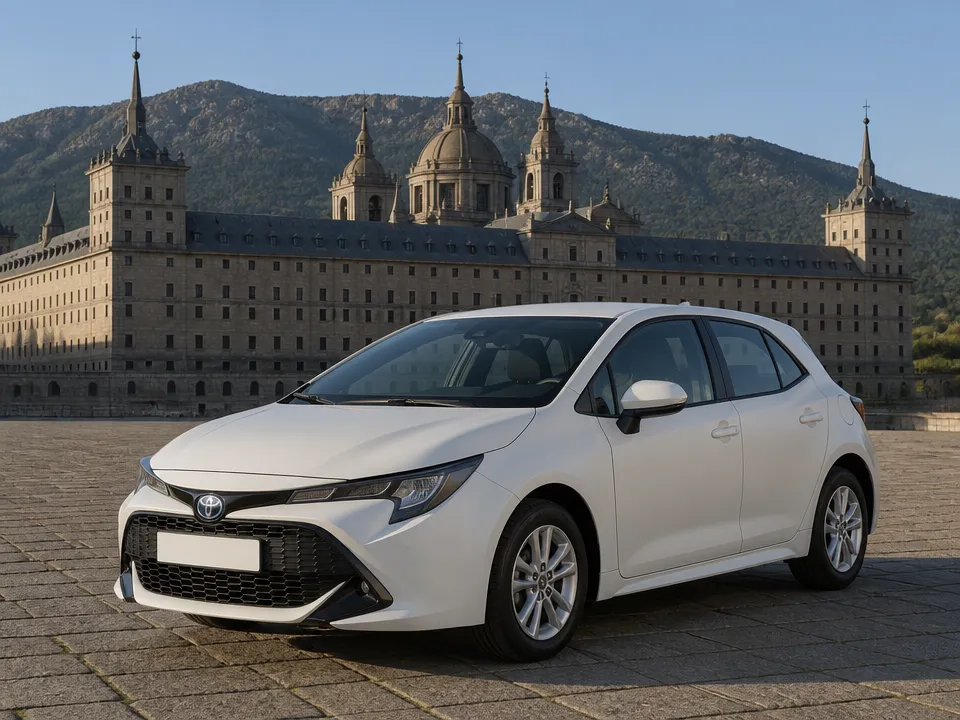
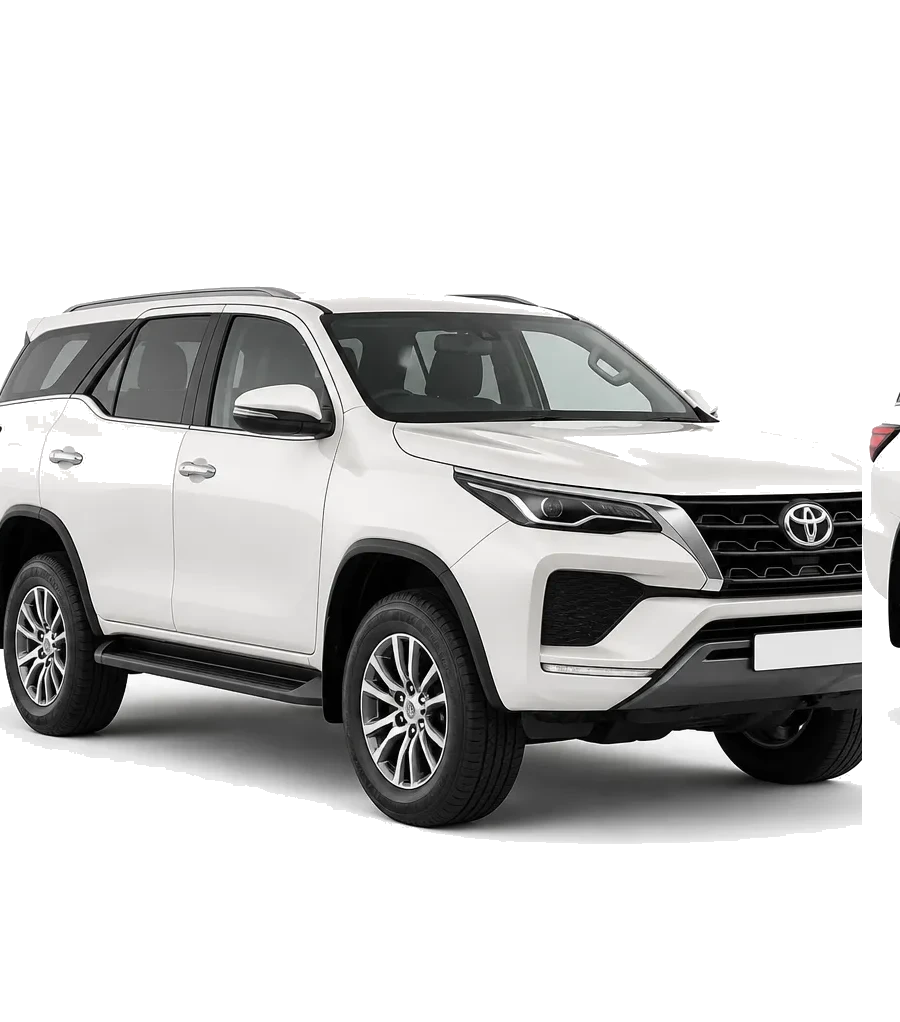
Toyota Corolla
★4.5· 67Automatic1.8 L140 hpFront-wheel5 seats
€60per day
Book now








If you need a hybrid car rental in Madrid, our fleet on this page has 6 hybrid cars, from €23 per day, with weekly rates from €138 and monthly rates from €483. We deliver the car to you anywhere in Madrid, and the booking is agreed with a manager.
A hybrid is less about saving the planet and more about a piece of paper on the windscreen — the DGT environmental label — plus a fuel bill that stays lower in stop-start traffic. All six cars on this page run on hybrid fuel, and that single fact decides where you may and may not drive.
Every car on this page runs on hybrid fuel and carries a DGT environmental label, which is what lets it into ZBE Madrid. The label is issued by DGT, Spain's traffic authority, and grades a car by its emissions: battery-electric and plug-in hybrids get 0 emisiones (blue), conventional hybrids get ECO, and older petrol and diesel cars get C or nothing at all. Our hybrid fleet sits in the ECO band, which is the one that keeps a hire car legal on every street of the municipality. The label is a physical sticker on the windscreen, not a database entry, so it travels with the car rather than with the driver. On our side, we check that each car goes out with its label in place — a vehicle without one is a vehicle you cannot use. If you are handed a car with no sticker on the glass, say so before you drive away.
ZBE Madrid covers all 21 districts of the municipality, and cars without a DGT label — petrol registered before 2000 and diesel before 2005 — cannot enter. Those vehicles fall into Category A, and the zone is enforced by reading the number plate rather than by an officer stopping you, so nothing about the car's origin matters: a foreign plate with no label is caught exactly like a local one. The rules come from Ordenanza 2/2026 of 24 March, whose seventh transitional provision took effect at 00:00 on 7 April. In practice the whole urban street network of the city is inside the zone, which means the question is not whether you will cross it but how often. Check the sticker before you leave the delivery point — once you are moving, a missing label is a fine you cannot argue your way out of.
A petrol car without a label simply cannot be driven into the zone, and since the zone is the city, that removes most of the reason you hired a car in the first place. The alternative is parking outside the boundary and switching to public transport — which defeats the point of self-drive. A hybrid avoids that trade-off entirely: the car is delivered to you and the booking is agreed with a manager, so the label question is settled before the keys change hands. Choose the class from the trip you have planned, not from the daily figure alone.
Six cars, five classes — from a city hatchback to a supercar, and every one of them a hybrid. Nothing on this page burns petrol alone.
| Model | Class | Seats | Transmission | Power | From per day |
|---|---|---|---|---|---|
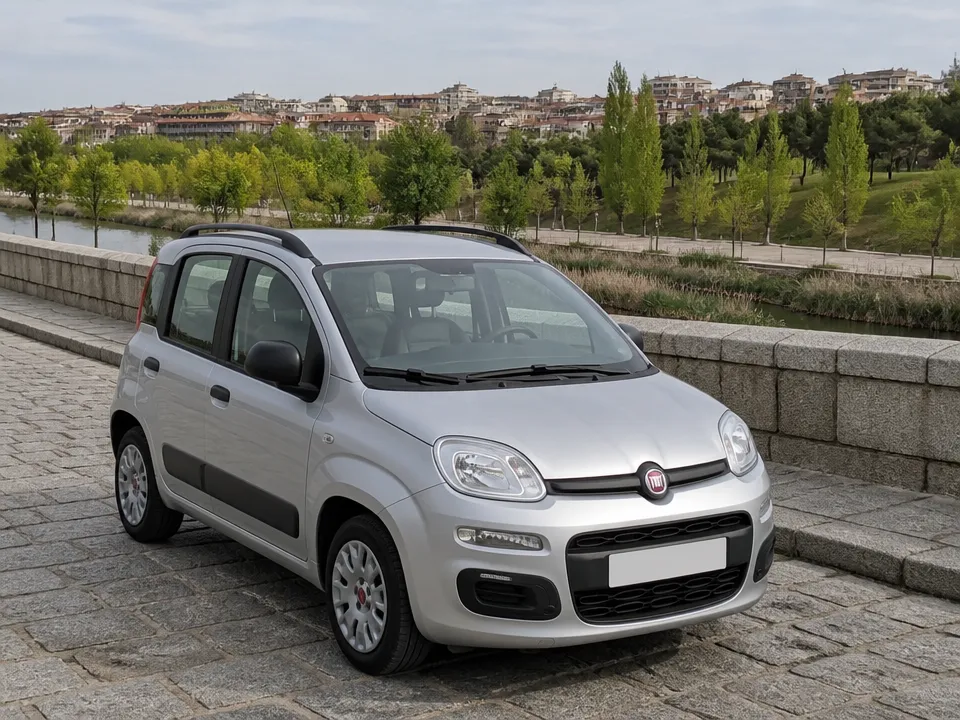
| Fiat Pandina | Economy | 5 | Manual | 70 hp | €23 |
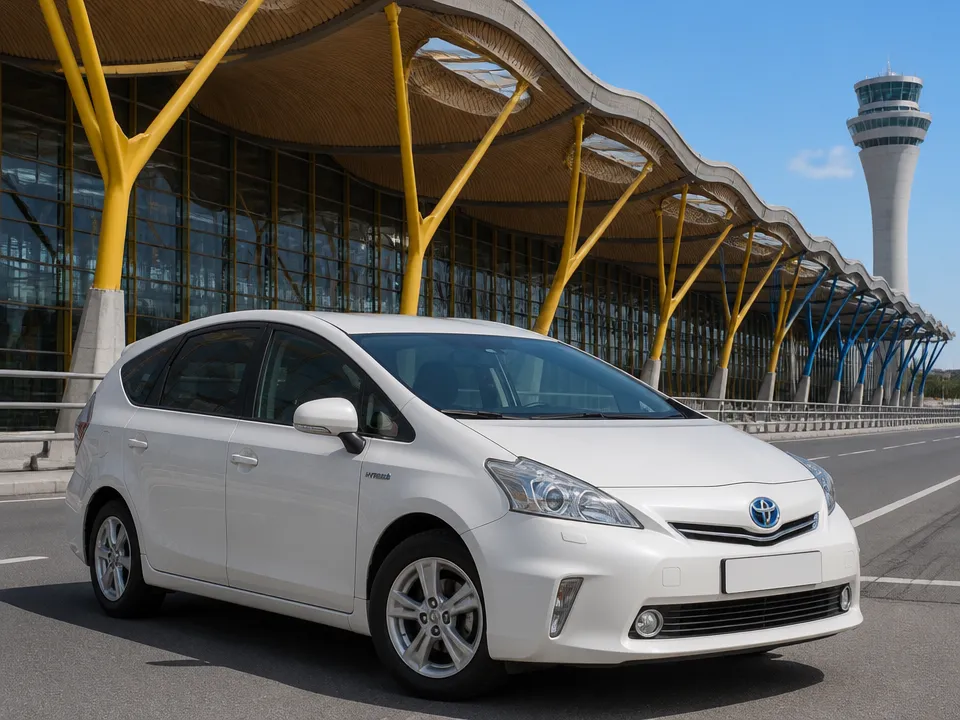
| Toyota Prius+ | Minivans | 7 | Automatic | 136 hp | €58 |
| Toyota Corolla | Comfort | 5 | Automatic | 140 hp | €60 |
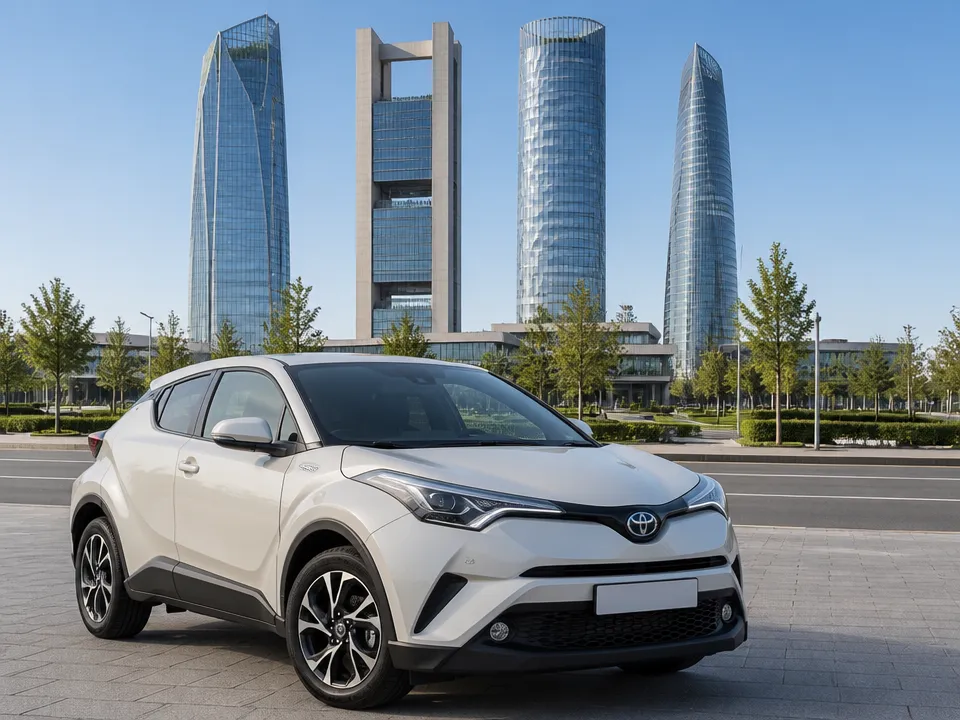
| Toyota C-HR | Crossover | 5 | Automatic | 140 hp | €84 |
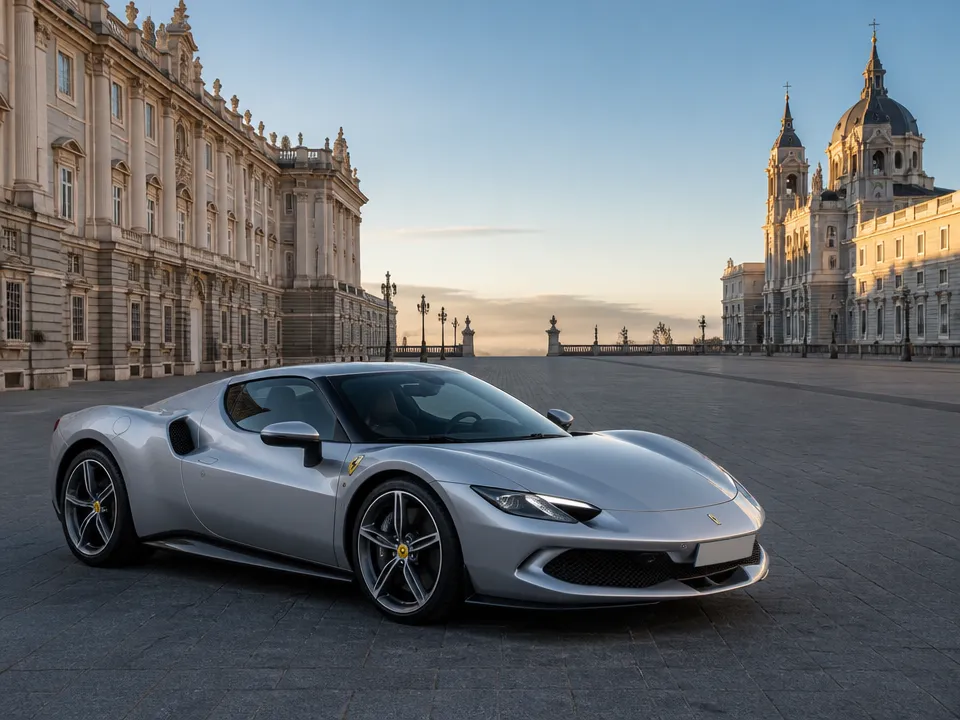
| Ferrari 296 GTB | Exotic | 2 | Automatic | 830 hp | €1,232 |
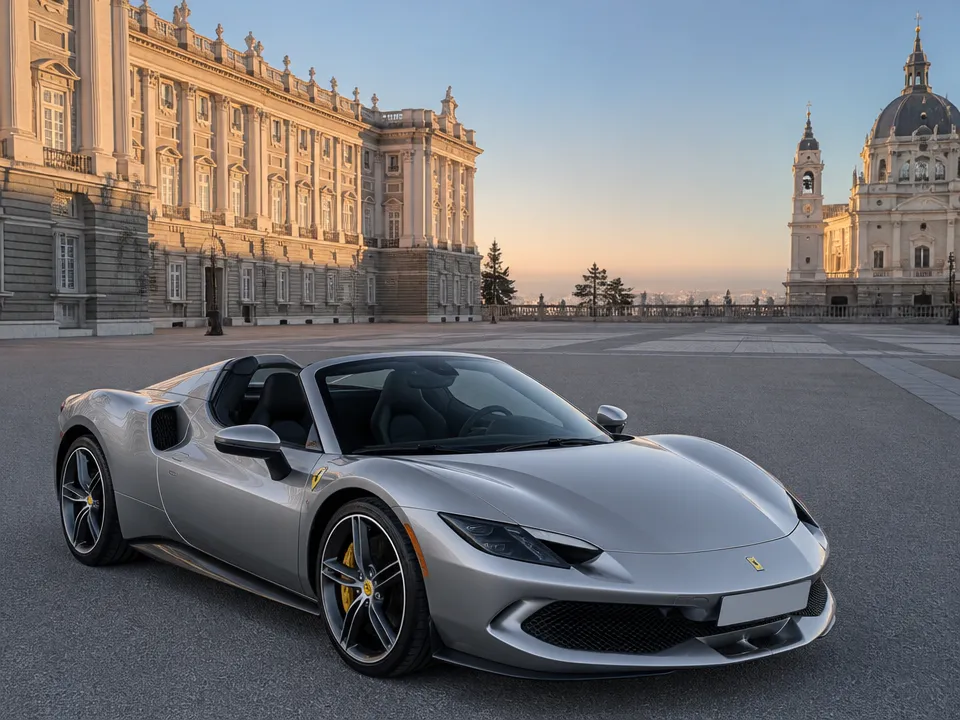
| Ferrari 296 GTS | Exotic | 2 | Automatic | 830 hp | €1,472 |
The Ferrari 296 GTB and 296 GTS are the only rear-wheel-drive cars in our hybrid fleet; the other four are front-wheel drive, which is what you want on wet cobbles around Centro and Gran Vía.
In our practice, a 5-seat hybrid with a proper boot beats a 7-seater for two people plus luggage — the third row in an MPV costs you luggage space you will actually use.
The Exotic class holds two hybrid Ferraris: the 296 GTB coupe at €1,232 per day and the 296 GTS convertible at €1,472 per day, both with 830 hp from a 3.0 L engine. Both are two-seat, rear-wheel-drive cars, and both are automatic. The difference between them is the roof — the GTS folds it away, the GTB does not. A convertible here means dust and sun on a long day out, so the coupe keeps the fixed roof of the two. Either way, the terms for the Exotic class are agreed when booking.
Hybrid car rental in Madrid on this page runs from €23 to €1,472 per day, and the longer you take the car, the lower the daily figure becomes. Weekly and monthly rates are calculated from the daily one: weekly is the daily price multiplied by six, monthly by twenty-one.
| Class | Cars | From, per day | Weekly from | Monthly from |
|---|---|---|---|---|
| Economy | 1 | €23 | €138 | €483 |
| Minivans | 1 | €58 | €348 | €1,218 |
| Comfort | 1 | €60 | €360 | €1,260 |
| Crossover | 1 | €84 | €504 | €1,764 |
| Exotic | 2 | €1,232 | €7,392 | €25,872 |
The spread between the cheapest and the dearest hybrid here is more than sixty times, so the class you pick decides the budget long before the length of the booking does. Economy starts at €23 per day and the two convertibles and coupes of the Exotic class start at €1,232 — the same multiplier applies to both ends. At the bottom of the range, a month in the Fiat Pandina costs less than a week in the Toyota C-HR, which is worth remembering if your stay runs past a fortnight.
The class is the first lever, but not the only one. The Ferrari 296 GTB at €1,232 per day and the Ferrari 296 GTS at €1,472 per day sit in the same Exotic class, and the difference between them is the difference between a coupe and a convertible — same 3.0 L engine, same 830 hp, same two seats. Among the everyday cars the steps are much smaller: €23 for the Fiat Pandina, €58 for the Toyota Prius+, €60 for the Toyota Corolla, €84 for the Toyota C-HR. In our experience the Prius+ and the Corolla are the two that most often get booked for a full week, because €348 and €360 for seven days read very differently from the daily figures alone. Ask the manager to price your exact dates — a booking that crosses a weekend is not always cheaper than one that does not.
A hybrid does not remove the rules of the road — it changes which ones apply to you. Here is what the DGT label, ZBE, the parking meters and the fuel station mean for a hybrid car rental in Madrid.
Every car on this page runs on hybrid fuel and carries a DGT environmental label, and that label is what opens ZBE Madrid to you. ZBE Madrid (Zona de Bajas Emisiones de Madrid) covers all 21 districts of the municipality, so there is no inner core you can slip around. Cars without a DGT label — category A, petrol registered before 2000 and diesel before 2005 — cannot enter at all. Enforcement runs on number plates and cameras, not on an officer waving you through, which is why a foreign-plate car with no label is caught the same way as a local one. Rent-Trip hybrid cars carry the ECO label, so the zone is simply not your problem. Check the sticker on the windscreen before you drive off from the delivery point — that is the one thing on the car that decides whether a camera fines you.
Where you fill up matters more than when, and the hybrid drivetrain is at its best in the stop-start pattern of the centre. The M-30, M-40, M-45 and M-50 rings and the radial A-1 to A-6 motorways cost nothing to use; only the R-2, R-3 and R-4 radial toll roads charge. Speed limits are 120 km/h on autopista and autovía, 90 km/h on a conventional road, and 30 km/h on a city street with one lane each way. On a hybrid, the petrol engine and the electric motor share the work in stop-start traffic, which is exactly the pattern of the centre. In our experience the fuel gauge falls far more slowly on the 1.8 L Toyota models than on the 1.0 L Fiat Pandina once you leave the city.
We deliver the car to you, and the hand-over is agreed with a manager when you book — that is how collection works on every Rent-Trip booking, and it is the same whether you land at Adolfo Suárez Madrid–Barajas Airport or stay in Barrio de Salamanca. The time and the place are settled in the booking conversation, and the manager confirms them with you before the delivery day.
Driving in Spain is allowed from 18, and the rest is agreed when booking. A passport or identity document in the main driver's name, a driving licence and a credit card in that same name are what the agreement is built around. EU and EEA licences are valid in Spain as they are until they expire, with no international permit needed. A licence from outside the EU or EEA is valid only if it is in force, if the holder is old enough for the equivalent category, and for no more than six months after taking up ordinary residence in Spain; if it is not written in Spanish or in the Latin alphabet, you need an official translation or an International Driving Permit. The DGT recommends arranging the international permit before you travel, not on arrival.
Check the label on the windscreen and the fuel level against the agreement, and take the copy of the condition record with you. The label is required on the ZBE Madrid boundary, so a car without one is fined automatically — which is why the label is worth confirming at the kerb before you set off.
Spain requires every car on the road to carry Seguro Obligatorio de Responsabilidad Civil, and that cover sits inside any rental agreement by law. The minimum sums are 70,000,000 EUR per case for personal injury and 15,000,000 EUR for property damage, under Real Decreto Legislativo 8/2004, article 4.2, as amended by Ley 5/2025, in force since 26.07.2025. The hybrid cars on this page run from €23 to €1,472 per day, and every one of them is covered by that policy.
The DGT recommends arranging a Permiso Internacional de Conducción before you travel. Minimum driver age, driving experience, the young-driver surcharge, the cards accepted and the deposit are not fixed by Spanish law — they are agreed when booking, and the terms are set out in the rental agreement.
CDW is an option that removes your liability for damage to the car in a collision with another vehicle or an object, except for the franquicia — the amount you pay yourself. THW does the same for full or partial theft and for vandalism. SCDW and SPCDW buy down part or all of the excess left uncovered by CDW, and they do not apply if CDW was not taken or a CDW exclusion has been triggered. STHW and SPTHW do the same for the theft excess. Glass and tyres normally sit outside basic CDW and are covered by a separate option, WWI.
Spanish consumer rules require the declared price to include every mandatory charge you cannot drive without, and require that scratches and dents be written into the contract or the inspection sheet before you drive away — both sides sign, and you keep a copy. If the model you booked is not available, you may ask for another car at no extra cost, even a class above; if you are given a lower class, the price must come down.
On our side, the hybrid you reserve is the hybrid you get: Fiat Pandina, Toyota Prius+, Toyota Corolla, Toyota C-HR, Ferrari 296 GTB or Ferrari 296 GTS. We deliver the car to you, and the booking is agreed with a manager. Fuel policy follows lleno a lleno — the car is handed over with a full tank and returned full — and the exact terms are set out in the rental agreement.
A hybrid car is the practical choice for out-of-town runs: the electric motor takes the low-speed stretches around town and the petrol engine handles the motorway, so you are not hunting for a charging point on the way back.
Toledo sits about 70 km south of the city on the A-42, Segovia about 90 km north-west on the A-6, and Ávila a further 60 km beyond Segovia. All three are walled or fortified hill towns where the streets inside the old centre are narrow, one-way and largely closed to through traffic — the practical move is to park outside the walls and walk in. Segovia and Ávila sit high on the Meseta, where the temperature drops several degrees against the capital and wind on the aqueduct square is a real thing even in summer. Toledo's old town is the steepest of the three, so if you are travelling with anyone who struggles on hills, park on the ring road rather than trying to get close. Fill up before you leave — the A-42 and A-6 service areas charge more than a gasolinera in the city, and a hybrid's tank will comfortably cover the round trip either way. Check the return time in your booking before you set off; a late return is a conversation with the manager, not a formality.
San Lorenzo de El Escorial is roughly 50 km north-west of the city, and the Sierra de Guadarrama rises directly behind it — the two make one day rather than two. The road up to the Puerto de Navacerrada is where DGT imposes temporary restrictions when snow affects driving, and cars without winter tyres or chains are held at the signs and overhead gantries. That is a winter condition only; on a dry autumn or spring day the same road is open and the views back over the plain are the reason to go. Our hybrid cars are front-wheel drive, which is fine on these roads in normal weather but not a substitute for chains where they are required. In our experience the mountain run is the one day trip where people underestimate the time — the climb is slow, the car parks at the top fill early, and the return in evening traffic on the A-6 takes longer than the drive out. Take the mountain before lunch, not after.
Aranjuez and Chinchón lie south-east, Alcalá de Henares east — all three are under an hour from the centre and none of them needs a full day. Aranjuez is the flat one, with the palace gardens and the river walks, and parking near the palace is straightforward outside peak weekends. Chinchón is small enough to leave the car at the entrance and walk the whole plaza in twenty minutes. Alcalá de Henares is a university town with a compact historic core and several public car parks on the edge of it. These three are the trips to take when you have hired the car for a few days and want to use it without committing a whole one.
Three decisions shape the whole booking: which hybrid class matches your trip, whether you need the car delivered, and what paperwork the agreement will ask of you. Settle those before you reserve, and the hand-over is a short conversation rather than a negotiation.
The class question is easier than it looks. Six of our cars are hybrids, spread across five classes, and the daily rate runs from €23 to €1,472 — so the price tells you almost nothing about which one suits you. Ask what the car has to do. A couple with two suitcases in the centre needs a five-seat hatchback and a boot, not an MPV. A family of six or seven needs the only seven-seater here, the Toyota Prius+ at €58 a day. Anyone driving out to the Sierra de Guadarrama or down to Toledo wants the Crossover, the Toyota C-HR at €84, for the higher seating position and the way it takes the motorway. And if the trip is the point rather than the transport, the two Ferraris are in a category of their own.
Delivery and timing come next. We bring the car to you rather than asking you to collect it, and the booking is agreed with a manager — which means the delivery point, the time and the practical details are settled in that conversation, not picked from a list. In our experience the awkward part is never the car; it is a delivery slot that clashes with a train arrival or a hotel check-in. Give the manager your realistic arrival time, not the optimistic one.
What the agreement will ask of you is the third decision, and it is worth reading before you commit. We do not put figures on them here, because they depend on the class and the booking. If any of it is unclear, ask while you are still deciding — it is a two-minute question before you book and a much longer one afterwards.
This page lists 6 cars, with makes Ferrari, Fiat and Toyota. Classes are Comfort, Crossover, Economy, Exotic and Minivans, with 2, 5 or 7 seats and Automatic or Manual transmission.
Daily prices on this page run from €23 to €1472. Fiat Pandina is at €23 per day, Toyota Prius+ at €58 per day and Toyota Corolla at €60 per day.
Third-country licences are valid for driving as a tourist in Spain. For residents, they are valid for no more than 6 months from obtaining permanent residence in Spain, after which an exchange (canje) applies.