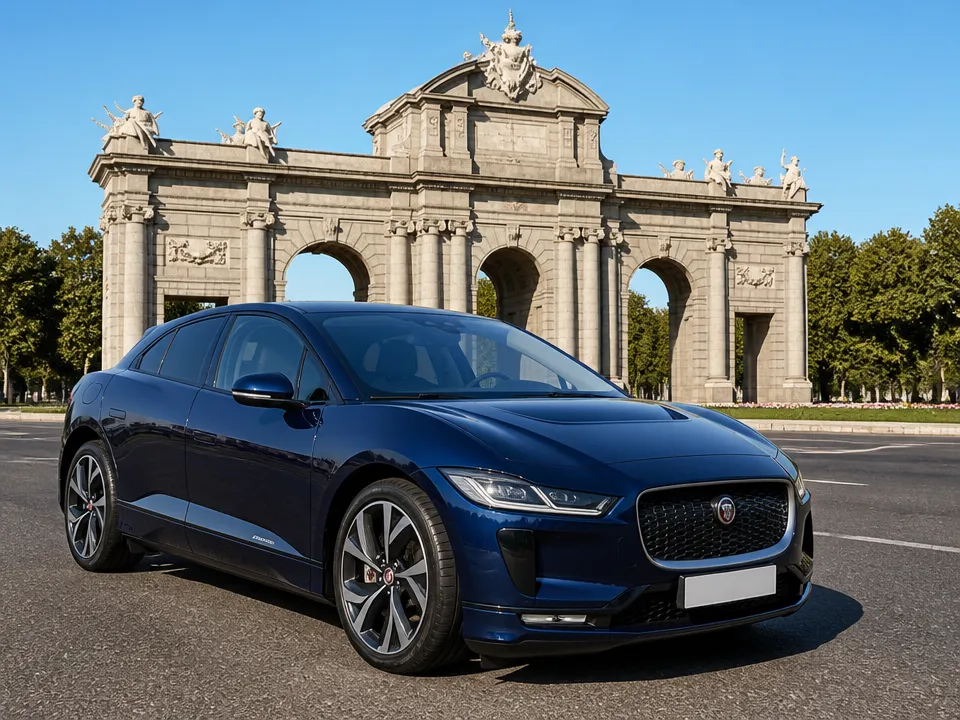
Jaguar I-Pace
★4.7· 42Automatic90 kWh400 hpAll-wheel5 seats
€90per day
Book now










Insurance, delivery and the rental agreement are arranged when you book — Rent-Trip supplies Jaguar car rental in Madrid with one electric model, the Jaguar I-Pace, from €90 per day. The booking is agreed with a manager.
For Jaguar car rental in Madrid we keep one car on this page: the Jaguar I-Pace. It comes to you rather than waiting in a lot, and the booking is agreed with a manager beforehand.
We deliver the Jaguar I-Pace — a fully electric crossover, 5 seats, 400 hp, all-wheel drive, automatic. It is the single model behind this page, and it sits in our Electric class at €90 per day. Two electric motors drive the front and rear axles, so the car pulls away cleanly on wet asphalt and holds its line through the roundabouts on the M-30. The cabin takes five adults with luggage for a weekend, and the automatic transmission means no clutch work in the stop-start traffic of Gran Vía. The 400 hp and all-wheel drive give a reserve you feel on overtakes outside the city, where a two-lane road opens up and the car simply goes. On a straight urban stretch that power is mostly unused — which is exactly why a day in the centre feels calm rather than twitchy.
The booking and the hand-over are agreed with a manager, and the car is delivered to the client. Nothing here is a self-service counter: you tell us when and where you need the I-Pace, we confirm it in the conversation, and the car arrives at the agreed point. That is the whole arrangement on this page — one model, one price, one agreed hand-over.
Agreeing the hand-over point in advance removes the one question that actually costs time on arrival day — where exactly to meet the car. In our experience, a client who has fixed that in the conversation walks out of the terminal and drives, while a client who has not is still messaging about the meeting point. Fix the spot and the time together with the manager, and the first hour of the trip belongs to the road instead of the phone.
The price is one figure because the car is one car: a single Jaguar I-Pace at €90 per day. Longer bookings are counted with two multipliers — daily × 6 for a week and daily × 21 for a month — and nothing else.
| Class | Model | Seats | Fuel | Transmission | Price per day |
|---|---|---|---|---|---|
| Electric | Jaguar I-Pace | 5 | Electric | Automatic | €90 |
| Electric | Jaguar I-Pace | 5 | Electric | Automatic | €540 per week |
| Electric | Jaguar I-Pace | 5 | Electric | Automatic | €1,890 per month |
The deposit, the insurance excess, delivery fees and discounts are set out in the rental agreement. We confirm all four when the booking is agreed with a manager, so the figure you see before you commit is the figure that stands in the contract. Compulsory third-party liability cover is included in any car that may legally be driven on a Spanish road: by Spanish law the minimum is 70,000,000 EUR per incident for personal injury and 15,000,000 EUR for property damage, under Real Decreto Legislativo 8/2004, article 4.2 as amended by Ley 5/2025, with those sums in force since 26.07.2025. Collision damage waiver is a separate option that limits what you owe for bodywork damage, and the excess it leaves with you is printed in the agreement — in our practice, reading that line before signing is what saves the argument later.
Seven days at daily × 6 comes to €540, and twenty-one days at daily × 21 comes to €1,890 — the multipliers we apply to every longer booking, whether it runs across a weekend or covers a full month. Both figures are the same for the whole Electric class, because the I-Pace is the only car we rent on this page. A month of driving is where the arithmetic pays off most: at €90 a day for 21 charged days, the daily equivalent drops to roughly €90 a day across 30 days of use, which is the kind of stretch a project or a long family stay in Madrid tends to fill. If your dates are firm, tell the manager at booking rather than at hand-over — a confirmed window is what fixes the weekly or monthly rate instead of a string of separate daily bookings.
The I-Pace is a battery-electric crossover, so charging is part of the route rather than a separate errand. We hand it over with the charging question already answered, and the rest is planning around your own day.
Public charging in Spain runs from €0.20/kWh (Acciona). The I-Pace takes a DC rapid charge on the CCS connector, and an AC top-up on the Type 2 cable that every hotel garage and shopping-centre bay in the city provides. On a rapid charger the battery goes from roughly a fifth to four-fifths in the time it takes to drink a coffee — the exact figure depends on the charger's output and the battery's temperature, which is why we do not quote a minutes number. In our experience the practical split is one rapid stop per long day out and an overnight AC charge at your hotel for city days. Plan the stop around a meal or a supermarket run rather than as a standalone twenty-minute wait — the two errands together cost you nothing extra.
The I-Pace is a BEV, so a day trip is planned around one charging stop. Toledo and Segovia both sit inside a comfortable there-and-back window on a full battery, and the run up to Sierra de Guadarrama is the one that asks for a top-up — the climb toward the passes burns noticeably more than the descent back gives. The car recovers energy on the way down, so the return leg is the cheap one. A useful habit: charge on arrival at your destination rather than on the way out, because the battery is warm and the charger is free while you walk around. Motorway service areas on the A-1, A-2 and A-6 radial routes all carry rapid points, and the M-30, M-40 and M-50 ring roads are untolled, so your charging detour never adds a toll.
If your route needs a charge and you would rather not think about it, say so when booking — the pickup point, the timing and the hand-over are agreed with a manager, and the rest is set out in the rental agreement.
The city controls access by sticker, not by engine size, and that is the first thing worth knowing before you leave the car park. A Jaguar car rental in Madrid sits in the cleanest band of the system, so the rules that stop older cars simply do not apply to it.
The I-Pace carries the 0 emisiones (blue) DGT sticker and is allowed on all 21 districts of Madrid inside ZBE Madrid. The zone is not a small central ring — it covers every city street of the municipality, all 21 districts, so the sticker decides access rather than the district you are heading to. Cars without any DGT sticker, category A, are the ones the restriction targets: petrol registered before 2000 and diesel before 2005. A battery-electric vehicle sits outside that group entirely. In our practice, drivers ask about the centre as if it were a separate permit area — it is not, and the blue badge settles the question before you turn the key.
Ordenanza 2/2026 of 24.03.2026, transitional provision seven, applies from 00:00 on 07.04.2026. The amendment tightens enforcement inside ZBE Madrid and keeps the same dividing line: the sticker on the windscreen, not the age of the driver or the purpose of the trip. What matters for a Jaguar car rental is that the vehicle already meets the highest band, so no additional registration or paperwork is triggered by the change.
The sticker also pays off at the meter. SER zona azul (blue) allows a maximum of 4 hours and SER zona verde (green) a maximum of 2 hours, with charging running 09:00–21:00 on weekdays and 09:00–15:00 on Saturday. Any reduction on resident season tickets is set out in the rental agreement. The rings M-30, M-40, M-45 and M-50 and the radial A-1 to A-6 motorways cost nothing to use; only the R-2, R-3 and R-4 radials are tolled. Check the sticker before you plan a route rather than after — a car without one cannot be driven into the zone at all, whatever the destination.
The rules are set by the municipality, not by us, so it pays to know them before you leave the car.
| Zone | Maximum stay | Who it favours |
|---|---|---|
| SER zona azul (blue) | 4 hours | Short errands and visitors |
| SER zona verde (green) | 2 hours | Residents and long stays |
Both zones are metered from 09:00 to 21:00 on weekdays and from 09:00 to 15:00 on Saturdays. Outside those hours, and on Sundays, street parking in the regulated area is not charged. The blue zone gives you double the time of the green one, which is why it is the better pick for a museum visit or a long lunch in the centre.
A car carrying the 0 emisiones DGT sticker parks at a 75% discount in the SER zones. The Jaguar I-Pace qualifies for that sticker as a battery-electric vehicle, so the meter charges a quarter of the standard rate — and the same 75% reduction applies to residents' season permits. Keep the receipt, and check the terms of your ticket, which are set out in the rental agreement.
An unpaid SER ticket is a fine, and in the busiest streets the grúa can take the car away. Because the I-Pace is a BEV with the 0 emisiones sticker, it sits outside the restrictions that catch older petrol and diesel cars, so a parking mistake never turns into an access problem inside ZBE Madrid. My advice: photograph the bay and the meter display before you walk away. In our experience, that single photo settles most disputes about which zone you were in.
Spain does not treat a licence from an EU or EEA country as a foreign document, and the Jaguar I-Pace is an automatic, so no gearbox adjustment is needed. What matters far more is the environmental sticker on the windscreen and the paperwork the agreement itself requires.
The remaining conditions of the hire are agreed when booking. Compulsory third-party cover (Seguro Obligatorio de Responsabilidad Civil) is a different matter: under Spanish law it comes with every hire by default and applies even when the driver at the wheel was not named in the contract. The statutory limits are €70,000,000 per incident for personal injury and €15,000,000 per incident for property damage.
Collision Damage Waiver is an option rather than a given: it removes the renter's liability for damage to the car after a collision with another vehicle or an object, except for the excess (franquicia), and vandalism outside the period of use is excluded. The excess is printed in the agreement whether or not you buy the waiver, and the amount depends on the company and the vehicle class — there is no single official figure. The remaining conditions of the hire are agreed when booking.
Speed limits for a passenger car are 120 km/h on autopista and autovía, 90 km/h on an ordinary rural road, and 30 km/h on a city street with one lane in each direction — with 20 km/h on single-platform streets and 50 km/h where there are two or more lanes each way. Exceeding the limit in town by more than 60 km/h, or by more than 80 km/h outside it, stops being an administrative fine and becomes a criminal offence. The alcohol limit is 0.25 mg/l of breath for most drivers and 0.15 mg/l for novices in their first two years and for professional drivers; above 0.60 mg/l it is a crime. A phone held in the hand costs €200 and six points, and the same €200 with four points applies to seat belts and child seats. Child restraints are compulsory for anyone 135 cm or shorter, and the DGT recommends them up to 150 cm. Winter tyres are not a permanent requirement in Spain — DGT restricts specific roads, sign by sign, when snow affects driving, which here means the mountain roads of the Sierra de Guadarrama. Fines are graded leve (up to €100, no points), grave (€200) and muy grave (€500), with a 50% reduction for payment within 20 days.
Because the I-Pace is a BEV, the sticker and the plug are connected: the 0 emisiones (blue) DGT badge is what lets the car onto all 21 districts inside ZBE Madrid, and public charging in Spain runs from €0.20/kWh (Acciona).
The I-Pace is a BEV, so a day out is planned around one charging stop rather than a fuel station. That single stop is what decides which of the day trips out of the city actually fit into a day.
The I-Pace is a BEV with 400 hp and all-wheel drive, and the mountain roads towards Sierra de Guadarrama climb steadily — consumption on the way up is higher than on the way back down, where the car recovers part of it. Plan the uphill leg with the bigger margin and treat the descent as a bonus, not as a reserve. A round trip to El Escorial or Segovia leaves far less room for a detour than a flat run to Aranjuez does, and adding a second stop on the same day is what turns a comfortable trip into a tight one. In our experience the mistake is not the distance — it is the extra 20 km of wandering at the far end.
Public charging in Spain starts at €0.20/kWh (Acciona), and the rate you pay depends on when you plug in — demand is lower outside the busiest hours, so pairing the stop with a coffee break costs less than charging in a hurry at a motorway services at midday. Charging points are spread along the main corridors out of the city, so the practical rule is to charge where you are already stopping rather than to drive out of your way for a cheaper point.
The 0 emisiones (blue) DGT sticker on the I-Pace opens all 21 districts of Madrid inside ZBE Madrid, and it is equally valid beyond the city boundary — the low-emission zone is a local rule, not a regional one. Further out, the mountain roads towards Sierra de Guadarrama are the ones where DGT imposes temporary restrictions for cars without winter tyres or chains when snow affects traffic, sign by sign and road by road. A BEV with the blue sticker sits outside the sticker-based restrictions entirely; the snow rule is about tyres, not about emissions. If a route is closed by weather, the alternative is agreed with a manager when booking.
This page lists 1 car: the Jaguar I-Pace, an Electric Crossover with 5 seats and Automatic transmission. Daily prices on this page run from €90 to €90.
Rental cars with Spanish plates carry a C, ECO or 0 sticker, so the ZBE Madrid restriction does not apply to them. Distrito Centro has its own rule for cars with a C sticker.
Public charging in Spain ranges from 0.20 EUR per kWh with Acciona up to 22 kW, to 0.95 EUR per kWh with Total Energies up to 100 kW. Ionity at 350 kW is 0.65 EUR per kWh without a subscription.