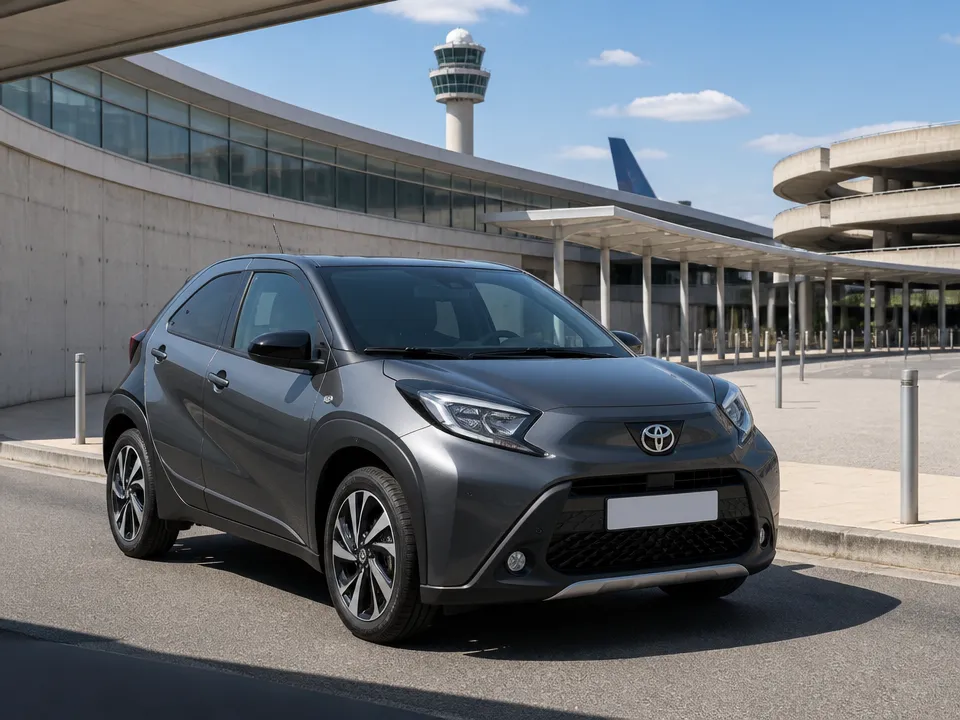
Toyota Aygo X
★4.7· 81Manual1.0 L72 hpFront-wheel5 seats
€39per day
Book now












Insurance, delivery and the rental agreement are handled by Rent-Trip, with three Toyota models available for self-drive hire in Paris from €39 per day. Choose the Toyota Aygo X, the Yaris Cross or the Corolla Hybrid, and we bring the car to you anywhere in the city — the exact meeting point and hand-over time are agreed with a manager when you book.
Our fleet holds three Toyotas: the Aygo X, the Yaris Cross and the Corolla Hybrid. All three seat 5, all three are front-wheel drive, and each one covers a different kind of trip.
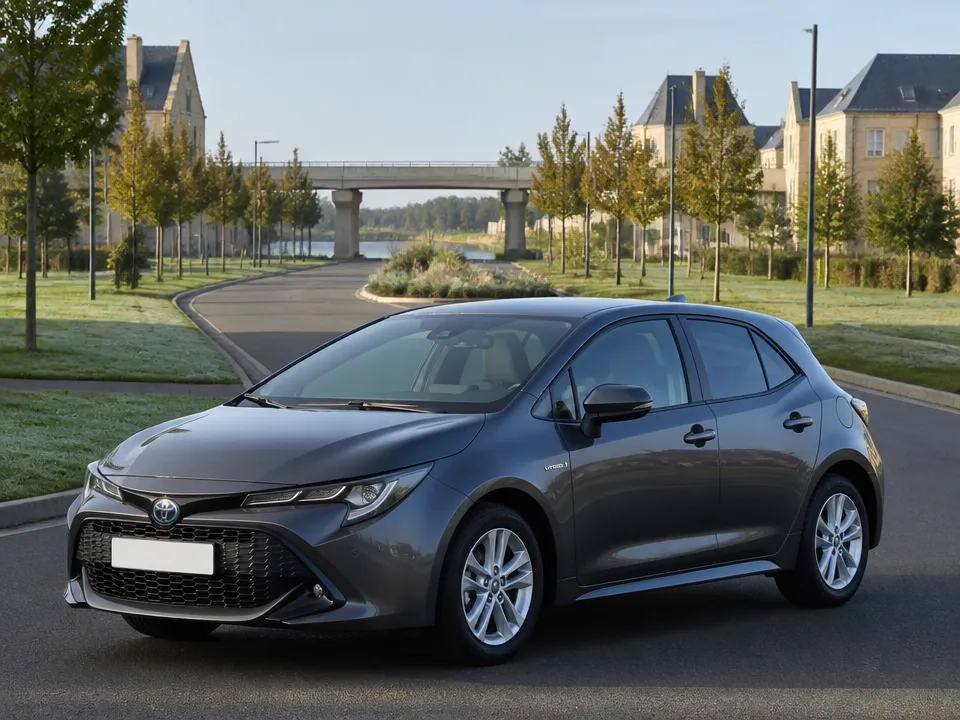
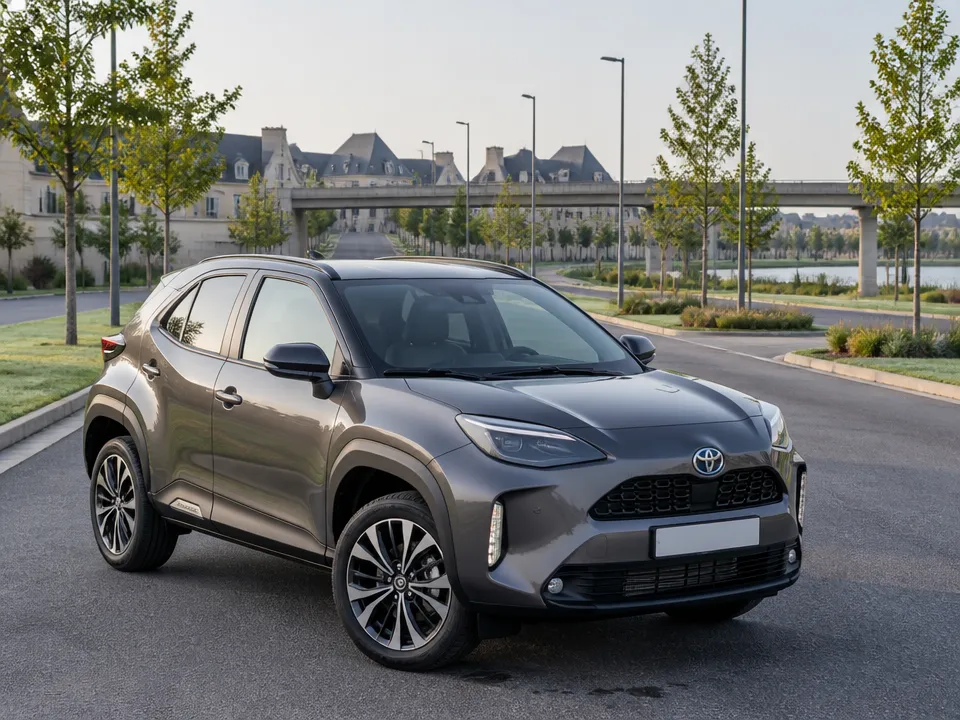
Our fleet holds 3 Toyotas — the Aygo X, the Yaris Cross and the Corolla Hybrid, all seating 5 with front-wheel drive. The Aygo X is an Economy hatchback with a 1.0 L gasoline engine and a manual gearbox. The Yaris Cross steps up to Crossover class with a 1.5 L hybrid unit and an automatic. The Corolla Hybrid is Comfort class: a 1.8 L hybrid, automatic, and the most powerful of the three at 140 hp. Between them they cover the whole span of what we hold on this page, from the smallest body to the roomiest cabin. All three are hatchback or crossover bodies, so none of them needs a special licence category — an ordinary passenger licence covers every model on this page.
| Model | Class | Fuel | Transmission | Engine | Power | From per day |
|---|---|---|---|---|---|---|
| Toyota Aygo X | Economy | Gasoline | Manual | 1.0 L | 72 hp | €39 |
| Toyota Yaris Cross | Crossover | Hybrid | Automatic | 1.5 L | 116 hp | €85 |
| Toyota Corolla Hybrid | Comfort | Hybrid | Automatic | 1.8 L | 140 hp | €95 |
The Toyota Yaris and the wider Corolla family exist in the brand's range, but this page lists only the three models we actually hold. You will see Yaris, Prius, C-HR and RAV4 named across booking sites as though every fleet carried them — in our case the Corolla name on this page means the Corolla Hybrid hatchback and nothing else. Classes and body styles get mixed up the same way: the Yaris Cross sits in Crossover here, not in Economy, and the Aygo X is the only manual. Model names travel between pages faster than fleets do, so confirm the exact car at booking rather than trusting a family name.
Toyota car hire with us runs from €39 to €95 per day across three classes. The weekly rate is the daily rate multiplied by six, and the monthly rate is the daily rate multiplied by twenty-one — for every model on this page.
| Class | Model | Per day | Per week | Per month |
|---|---|---|---|---|
| Economy | Toyota Aygo X | €39 | €234 | €819 |
| Crossover | Toyota Yaris Cross | €85 | €510 | €1,785 |
| Comfort | Toyota Corolla Hybrid | €95 | €570 | €1,995 |
The Aygo X is the cheapest Toyota we list, at €39 per day and €234 per week. It is an Economy-class hatchback with a 1.0 L engine, 72 hp and a manual gearbox, and it runs on petrol rather than hybrid power.
On a week-long booking the rate is the daily figure multiplied by six, not by seven — that is how the €234 is built, and the same rule holds for the Yaris Cross at €510 and the Corolla Hybrid at €570. Our three Toyotas all seat five and all drive the front wheels, so the difference between them is class, fuel and transmission rather than size of cabin.
In our experience the daily rate is not the whole cost of a week behind the wheel. A smaller car burns less fuel and slots more easily into the tight street bays of the central arrondissements, where the first hour of paid parking is €6.
Read those lines before you confirm, because they move the total far more than a euro or two on the daily price. A manager goes through them with you when the booking is agreed, so you know what the week actually costs before the car reaches you.
The ZFE de la Métropole du Grand Paris (Zone à Faibles Émissions) applies inside the A86 motorway — the A86 itself is excluded — and takes in the boulevard périphérique, the Bois de Boulogne and the Bois de Vincennes. Crit'Air 5, Crit'Air 4, Crit'Air 3 and «Non classé» vehicles are barred from that perimeter, and the sticker has to sit on the windscreen.
None of the three Toyotas we hold here runs on Gazole. The Aygo X takes petrol, the Yaris Cross and the Corolla Hybrid run self-charging hybrid petrol, and that keeps them clear of the diesel sticker classes the ZFE tightens first. Fuel prices are not gentle: Gazole sits at 2.44 per litre in the département and SP95-E10 at 2.183. A hybrid pays that back in the city, where the electric motor carries the stop-start traffic of the inner arrondissements and the petrol engine rests.
The perimeter is the ring inside the A86, and the practical reading for a hire car is simple: the centre, the two woods and the périphérique are inside it, the A86 and everything beyond is not. Outside the ZFE, the tolled roads start — the Duplex A86 tunnel between Rueil-Malmaison, Vaucresson and Vélizy is around 10 km and runs 8.30–13.70 € for a class 1 car on Monday to Thursday, up to 14.90 € on Fridays and the eve of a public holiday. Street parking in zones 1 (arrondissements 1–11) is progressive rather than hourly: 6 € for the first hour, 12 € for two, 24 € for three, and a six-hour ceiling on one spot. On a hybrid, the crawl between those bays is where the car spends least. If your trip runs to the Alps between 1 November and 31 March, the winter-tyre rule applies there — four winter tyres or chains on two driven wheels — but Île-de-France is outside it.
We bring the car to the point you agree and hand it over there. Every booking on this page is confirmed by a manager, who also goes through the agreement with you before the keys change hands.
Our delivery model is simple: you tell us where you want the Toyota, we agree the exact point with you, and the car arrives there. Nothing is tied to a fixed desk or a named address — the meeting point is whatever you and the manager settle on when you book. In our experience the hand-over point is the single detail travellers leave to the last minute, and it is the one that decides whether the first day goes smoothly. Agree it in writing at booking, not on the day of collection.
The driver's licence must have been issued more than 1 year ago, and digital licences are not accepted for rental. An EU/EEA licence is valid in France with no time limit and does not need exchanging while it stays valid. A licence from outside the EU/EEA is accepted too, but if it is not in Latin script you need an official translation or an International Driving Permit alongside it — the permit is only a translation and never replaces the licence itself. The IDP must be no older than 3 years. The minimum age, any young-driver supplement, and the card and passport requirement are not fixed by French law; that condition is agreed when booking.
Toyota car rental in Paris through Rent-Trip runs on one rule: nothing about the hand-over is assumed. The meeting point, the time, the model and the terms in the agreement are all fixed in the conversation with the manager, so the delivery itself holds no surprises. If you are arriving by air or by train, say so when you book — an agreed point near your arrival is easier to arrange in advance than to improvise once you are standing outside with luggage.
France accepts driving licences from the EU and EEA with no time limit and no exchange, and tourists from outside those areas can drive on their national licence. The rules below are the ones that change what you may hand us at booking and how fast you may drive a Toyota car rental in Paris afterwards.
| Road | Dry | Rain |
|---|---|---|
| Built-up area | 50 km/h | 50 km/h |
| Ordinary road outside towns | 80 km/h | 80 km/h |
| Dual carriageway with a central divider | 110 km/h | 100 km/h |
| Motorway | 130 km/h | 110 km/h |
The 50 km/h in town can be raised to 70 km/h on individual stretches, and on ordinary roads a department may allow 90 km/h where there are two lanes in one direction. Below 50 m of visibility the limit is 50 km/h on every road, and a driver with less than 3 years of experience — a permis probatoire — is held to 110 km/h on a motorway, 100 km/h on a divided road and 80 km/h elsewhere. These sit in the Code de la route, articles R413-2, R413-3, R413-4 and R413-5. The boulevard périphérique runs at 50 km/h under a Paris city-hall decision introduced in stages from 1 October 2024, even though the Code de la route would permit up to 70 km/h there. Its left lane between the Issy embankment and porte de Bercy is reserved, in both directions, for cars carrying 2 or more people on weekdays from 7:00 to 10:30 and from 16:00 to 20:00; using it alone costs €135, a fourth-class contravention, enforced since 2 May 2025.
The general alcohol limit is 0.5 g per litre of blood, or 0.25 mg per litre of breath, and for a permis probatoire driver it drops to 0.2 g per litre of blood, or 0.10 mg per litre of breath, since 1 July 2015. Exceeding the lower limit costs €135, six points and possibly the licence. A child under 10 years old or shorter than 135 cm must be in a child seat — both conditions have to be met before a seat becomes unnecessary — and the fine for going without reaches €750, a fourth-class contravention. Winter tyres are compulsory from 1 November to 31 March in roughly 34 mountain departments, covering more than 4,000 communes by prefect decision, where you need either four winter tyres or chains on 2 driven wheels; Île-de-France is not included, so the requirement does not apply to a booking here, but it does follow you into the Alps, with a €135 fine and the car immobilised. Tell the manager when booking if a mountain trip is on your plan — the tyres on the car have to match the season you are driving into.
Three of the country's most-visited day trips sit within a single tank of fuel from the city — Disneyland Paris, Versailles and Giverny — and all three suit a Toyota better than a train timetable does. We hand the car over with a full tank, so the first leg costs you nothing at the pump until you refuel.
Petrol in the département sits at €2.44 per litre for Gazole and €2.183 for SP95-E10, so a 200 km round trip in the Yaris Cross costs noticeably less than the same run in a petrol-only car of the same size. Streets inside the city and the boulevard périphérique carry no toll at all; the only paid road you are likely to meet on a short break is the Duplex A86, the 10 km underground tunnel between Rueil-Malmaison, Vaucresson and Vélizy run by Cofiroute/Vinci, where class 1 pays €8.30–€13.70 between 8.30 and 13.70 on Monday to Thursday depending on the hour, and up to €14.90 on Fridays and the eve of public holidays.
Parking at the far end is where day-trippers lose money. In zone 1 — arrondissements 1 to 11 — the street tariff climbs by the hour: €6 for the first hour, €12 for two, €24 for three, €39 for four, €57 for five and €75 for six, with a maximum of six consecutive hours in one place. The tariff is split into 15-minute blocks, so a 90-minute stop costs €9 rather than a full two-hour charge.
Two things change the shape of a day trip in a Toyota. The first is the low-emission perimeter of the Métropole du Grand Paris, whose boundary runs inside the A86 motorway — the A86 itself is excluded — and takes in the boulevard périphérique, the Bois de Boulogne and the Bois de Vincennes. Crit'Air 5, 4, 3 and «Non classé» vehicles are barred, which is why the two hybrids on this page are the safer pick for any route that clips the boundary. The second is that this is a city rule, not a country one: once you are past the A86 on the way to Giverny or Reims, it no longer applies.
Longer runs north and west — Deauville and the Normandy coast, the Loire Valley châteaux, Mont-Saint-Michel — are autoroute trips of several hours each way, and the Corolla Hybrid is the model we would put on them. Book the day before rather than the morning of: the car is delivered to the point you agree, and a manager confirms the booking and the rental agreement with you first.
The daily rate is the smallest number in a Toyota booking. The deposit, the excess, the delivery fee and any discount live in the agreement, and we set all four out there before you confirm anything.
Third-party liability (responsabilité civile) is compulsory in France and comes with every hire automatically — it covers injury and property damage to other people up to the legal limits of the country, but not injuries to the driver. Collision damage protection and theft protection are part of the base package with French companies: they cap what you owe at the excess rather than removing it. You can buy that excess down — a mid-level option lowers it, a top-level one takes it to zero — and some Visa Premier or Gold Mastercard cards cover the excess if the booking was paid with that card and the holder is the main driver. That last point comes from industry practice, not from a bank document, so check with your card issuer. The exact deposit and excess figures belong to your individual agreement, and we confirm them with you at booking.
Tyres damaged by abnormal use, glass except in a collision, sunroof and panoramic roof, the underside, misfuelling and the engine damage it causes, lost or stolen keys, and any damage from negligence or intent stay outside the standard cover. Fuel policy is the usual full-to-full: you collect the car full and return it full, with unlimited mileage unless your agreement says otherwise. Ask us which of these apply to the Toyota you have chosen before you drive away, because a misfuelled Aygo X or a kerbed Yaris Cross alloy costs more than the daily rate for the week.
Daily prices on this page run from €39 to €95. The Toyota Aygo X is €39 per day, the Toyota Yaris Cross is €85 per day and the Toyota Corolla Hybrid is €95 per day. This page lists 3 cars in Paris.
The classes listed here are Comfort, Crossover and Economy. Body types are Crossover and Hatchback, with Automatic and Manual transmissions. All cars on this page have 5 seats.
As a tourist you may drive on your national licence. If it is not in Latin characters, an official translation or an International Driving Permit is needed, shown together with the national licence. The IDP alone does not replace it.