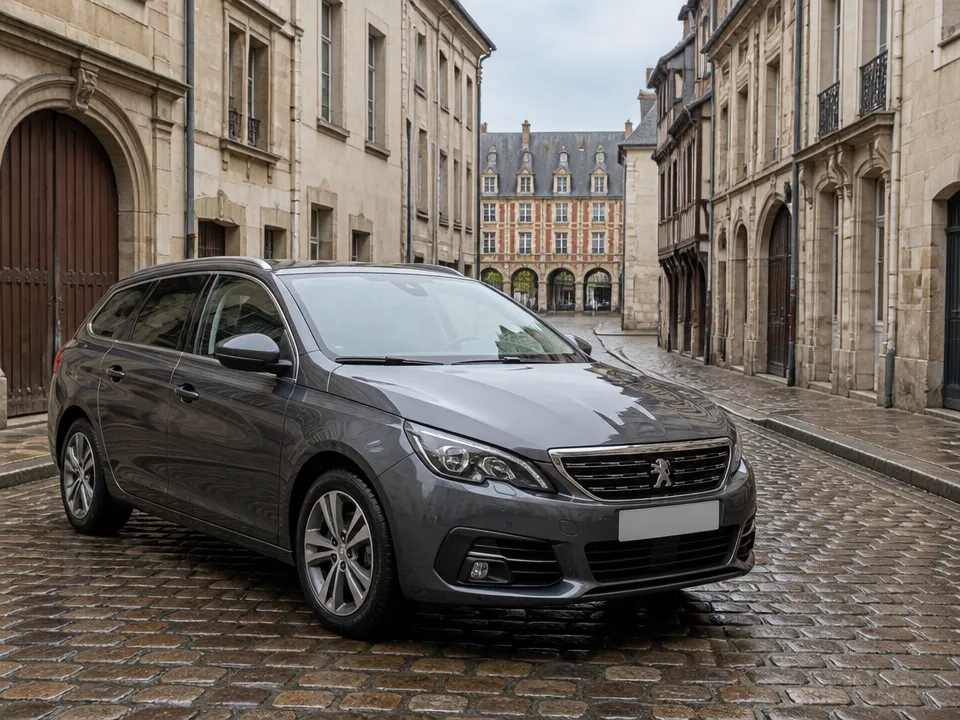
Peugeot 308 SW
★4.8· 70Automatic1.2 L130 hpFront-wheel5 seats
€92per day
Book now










Need a station wagon car rental in Paris with the car brought to you rather than collected from a lot? Rent-Trip has 2 estate cars on this page — a Peugeot 308 SW from €92 per day and a Cupra Leon Estate from €105 per day, both Comfort class, 5 seats, automatic — and we deliver the car to the address you give us, with the hand-over agreed with a manager when you book.
Our estate line-up for this city is deliberately small: two Comfort-class station wagons, both with five seats and an automatic gearbox. Between them they cover petrol and hybrid, and both are front-wheel drive.
The Peugeot 308 SW is a Comfort-class estate with 5 seats, gasoline, automatic transmission, front-wheel drive and a 1.2 L, 130 hp engine at €92 per day. It is the smaller of the two estates we keep for this city, and the 1.2 L turbo petrol unit is the reason it holds the lower rate: on a five-seat wagon with a full boot, that engine returns sensible consumption on the ring road and the motorways heading out towards Versailles or Reims. The automatic gearbox is standard, not an upgrade, so the price you see already includes it. At 4.6 metres with the rear bench up, the boot swallows a folded pram plus two cabin cases, and the load floor sits low enough that you lift nothing above waist height. Rent-Trip supplies this model as a self-drive car delivered to you.
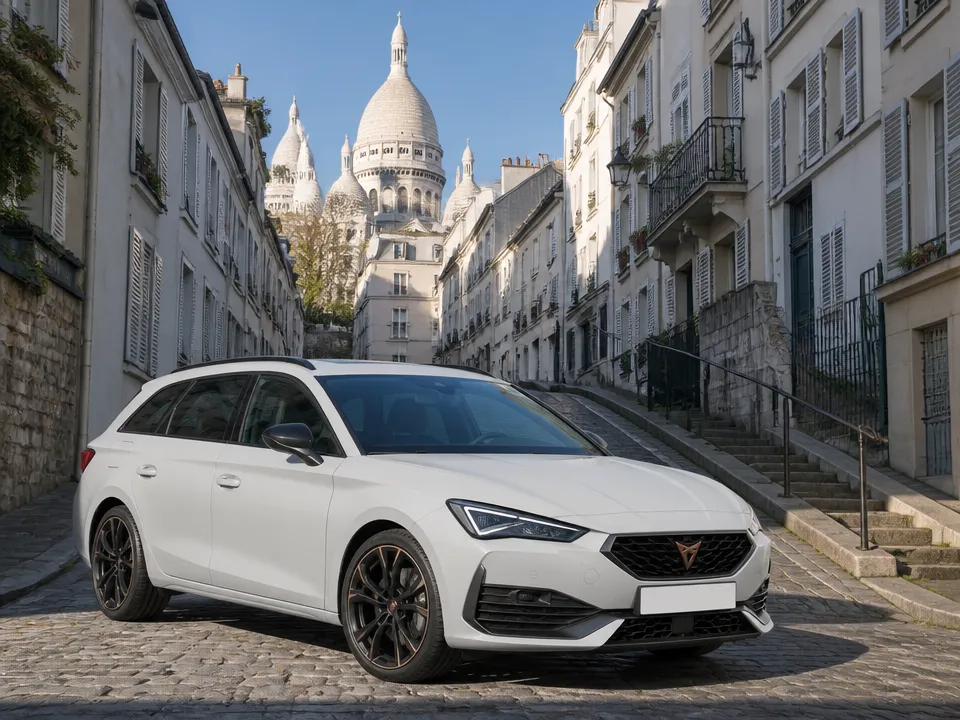
The Cupra Leon Estate is a Comfort-class hybrid estate with 5 seats, automatic transmission, front-wheel drive and a 1.5 L, 150 hp engine at €105 per day. It is the second and faster estate on this page: 150 hp against 130 hp, and a hybrid drivetrain rather than straight petrol. That combination earns its €13 daily premium in the kind of driving this city actually produces — short, repeated, low-speed runs between the périphérique, the inner arrondissements and the car parks under the boulevards, where the electric side carries the crawling stretches and the petrol engine takes over once you are on the A13 or the A86. The estate body itself is unchanged: five seats, a low load sill, and a boot that stays usable with all five places occupied.
| Model | Class | Seats | Fuel | Transmission | Price per day |
|---|---|---|---|---|---|
| Peugeot 308 SW | Comfort | 5 | Gasoline | Automatic | €92 |
| Cupra Leon Estate | Comfort | 5 | Hybrid | Automatic | €105 |
Both models are front-wheel drive and both come with a 1.2 L or 1.5 L engine respectively, so the €13 gap between them buys a hybrid drivetrain and 20 hp more, while luggage capacity and seating are effectively the same. In our experience, travellers who spend most of the booking inside the city take the hybrid, while those heading straight out to the Loire Valley châteaux or the Normandy coast take the petrol estate and pocket the difference.
Rates on this page run from €92 to €105 per day, and a longer booking changes the figure through a fixed multiplier: six daily rates for a week, twenty-one for a month. Below are the daily rates by model, then the weekly and monthly totals they produce.
Station wagon hire with us starts at €92 per day for the Peugeot 308 SW and €105 per day for the Cupra Leon Estate. Both sit in the Comfort class and both are automatic, so the €13 gap is not a question of gearbox or trim — it buys the hybrid drivetrain of the Cupra, a 1.5 L unit at 150 hp against the 1.2 L, 130 hp petrol engine in the Peugeot. Over a three-day break that gap is €39; over a fortnight it reaches €182. In our experience the petrol estate goes out for short family visits and airport runs, while the hybrid earns its premium on bookings that spend real hours in stop-start traffic inside the city. Pick the smaller-engined car for a weekend and the hybrid for a longer stay, and the daily rate tracks how the car is actually driven.
A week of station wagon hire starts at €552 and a month at €1,932, calculated as the daily rate multiplied by six for a week and by twenty-one for a month. Those figures are the floor of the range, so they come from the Peugeot 308 SW at €92; the Cupra Leon Estate scales the same way, from €105 per day. The multiplier is the same on both cars, which means the saving does not depend on which estate you choose — only on how long you keep it. We handle longer bookings as a single reservation with one hand-over and one return, agreed with a manager when you book, rather than as several back-to-back rentals. If your stay runs past three weeks, price the whole period as one monthly booking before you compare it with a stack of weekly ones.
| Model | Per day | Per week | Per month |
|---|---|---|---|
| Peugeot 308 SW | €92 | €552 | €1,932 |
| Cupra Leon Estate | €105 | €630 | €2,205 |
The weekly column is the daily rate multiplied by six and the monthly column the daily rate multiplied by twenty-one; the Cupra figures follow the same rule from its €105 daily rate. What the table cannot show is the fixed part of a booking — the deposit, the insurance excess and any delivery fee are set out in the rental agreement, not in the rate. Read those lines before you fix the length of the booking, because a longer term lowers the daily figure but does not change what the agreement says about the excess.
We deliver the car to you and agree the booking with a manager, so the hand-over point is settled before the trip. What follows is the sequence we follow, from the first message to the moment the keys change hands.
You send us the dates, the model you want and where you will be staying, and a manager confirms the booking with you directly. Nothing is charged at the moment of the request — the terms are agreed when booking, and we go through them with you before anything is fixed. If only one of the two estates is free on your dates, the manager tells you which one and what it costs per day, so you decide with the real figure in front of you. Contact details and the hand-over address are part of that same conversation, not something you have to hunt for afterwards.
The minimum age and any young-driver surcharge are set by each company in France rather than by a single national rule, so we confirm them with you when booking. The same goes for the deposit and the excess: both are agreed when booking, and we walk you through them before you sign anything. Checking your licence date and IDP validity before you travel is the one thing that most often holds up a hand-over — a licence issued less than a year ago cannot be accepted, however good the rest of the paperwork looks.
Every rental in France carries responsabilité civile by law, and the French market adds collision and theft protection to the basic package; what sits above that is the excess, and the exact figure is set out in the rental agreement. Bring documents that match the rules below, and the booking itself is agreed with a manager.
Winter tyres are required from 1 November to 31 March in around 34 mountain départements, but not in Paris or the Île-de-France — the rule only matters if your trip heads for the Alps. Our two estates are both automatic, which is the pricier category on the French market, so confirm the protection level you want when the manager agrees the booking with you.
The streets here, the périphérique and the ZFE de la Métropole du Grand Paris (Zone à Faibles Émissions) all work on rules that catch visiting drivers off guard. Before you collect a station wagon, it is worth knowing which sticker your car carries, what a parking hour really costs and where a toll is charged.
The ZFE de la Métropole du Grand Paris covers the area inside the A86 motorway (the A86 itself is excluded), including the boulevard périphérique and the Bois de Boulogne and Bois de Vincennes, and entry requires a Crit'Air sticker on the windscreen. Crit'Air 5, Crit'Air 4, Crit'Air 3 and «Non classé» vehicles are barred from the zone, with the Crit'Air 3 restriction phased in from 1 January 2025. Both of our estates are Comfort-class cars, the Peugeot 308 SW at €92 a day and the Cupra Leon Estate at €105 a day, so the sticker question is settled for you at booking — but confirm which class your exact model carries before you drive into the perimeter, because a missing vignette makes entry formally prohibited.
In our experience the périphérique's 50 km/h limit and the car-share lane catch drivers who last visited a few years ago — set the lane discipline before you merge, not after.
Both estates on this page seat 5 and sit in the Comfort class, so the real question is not size but shape: how the car carries people and luggage on a family trip out of the city.
An estate carries five people and their luggage in one volume rather than stacking it upward. The Peugeot 308 SW and the Cupra Leon Estate both come with 5 seats, automatic transmission and front-wheel drive, and both measure their load space from the floor of the boot to the roof — a long, low box that swallows prams, folded pushchairs and hard cases side by side. That low load floor is the practical difference on a family trip: you lift bags to knee height instead of shoulder height, and nothing has to be strapped above the seatbacks where it blocks the rear view. For a week away with three children, the estate shape usually beats a taller car of the same footprint, because the weight stays low and the boot stays flat when the third row of a seven-seater would otherwise be folded down anyway.
The Peugeot 308 SW runs on gasoline with a 1.2 L, 130 hp engine at €92 per day; the Cupra Leon Estate is a hybrid with a 1.5 L, 150 hp engine at €105 per day. For a family break built around motorway miles to the coast or the Loire Valley châteaux, the petrol estate keeps the daily rate lowest. For a stay that mixes short city hops with weekend runs, the hybrid's electric side covers the slow stretches. In our experience, families booking a week tend to take the 308 SW and put the €13 a day difference towards parking, which in the centre runs to €6 for the first hour and €75 for six. Whichever you choose, tell the manager the number of child seats when booking — the condition is agreed then, and the rental agreement sets out the rest.
An estate earns its keep on the road out of the city: Disneyland Paris, Versailles, Giverny, Reims and Champagne, Deauville and the Normandy coast, Mont-Saint-Michel and the Loire Valley châteaux all sit within a day's drive, and the load bay swallows a week of luggage for five without anyone riding with a case on their knees.
Versailles is a straightforward motorway run and the car park at the palace fills early, so arriving before mid-morning is worth the alarm. Disneyland Paris works best as a single day with the estate parked for the duration rather than as a hotel-to-park shuttle. Giverny and the Loire Valley châteaux reward a slower route on D-roads, where the estate's 1.2 L or 1.5 L engine returns sensible consumption at 80 km/h. Reims and Champagne is a motorway day, and Deauville and the Normandy coast needs an early start to make the return before evening. The Cupra Leon Estate's hybrid drivetrain is the better companion for the stop-start stretches around Disneyland Paris, while the Peugeot 308 SW keeps the daily rate lower for a straight motorway there-and-back — at €92 against €105 per day, that €13 gap is the hybrid premium.
Book the estate for the whole trip rather than day by day, because weekly pricing runs at the daily rate multiplied by six and monthly at the daily rate multiplied by twenty-one. Winter tyres are compulsory from 1 November to 31 March in around 34 mountain departments — the Alps, Pyrenees, Massif Central, Jura, Vosges and Corsica — but Paris and Île-de-France are not among them, so a car collected here is unaffected unless the trip heads for the Alps. Tolls, parking and any charges on the road are set out in the rental agreement. Anything else about the journey — drop-off timing, who drives, what happens if plans change — is agreed with a manager when you book with Rent-Trip.
This page lists 2 cars. Daily prices run from €92 to €105: the Peugeot 308 SW is at €92 per day and the Cupra Leon Estate at €105 per day.
All cars on this page have automatic transmission and 5 seats. The class is Comfort, the makes are Cupra and Peugeot, and the body type is estate.
In zone 1, covering districts 1 to 11, the visitor tariff is €6 for the first hour and rises progressively, with a maximum of 6 hours in one place. The rate is split into 15-minute parts.