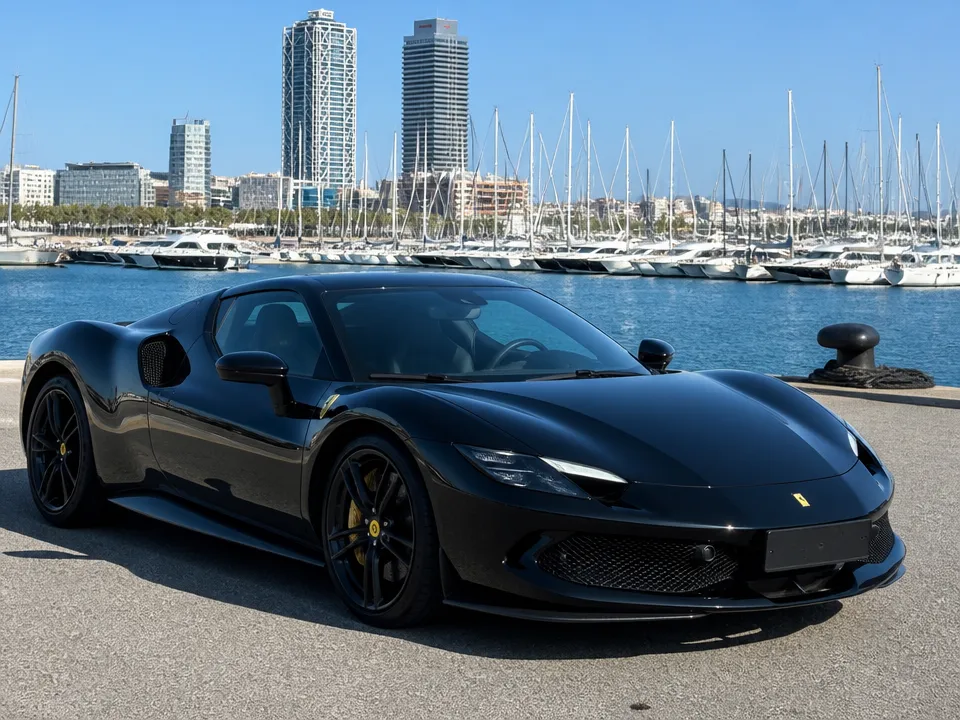
Ferrari 296 GTB
★4.8· 6Automatic3.0 L830 hpRear-wheel2 seats
€1,232per day
Book now










From €1,232 per day, Ferrari car rental in Barcelona puts two cars at your disposal — the Ferrari 296 GTB and the Ferrari Roma — with the car delivered to you and the booking agreed with a manager. Both are Exotic-class coupés with automatic transmission, and the 296 GTB runs as a plug-in hybrid at 830 hp while the Roma carries four seats and a 620 hp petrol V8.
At Rent-Trip, choosing a Ferrari here comes down to two cars, both in the Exotic class: the Ferrari 296 GTB and the Ferrari Roma. Both are coupes with automatic transmission and rear-wheel drive, so the real choice is about seating and character, not about which one is faster on paper.
The Ferrari 296 GTB on our fleet is an Exotic-class Coupe with 2 seats, a 3.0 L plug-in hybrid powertrain, 830 hp, automatic transmission and rear-wheel drive, from €1,232 per day. The hybrid part of the drivetrain does not change how the car behaves for a driver: it stays rear-wheel drive, and the electric range is not built for long runs out of the city. What it does change is the way the car picks up — the electric motor fills in below the turbos, so the 296 GTB pulls cleanly from low revs in traffic on the Rondes and along the B-20. In our experience, drivers who book this one are chasing the sharper side of the drive rather than luggage space. If your plan includes a passenger who wants to stretch out, look at the second car instead.
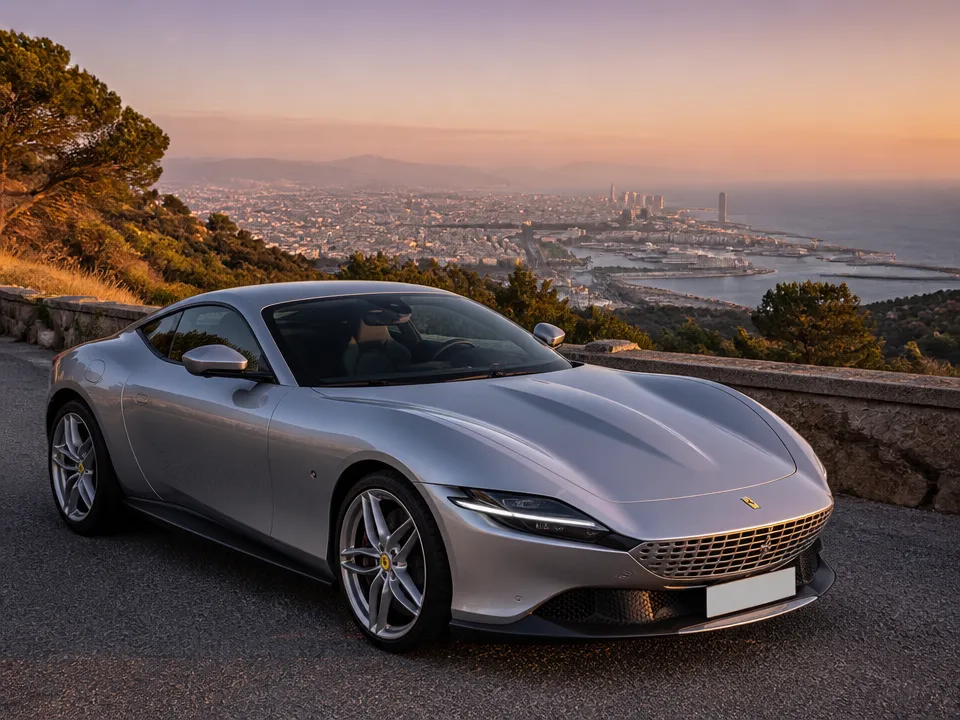
The Ferrari Roma is an Exotic-class Coupe with 4 seats, a 3.9 L petrol engine, 620 hp, automatic transmission and rear-wheel drive, from €1,490 per day. Four seats make the Roma the only car on this page that takes two passengers in the back, but it is still a coupe — the rear bench is shaped for short hops, not for a full day of driving. The petrol V8 delivers its power differently from the hybrid: there is no electric assistance, so everything comes from the 3.9 L engine, and the car feels calmer and more relaxed at a cruise. That makes it the better pick for a route that mixes motorway stretches with stops — the Penedès wine country or a run up to Montserrat. The two models sit in the same Exotic class, so the difference in price buys you two extra seats and a different power delivery, not a different class.
| Model | Seats | Fuel | Engine | Power | Price per day |
|---|---|---|---|---|---|
| Ferrari 296 GTB | 2 | Plug-in Hybrid | 3.0 L | 830 hp | €1,232 |
| Ferrari Roma | 4 | Petrol | 3.9 L | 620 hp | €1,490 |
Both cars are Exotic-class Coupes with automatic transmission and rear-wheel drive, so the table really only separates them on seating, fuel, engine size, power and price. If your trip runs longer than a single day, the four-seat Roma answers the question of what to do with the people travelling with you — without a second car in the convoy.
Prices here follow the model and the length of the booking, not the season. We calculate longer hires from the daily rate with fixed multipliers, so the figure you see before booking is the figure you pay.
Ferrari car rental in Barcelona starts at €1,232 per day for the 296 GTB and €1,490 per day for the Roma. Both sit in the same Exotic class, both are coupes with automatic transmission and rear-wheel drive, so the difference between them is power and seating rather than a step up in category: 830 hp and a 3.0 L plug-in hybrid against 620 hp from a 3.9 L petrol engine. The 296 GTB carries two seats, the Roma four, which is the difference most of our customers actually weigh up before they choose. In our experience the deciding question is rarely the engine — it is whether anyone is travelling in the back.
| Model | Per day | Per week (daily × 6) | Per month (daily × 21) |
|---|---|---|---|
| Ferrari 296 GTB | €1,232 | €7,392 | €25,872 |
| Ferrari Roma | €1,490 | €8,940 | €31,290 |
The multipliers are fixed and published, so a week is charged as six daily rates and a month as twenty-one. That means you can price a longer booking yourself before you call us, and the total does not move with demand on the dates you pick. The monthly column is the one worth reading twice: at daily × 21, a full month of Roma comes to €31,290, which is the same arithmetic we apply to every model in the fleet.
The quoted rate includes the Seguro Obligatorio de Responsabilidad Civil, the compulsory third-party cover that Spanish law requires on any car legally on the road. The deposit, the excess on damage cover, delivery fees and any discount are set out in the rental agreement, and we confirm them with you before anything is signed. Spanish consumer rules require an advertised price to include every mandatory charge a car cannot leave without, which is why comparing offers on the headline figure alone tells you very little — the contract is where the real cost sits. Both models are coupes with automatic transmission, so the choice between them comes down to the 296 GTB's 830 hp plug-in hybrid drivetrain and two seats against the Roma's 620 hp petrol engine and four.
What you need at hand depends on where your licence was issued. Spanish rules are specific here, and the two Ferraris on this page are no exception — the paperwork is the same as for any other car in the fleet.
An EU or EEA driving licence — including Iceland, Liechtenstein and Norway — is fully valid in Spain for as long as it has not expired, and nothing further is required. There is no need to carry an international driving permit alongside it. If your licence was issued outside the EU and EEA, it is valid here when three things hold at once: the licence is still in force, you are old enough in Spain for the equivalent category, and no more than six months have passed since you took up ordinary residence in the country. The DGT advises getting an international driving permit before the trip, and it is worth doing — the permit is issued for one year and is a grey triptych booklet of sixteen pages in Spanish, German, English, French, Italian, Portuguese, Arabic and Russian. It is a supplementary document only: you present it together with your passport and your national licence, never on its own. In our experience the booklet settles most questions at hand-over faster than a translation does.
Driving in Spain is allowed from 18 for category B. The minimum age for renting and any young-driver surcharge are not fixed by law — they are the company's own condition and are agreed when booking, as is the credit card in the main driver's name that stands behind the deposit; debit cards are not accepted everywhere. A licence held for at least a year is the common requirement attached to that. None of this changes because the car is a Ferrari: the same document set applies to the 296 GTB and the Roma. Check the age and card terms before you confirm the dates — they are the two points that most often stop a booking at the last step, and they are settled with the manager rather than at the wheel.
Every Ferrari booking on this page carries the same legal floor: Seguro Obligatorio de Responsabilidad Civil is built into the rate, because no car may legally leave the kerb in Spain without it. Above that floor sit the optional waivers, the excess and the deposit — and those are the numbers that vary. We set them out in the agreement before you commit, never after.
Seguro Obligatorio de Responsabilidad Civil is included in any booking and applies at all times, even if the person driving was not named in the agreement. It pays for harm to third parties, with statutory limits of 70 million EUR per incident for personal injury regardless of how many people are hurt, and 15 million EUR per incident for property damage. It does not cover the driver, and it does not cover the car itself. That is the gap the optional products are designed to close, and it is why a Ferrari rate is never judged on the daily figure alone.
The deposit is a preauthorisation blocked on a credit card to cover possible damage and extras, and its size is confirmed before the agreement is signed. The excess depends on the company and the vehicle class, and there is no single official standard for it — so both figures belong in the agreement, not in a headline. Spanish consumer rules require the advertised price to include every mandatory charge without which the car cannot legally be driven, compulsory insurance and young-driver surcharge among them. The same rules give you a specific protection at hand-over: every scratch and dent must be written into the agreement or the inspection record before you drive away, with both sides signing and a copy staying with you. Skip that step on an 830 hp coupe and the damage comes back to you.
If the model you reserved is unavailable, you can require a replacement at no extra cost, including one from a higher class. If you are handed a lower class, the price must be reduced. And if the car does not match the agreed conditions — automatic transmission, four doors — the booking can be cancelled and the prepayment refunded. On a two-car Ferrari page that clause matters more than usual: only the 296 GTB and the Roma sit in the Exotic class here, so confirm which one is on your agreement at booking.
We deliver the car to you, and the booking is agreed with a manager. You tell us the model, the dates and where you want the Ferrari handed over, and a manager confirms what is available.
Our fleet on this page is small on purpose: the 296 GTB at €1,232 per day and the Roma at €1,490 per day, both automatic, both rear-wheel drive. A manager talks you through the difference between them before you commit, because the choice comes down to seating and character rather than class: two seats and a plug-in hybrid against four seats and a 3.9 L petrol engine.
In our practice, the questions that decide a booking are rarely about power. They are about where the car is handed over, how long the trip runs and whether the driver's licence is the one the agreement expects. Ask those three first, and the rest of the paperwork follows.
Weekly and monthly bookings are worked out from the daily rate — weekly is the daily rate times six, monthly is the daily rate times twenty-one — so a week in the 296 GTB starts at €7,392 and a month at €25,872. Those multipliers are fixed, which means you can price a long rental before you know which car is free on a given date.
If your plans include a drive out of the city, say so when you book. Delivery, the hand-over point and the terms of the trip are agreed with the manager in advance, not on the day.
ZBE Rondes BCN, the C-16 tunnel toll and AREA Blava rates are the three things that shape a Ferrari route out of the city. All three are facts of the Catalan capital, and all three are manageable once you know the numbers.
The Zona de Bajas Emisiones Rondas de Barcelona (ZBE Rondes BCN) covers more than 95 km²: the whole municipality of Barcelona except the Zona Franca industrial estate and the Vallvidrera – el Tibidabo i les Planes neighbourhood, plus L'Hospitalet de Llobregat, Sant Adrià de Besòs and parts of Esplugues de Llobregat and Cornellà de Llobregat. It runs on working days, Monday to Friday, and entry is decided by the DGT environmental sticker (distintivo ambiental) on the windscreen — 0 emisiones (blue) or ECO (blue-green). Both Ferraris on this page carry a Plug-in Hybrid or Petrol drivetrain, and the 296 GTB's hybrid system is the reason the sticker question matters at all: a car without the right distintivo is stopped at the boundary rather than fined on the street. Foreign plates need prior registration in the Registre metropolità de vehicles estrangers i altres vehicles autoritzats a les zones de baixes emissions before the car enters the zone — arrange it with the manager when you book, not at the barrier.
A phone held in the hand costs €200 and 6 points; a seatbelt or child-seat offence is €200 and 4 points, and child seats are mandatory for anyone under 135 cm. Pay within 20 calendar days and the fine drops by 50%. On our side, the car is delivered to you and the booking is agreed with a manager, so the route, the ZBE registration and the return point are settled before the keys change hands.
We keep two Ferraris on this page, and both are handed over with a full tank under the lleno a lleno policy, so a day trip starts the moment you pull away.
It operates on working days, Monday to Friday. The permitted badges are 0 emisiones (blue) and ECO (blue-green), and a foreign-plated car needs prior registration in the Registre metropolità de vehicles estrangers i altres vehicles autoritzats a les zones de baixes emissions before it may enter. Our cars are registered for the zone, so the rule affects your route planning rather than your booking — but if you plan to drive out to the Pyrenees or La Cerdanya, remember that winter restrictions there are set by signs and overhead panels, not by season.
This page lists 2 cars, both Ferrari and both in the Exotic class. They are the Ferrari 296 GTB and the Ferrari Roma.
Daily prices on this page run from €1232 to €1490. The Ferrari 296 GTB is €1232 per day and the Ferrari Roma is €1490 per day.
All cars on this page are Automatic and all are Coupe body types. Seat counts on this page are 2 and 4.