Tesla Model 3, Electric
★4.9· 15Automatic—283 hpRear-wheel5 seats
£309per day
Book now




No cars match the selected filters. Remove some of the conditions.









This page lists 3 cars, all Tesla and all Electric, with 5 seats and Automatic transmission. Body types are Crossover and Sedan. Daily prices in London run from £309 to £322.
The Tesla Model 3 is £309 per day, and the Tesla Model Y is £322 per day. Daily prices on this London page run from £309 to £322.
Under the UK rule, you may drive on full valid foreign licences for 12 months from your last entry into Great Britain. London's Congestion Charge and ULEZ rules apply as city rules; the page does not mention an IDP or age.
From £309 per day, Tesla car rental in London gives you a choice of three electric cars — Model 3, Model Y and Model S — delivered to any address in the city and to Heathrow, Gatwick, Stansted, Luton, London City and Southend airports. The delivery address, date and time are agreed with a manager before the booking is fixed.
The Tesla line-up for Tesla car rental in London on this page is three cars, all fully electric, all automatic and all five-seat. Which one you take comes down to the trip: a sedan for city work, a crossover for luggage, all-wheel drive for motorway miles.
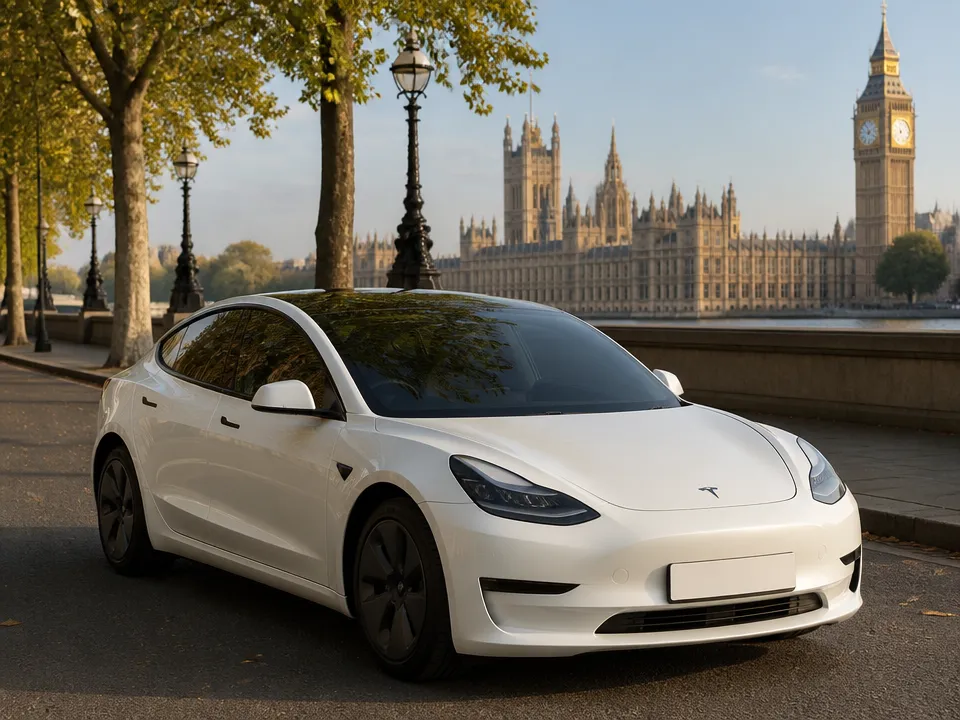
The Tesla Model 3 is the entry point at £309 a day — a five-seat electric sedan with 283 hp and rear-wheel drive. It shares the lowest price on this page with the Model S, and for a lot of bookings it is simply the right one: two people, a weekend in the city, a run out to Windsor and back. The sedan body sits low, the 283 hp is more than enough for the 30 mph limits that cover most of central London, and rear-wheel drive keeps the car predictable in traffic. Rent-Trip supplies it clean, and the return conditions are set out in the rental agreement. Rear-wheel drive and the sedan body make the Model 3 the easiest of the three to place in tight parking bays and multi-storey car parks — if your hotel has a low-clearance entrance, check the height before you book the bigger cars.
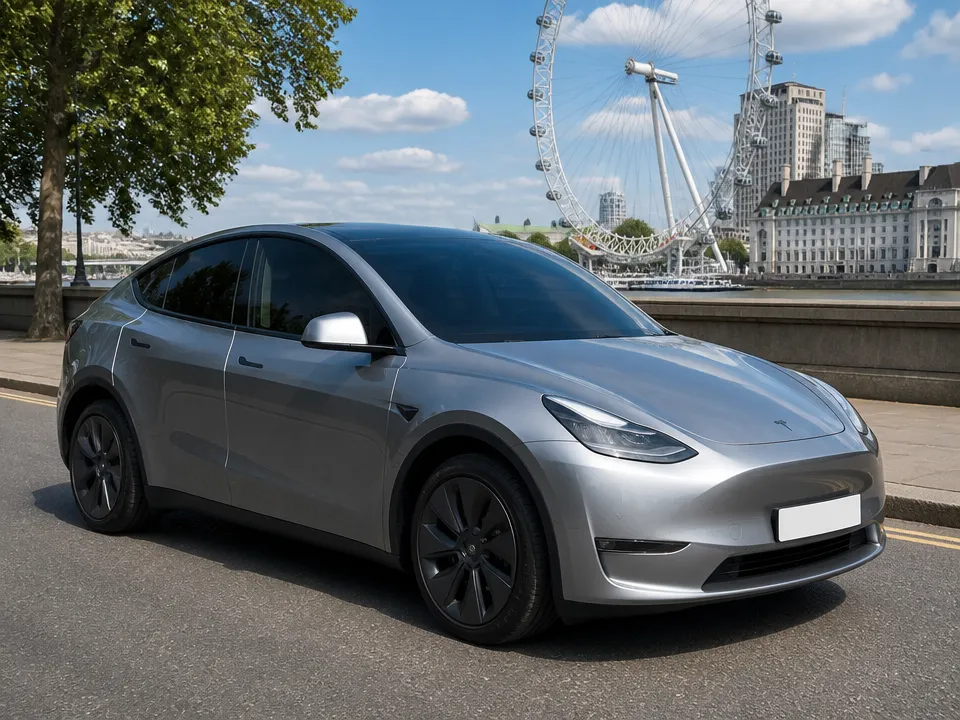
The Tesla Model Y is our crossover at £322 a day, with 299 hp, rear-wheel drive and the same five seats as the other two. It costs £13 a day more than the Model 3, and what that buys is shape rather than power: a taller body, a higher roofline and a boot opening you can lift a full-size suitcase through without angling it. For an airport run with four people and four bags, that difference shows up in the first five minutes. The Model Y is also the only crossover on this page — the other two are sedans — so if anyone in the group finds a low seat awkward to get out of, this is the one to take. The crossover body gives more headroom and a taller boot opening than the sedans — worth the £13 a day over the Model 3 if you travel with bulky luggage.
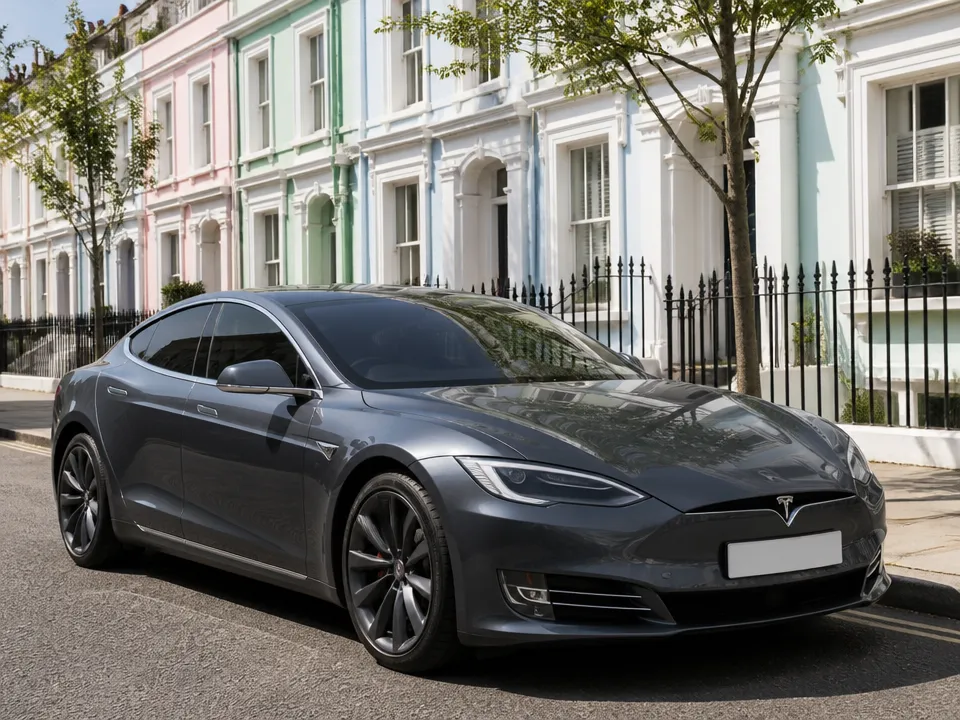
The Tesla Model S, at £309 a day, is the only one with all-wheel drive and 670 hp. It is a sedan like the Model 3 at the same price, but the drive is not close: 670 hp against 283 hp, and drive to all four wheels instead of two. That is the specification that matters if your plans include the motorway ring around the city or a run out to Oxford and back in wet weather. It is also the car to take if the trip is partly about the drive itself rather than purely about getting somewhere. All-wheel drive matters on wet British motorway surfaces and on the gravel approaches to out-of-town estates; it is the one spec that separates the S from the other two.
| Model | Body | Power | Drivetrain | Seats | Daily rate |
|---|---|---|---|---|---|
| Tesla Model 3 | Sedan | 283 hp | Rear-wheel | 5 | £309 |
| Tesla Model Y | Crossover | 299 hp | Rear-wheel | 5 | £322 |
| Tesla Model S | Sedan | 670 hp | All-wheel | 5 | £309 |
Pick by drivetrain first — rear-wheel for city work, all-wheel if the trip includes motorway miles in rain. Then by body: the crossover takes luggage more easily than either sedan. Then by budget: the gap between the cheapest and the most expensive car here is £13 a day, which over a week is the difference between one model and another rather than between renting and not renting. All three run on the same fuel, so charging works the same way whichever you choose.
The daily rate is the base for everything else: a week is the daily rate times six, a month is the daily rate times twenty-one. We quote three Teslas, and the whole spread between them is £13 per day.
A week of Tesla car rental starts at £1,854 and a month at £6,489 — weekly is the daily rate times six, monthly times twenty-one. The Model 3 and the Model S set that floor at £309 per day and the Model Y runs at £322, so a seven-day booking lands between £1,854 and £1,932 and a month between £6,489 and £6,762 depending on which car you take. The multiplier is fixed, so a longer booking only pays off if you actually need the car on most of those days: a two-day trip is cheaper at the daily rate, and a three-day trip still is. In Rent-Trip booking practice, most hires here run two to four days, which is exactly the range where the daily rate wins. If your trip stretches past three and a half weeks, ask the manager to price the whole span at the monthly multiplier before you confirm — that is the one calculation worth doing twice.
| Model | Body | Power | Drivetrain | Seats | Daily rate | Weekly (daily x 6) | Monthly (daily x 21) |
|---|---|---|---|---|---|---|---|
| Tesla Model 3 | Sedan | 283 hp | Rear-wheel | 5 | £309 | £1,854 | £6,489 |
| Tesla Model Y | Crossover | 299 hp | Rear-wheel | 5 | £322 | £1,932 | £6,762 |
| Tesla Model S | Sedan | 670 hp | All-wheel | 5 | £309 | £1,854 | £6,489 |
The deposit, the insurance excess and any delivery fee are set out in the rental agreement, not quoted on this page. Those three lines sit outside the daily rate and are set out in the agreement for your dates. Everything else on this page is the car itself: three electric models, all automatic, all five-seat, all with the same rate structure behind them. Read the deposit and excess lines before you confirm dates rather than after, because they are the numbers that decide whether the Model S is worth taking over the Model 3 at the same £309. Delivery to an address in the city or to one of the six airports we serve is arranged when you book, and the manager confirms the address, date and time before the booking is fixed. Ask for the full breakdown in one message — daily rate, weekly or monthly total, deposit, excess and delivery — so nothing arrives as a surprise on the day.
Three days at the daily rate on the Model 3 comes to £927; the weekly figure of £1,854 covers seven days, so six days at the daily rate cost the same as the week. Up to six days, pay daily; from the seventh day, the weekly multiplier does the work for you. The same logic runs for the Model S: at £309 per day it is £1,854 for a week, the same as the Model 3, so all-wheel drive and 670 hp add nothing to the weekly figure. In our experience the choice is rarely about the money and almost always about the trip — city work and short hops suit the rear-wheel cars, while a week that includes motorway miles in rain is where the S earns its keep. Work out your real driving days first, then pick the multiplier.
Every Tesla for Tesla car rental in London is delivered clean, and the battery level expected on return is set out in the rental agreement — the full-to-full rule on this site is written for a fuel tank. That decides how you plan the charging stops: you top the battery up as you go and check the return level in the agreement before the last day.
The car's own navigation lists chargers live and routes you through them, so you do not need a separate app to find the next stop. On a Model S with 670 hp the range drops faster than on the Model 3 if you use the acceleration, and the difference shows up on a motorway run in cold weather. Plan the first stop before you leave the delivery address rather than after the battery warning appears.
The Congestion Charge applies to electric cars: £18 a day if you pay on the day or in advance, £21 if you pay by midnight on the third day after the trip, charged 07:00-18:00 Monday to Friday and 12:00-18:00 on Saturday, Sunday and bank holidays, and not charged from 25 December to the New Year bank holiday inclusive. The 100% Cleaner Vehicle Discount for electric cars has ended, so from 02.01.2026 a Tesla pays with a 25% discount only with Auto Pay — £13.50 instead of £18 — and there is no discount without Auto Pay. The ULEZ charge of £12.50 a day for non-compliant vehicles does not apply to a Tesla, because the zone's petrol and diesel standards are about emissions the car does not produce.
Who pays road charges, tolls and penalty notices on the rental car is agreed when booking — it is not something this page settles for you. On the Dartford Crossing the charge is £3.50 per crossing for cars, or £2.80 if you pre-pay, and it is payable by midnight the following day. The Blackwall and Silvertown tunnels charge £4.20 at peak (northbound 06:00-10:00 and southbound 16:00-19:00 on weekdays) and £1.55 off-peak with Auto Pay. Charging itself is the cheap part of a Tesla day in the city: the public network costs a fraction of what the same distance would cost in petrol, and the £18 Congestion Charge is the bigger daily figure.
A full battery on a Model 3 covers a normal day of central driving with a comfortable margin, so most customers never touch a charger until the evening. The pattern that works: charge overnight at your address if a unit is available, drive the day, and top up once before returning the car to the level the rental agreement sets. If you are staying somewhere without a charger, a 30-minute stop at a rapid unit on the way back is usually enough for that top-up. We deliver to any address in the city and to Heathrow, Gatwick, Stansted, Luton, London City and Southend, and the delivery address and time are agreed with a manager before the booking is fixed — ask about the nearest charger when you confirm, and the route from the hand-over point can be planned around it.
One practical note from Rent-Trip deliveries: the car arrives clean, and the battery level expected on return is set out in the rental agreement. Photograph the battery percentage on the dash at hand-over — it is the simplest record if the return level is ever questioned.
Two road charges cover the capital: the Congestion Charge inside the Inner Ring Road and the ULEZ, which covers all 32 boroughs. Both are daily charges, and who pays them is agreed when booking.
The Congestion Charge is £18 a day when paid on the day of the trip or in advance, and £21 if paid by midnight on the third day after the trip. It runs 07:00–18:00 Monday to Friday and 12:00–18:00 on Saturdays, Sundays and bank holidays, and it is not charged from 25 December to the New Year bank holiday inclusive. The zone sits inside the Inner Ring Road — Pentonville Road, City Road, Old Street, Commercial Street, Mansell Street, Tower Bridge Road, New Kent Road, Elephant & Castle, Kennington Lane, Vauxhall Bridge Road, Park Lane, Edgware Road, Marylebone Road and Euston Road form its edge, and those roads themselves are outside or on the boundary. The fee has climbed steadily: £5 in 2003, £8 in 2005, £10 in 2011, £11.50 in 2014, £15 in 2020 and £18 from 2 January 2026. A PCN is £180, cut to £90 if paid within 14 days, rising to £270 after a charge certificate, with 28 days to pay.
The electric-car picture changed at the start of 2026. The 100% Cleaner Vehicle Discount has ended, so a Tesla is no longer exempt. From 2 January 2026, electric cars pay £13.50 instead of £18 with Auto Pay — a 25% discount — while electric vans and HGVs get 50%; without Auto Pay there is no discount at all, and the Blackwall and Silvertown tunnels carry a 0% discount. Further changes are planned for 4 March 2030, at 12.5% and 25%. In our practice, drivers who set up Auto Pay before the trip are the ones who avoid the £21 rate — the discount only exists inside that account.
ULEZ is £12.50 a day for vehicles that do not meet the emission standard, charged 24 hours a day, seven days a week, except 25 December. It covers all 32 boroughs — over 1,500 km² — and before that it ran inside the North and South Circular and in the centre. The M25 is outside the zone. Petrol cars and vans must meet Euro 4 (roughly 2006 or later), diesels Euro 6 (September 2016), motorcycles Euro 3; vans and minibuses up to 3.5 tonnes pay if they fall short, while vehicles over 3.5 tonnes and buses over 5 tonnes fall under LEZ instead. The PCN is £180, reduced to £90 within 14 days, and TfL's vehicle checker confirms a registration against the standard. A Tesla meets the ULEZ standard, so the £12.50 does not apply to it — but the Congestion Charge does, and who pays it on a hired car is agreed when booking.
Who pays road charges, tolls and penalty notices on a hired car is not fixed on this page — it is agreed when booking. Ask the manager to confirm it alongside the delivery address, date and time, and read the rental agreement before you set off.
Three lines in the agreement sit outside the daily rate: the deposit, the insurance excess and any delivery fee. Reading them before you confirm dates is what keeps the final bill predictable.
The deposit and excess are the numbers that decide whether the Model S at £309 a day is worth taking over the Model 3 at the same rate — the excess for each car is set out in the agreement. Ask for all three figures in one message before you confirm, then compare them against the daily rate rather than in isolation.
The rest is the driving side. Speed limits in built-up areas are 30 mph (48 km/h) in England, Scotland and Northern Ireland, 60 mph (96 km/h) on single carriageways, 70 mph (112 km/h) on dual carriageways and motorways, and many zones locally sign 20 mph — signs beat the default. Holding a phone at the wheel, even at a red light, is £200 and 6 penalty points.
Three electric cars on the page and a handful of typical trip types — matching one to the other is most of the decision. What follows is how each model actually behaves on the journeys customers bring to us.
A day of central driving suits the Model 3 better than either of the other two cars. The sedan body and rear-wheel drive make it the easiest to slot into multi-storey car parks and tight basement bays, and 283 hp is far more than the 30 mph limits of most central streets call for. A trip from Mayfair to Canary Wharf and back, with a stop at ExCeL London, is a short day that a full battery covers without a thought. The Model 3 also shares the lowest price on this page, £309 a day, with the Model S, so a city-only booking rarely justifies paying more. In our practice, the customers who regret a bigger car are the ones who booked the S for a day inside the Congestion Charge zone.
For a Heathrow or Gatwick pick-up with four people and four suitcases, the Model Y at £322 a day is the car to take. Its crossover body gives a taller boot opening, so a full-size case lifts in upright instead of being angled through a sedan aperture, and the higher roofline means the rear passengers are not ducking. Heathrow sits 30.3 km from the centre by road, roughly 45 minutes without traffic; Gatwick is 48.6 km and about 70 minutes, so luggage room matters more than the £13 a day over the Model 3. Stansted at 57.9 km and Luton at 56.9 km are longer transfers where the same logic holds. If your group is two people with soft bags, the Model 3 does the job and saves the difference.
A run to Oxford, Cambridge or Bath is where the Model S earns its £309 a day. All-wheel drive and 670 hp are not about speed limits — they are about wet motorway surfaces and the gravel approaches to out-of-town estates, where drive to all four wheels keeps the car settled. The M25 ring and the M1 are the roads most of these trips use, and both are covered by the same charging plan as any other route. Rear-wheel drive on the Model 3 and Model Y is perfectly predictable in traffic, but on a long motorway leg in rain the S is the one that feels planted. If your week includes two or three such runs, there is no daily gap between the S and the Model 3 to weigh — both are £309.
All three cars are electric, automatic and five-seat, so the comparison is narrower than it looks: body shape, drivetrain and power are the main things that separate them. Everything else — the fuel rule, the delivery arrangement, the rate structure — is identical across the page.
| What you are comparing | Model 3 | Model Y | Model S |
|---|---|---|---|
| Body | Sedan | Crossover | Sedan |
| Power | 283 hp | 299 hp | 670 hp |
| Drivetrain | Rear-wheel | Rear-wheel | All-wheel |
| Daily rate | £309 | £322 | £309 |
| Best for | City days | Luggage and airports | Motorway miles |
The table reads top to bottom as a set of trade-offs rather than a ranking. Body shape decides how easily luggage goes in; drivetrain decides how the car behaves on a wet motorway; power is the least useful column for city driving and the most useful for a long run out of town. Note that the Model Y is the only crossover here and the Model S the only all-wheel-drive car — those two facts settle most bookings before price comes into it.
Rear-wheel drive covers the overwhelming majority of trips without a compromise. The Model 3 and Model Y put their power through the back wheels, which is predictable in stop-start traffic and perfectly adequate on the 20 mph and 30 mph zones that cover much of the centre. All-wheel drive on the Model S changes the picture on wet motorway tarmac and on the loose surfaces of estate driveways outside the city, where traction to four wheels is the difference between a confident turn and a cautious one. British weather supplies rain often enough that the distinction is real rather than theoretical. If your itinerary never leaves the built-up area, rear-wheel drive is the sensible choice; if it includes the M25 in November, the S is the one to take.
Because the shared ground is this wide, the choice comes down to the two or three columns that differ. Pick the body first, the drivetrain second, and treat the daily rate as the tie-breaker rather than the starting point.
For Tesla car rental in London we bring the car to you rather than asking you to collect it: any address locally, plus Heathrow, Gatwick, Stansted, Luton, London City and Southend airports. The address, date and time are agreed with a manager before the booking is fixed, so the hand-over slot is confirmed rather than assumed.
Delivery outside these places is arranged case by case and is not promised on the site, so ask before you build a plan around it. The car arrives clean, and the battery level expected on return is set out in the rental agreement.
The full-to-full rule on this site is written for a fuel tank; for a Tesla, the battery level expected on return is set out in the rental agreement. Plan the last charging stop into your final day rather than hoping to find one near the drop-off address. A 30-minute stop at a rapid charger on the way back is normally enough for that top-up.
Build the delivery slot around your landing time rather than your departure time. A flight into Heathrow that lands at 07:00 puts you in the car well before the morning peak, while the same landing at 16:30 means the 45-minute run into the centre stretches considerably. Gatwick and Stansted add 70 and 63 minutes respectively without traffic, so an evening arrival at either is worth padding. Tell the manager your flight number and expected landing time when you confirm — the delivery slot is agreed with them, and a buffer costs nothing while a missed hand-over costs a day. The same applies at the end: leave an hour between the return check and your check-in.
A booking that runs past a week changes the arithmetic: the monthly multiplier at daily times twenty-one is where the savings sit, and the question becomes how many of those days you actually drive. Rent-Trip bookings skew short, but the long-stay enquiries we get follow a clear pattern.
Six days at the daily rate cost the same as the week. Up to six days, pay the daily rate; from the seventh day, the weekly figure of daily times six does the work. On the Model 3 that means £1,854 for a week against £309 a day, and on the Model Y £1,932 against £322 — the same rule, scaled. The monthly multiplier at daily times twenty-one works the same way over a longer horizon, and it is the one calculation worth asking the manager to run for you before you confirm. A stay of three weeks rarely means driving every day, so work out your real driving days first and only then choose the multiplier. Booking a month for a fortnight of use is a common mistake.
Over a week or more, charging stops stop being an event and become routine. If your address has a charger, overnight top-ups keep the car full without a detour; if it does not, a weekly pattern of one rapid-charge stop on a longer drive covers the ordinary city days in between. The Congestion Charge is the line that accumulates: £18 a day inside the Inner Ring Road adds up quickly across a long stay, so plan city-centre days deliberately rather than drifting in and out. Setting up Auto Pay before the trip brings that to £13.50 a day from 2 January 2026, and the discount exists only inside that account. The ULEZ charge of £12.50 does not apply to a Tesla, so the Congestion Charge is the one that applies; who pays it is agreed when booking.
Once your driving days justify the monthly multiplier, check the deposit and excess lines for that length of booking too. Read all three figures before you confirm dates, and ask for the full breakdown in one message.
Most problems we hear about come from planning, not from the car: a charging stop left too late, a Congestion Charge forgotten, a delivery slot booked against the wrong flight time. Each is easy to avoid with one line of forethought.